This has been a year packed with history-making moments for Wall Street and investors. The Dow Jones Industrial Average (^DJI -0.34%), S&P 500 (^GSPC -1.09%), and Nasdaq Composite (^IXIC -2.15%) exploded to new highs, the largest-ever initial public offering took shape, and the nation's foremost financial institution has a new leader.
Following roughly eight years at the helm, Jerome Powell's final day as Fed chair was May 15. President Donald Trump's handpicked successor, Kevin Warsh, officially took over on May 22. Warsh is only the 17th Fed chair since the central bank's founding in December 1913.
When new Fed chairs grab the proverbial reins, it's not uncommon for changes to be made. But with Kevin Warsh, Wall Street may be looking at a complete ideological overhaul -- and that's not the best news for a historically expensive stock market.
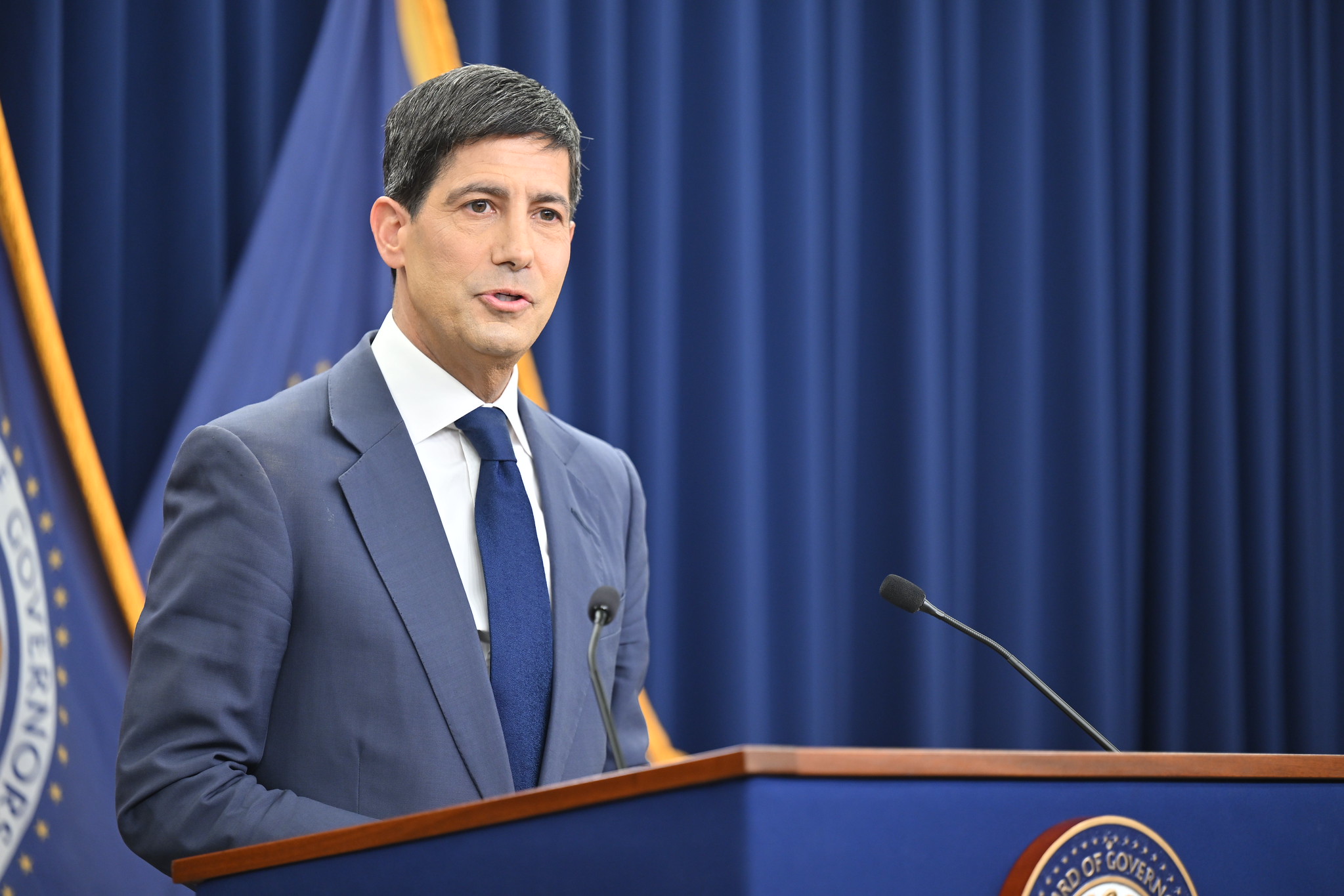
Fed Chair Kevin Warsh delivering remarks. Image source: Official Federal Reserve Photo.
To Trump's chagrin, rate hikes appear to be firmly on the table
Since taking over as head of the Fed, Wall Street and investors have had somewhat limited commentary from Warsh. He spoke broadly for a few minutes during his White House swearing-in ceremony on May 22, and addressed the media after the June 17 Federal Open Market Committee (FOMC) meeting.
However, the annual ECB Forum on Central Banking, held from June 29 to July 1 in Sintra, Portugal, offered new insights into Warsh's thought process and plans. Though Warsh was joined by European Central Bank President Christine Lagarde, Bank of England Governor Andrew Bailey, and Bank of Canada Governor Tiff Macklem, all eyes were on the new Fed chair.
While Warsh refused to provide anything resembling forward-looking guidance, he said just enough to terrify Wall Street, and likely draw the ire of President Trump, who's repeatedly lobbied for rate cuts. Said Warsh during a panel discussion with CNBC's Sara Eisen:
We're all in the price stability business, that might not be our only business, but if there was a common thing I heard over the last couple of days, it was open-mindedness on these questions of AI, open-mindedness on productivity, but we've all looked around, and we've seen that prices are too high.
Warsh's blunt seven-word admission, "we've seen that prices are too high," makes it abundantly clear that price stability is the FOMC's focus at the moment. Even without forward-looking guidance, he's showing Wall Street his proverbial cards.
Very hawkish dot plot.
-- Nick Timiraos (@NickTimiraos) June 17, 2026
Nine out of 18 officials have at least one hike this year (and six of those 9 have *multiple hikes*).
Only one person has a cut this year, and one participant (presumably Warsh) didn't submit an SEP
The statement gets a complete writethru from top to... pic.twitter.com/KRwatpTFOP
Warsh's comments also follow the June 17 release of the quarterly filed Summary of Economic Projections (i.e., the dot plot). Nine of the 18 FOMC members who provided federal funds target rate guidance predicted that interest rates would rise before the end of 2026.
Additionally, don't forget that Warsh's voting record as a former FOMC member from Feb. 24, 2006, to March 31, 2011, shows he was a monetary hawk. Even as the unemployment rate surged during the financial crisis, Warsh favored higher interest rates as a tool to suppress inflation.
The probability of the FOMC raising interest rates has soared over the last month. While one or two rate hikes wouldn't normally be a big deal for a rising stock market, Wall Street's entire identity is based on the artificial intelligence (AI) revolution. Outsize growth forecasts are dependent on the partially debt-financed AI data center build-out. If borrowing costs increase and this expansion slows or becomes notably pricier to Wall Street's most influential businesses, it could spell doom for an expensive stock market with no margin for error.

Image source: Getty Images.
Fed Chair Warsh's reform-oriented approach complicates matters for Wall Street
On top of rate hikes seeming likely over the coming quarters, Kevin Warsh's rejection of conventional wisdom can make matters worse for the stock market.
Although Warsh has maintained the FOMC's long-term inflation target of 2%, pretty much all other expectations have been tossed out the window. He's removed forward-looking guidance from the FOMC's meeting statements, which is likely to increase volatility in the bond market. Given the Iran-war-driven surge of inflation, bond market volatility could push interest rates modestly higher without the FOMC altering its federal funds target rate.
The new Fed chair is also establishing five specialized task forces to modernize the central bank. Warsh addressed this at the ECB Forum, noting:
My hope, my aspiration, is that nine to 12 months from now we're going to be using new technologies to understand what's happening in the real economy in a contemporaneous real-time way that positions us as central bankers to make better decisions.
While modernized data may help the FOMC avoid falling behind the curve, which is a common occurrence when relying on backward-looking economic data, it completely removes the transparency and predictability that have been foundational to the Dow's, S&P 500's, and Nasdaq Composite's historic rallies.
Warsh even wants to change how we/the FOMC think about inflation. The time-tested Core Personal Consumption Expenditures (PCE) might not be the central bank's preferred inflation measure for much longer.
Though higher interest rates can be problematic for the AI data center build-out, the lack of transparency and predictability introduced by Warsh's reforms is arguably far more dangerous for a stock market that's been priced for perfection.