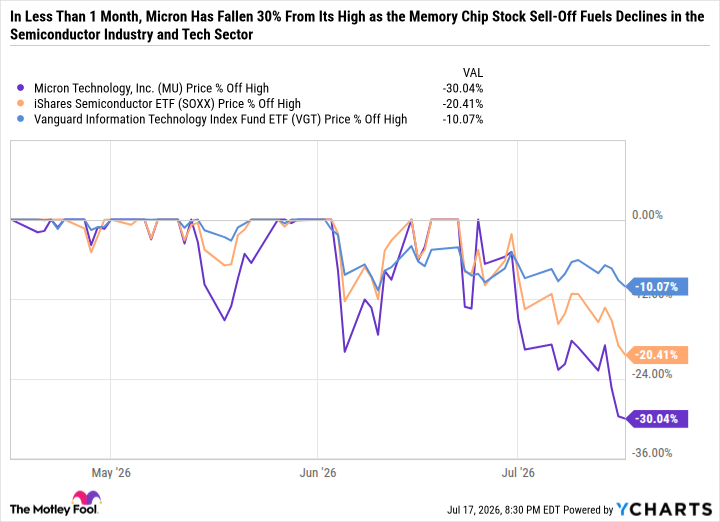
Semiconductors have been one of the best-performing industries this year. The iShares Semiconductor ETF (SOXX -0.69%), which closely tracks the industry, is up a staggering 73.1% year-to-date (YTD) but is down over 20% from its June 22 all-time high.
Here's why semiconductor stocks are selling off, and why the Vanguard Information Technology ETF (VGT +0.57%) is a better buy than the iShares Semiconductor ETF.

Image source: Micron.
The memory chip bottleneck
The all-time high in the iShares Semiconductor ETF occurred when many memory chip stocks, including Micron Technology (MU -0.66%) and Sandisk, hit all-time highs. Those rallies have been fueled by surging earnings growth.
Micron's stock price is up 629% in the past year. To the company's credit, its earnings are also up 483% -- with analysts projecting more room to run.
AI workflows require massive amounts of computing power from logic chips such as graphics processing units (GPUs), central processing units (CPUs), and custom application-specific integrated circuits (ASICs) such as Alphabet's Tensor Processing Units. But high-powered AI computing clusters won't perform at optimal levels without memory chips such as high-bandwidth memory, a form of dynamic random-access memory.
The memory shortage has given Micron and others incredible pricing power that has fueled margin expansion and an earnings surge. Micron CEO Sanjay Mehrotra said the following on Micron's June earnings call:
AI systems are powered by GPU, ASIC, and CPU designs from an increasingly broad set of suppliers. However, they all share one important characteristic -- AI system performance is architecturally dependent on memory subsystem performance and capacity. This has given rise to a more complex memory hierarchy that is providing greater differentiation opportunities for Micron than at any time in our history. It has also elevated the role of memory in the AI world to a strategic asset.
The rapid increase in memory chip stocks has pole-vaulted Micron to one of the largest holdings in the iShares Semiconductor ETF, with a 7.6% weighting. Semiconductor equipment makers Applied Materials, KLA Corp., Lam Research, and ASML collectively make up 17.3% of the ETF, with all four stocks more than doubling in the past year.
In sum, the iShares Semiconductor ETF is heavily weighted toward stocks that have recently surged. But concentration is a double-edged sword, as high allocations to hot stocks have accelerated the sell-off in the iShares Semiconductor ETF over the last month.

NASDAQ: SOXX
Key Data Points
A better-structured growth stock ETF
The semiconductor industry has also been a driving force behind the sustained outperformance of the tech sector relative to the S&P 500 (^GSPC +0.59%) and the Nasdaq-100 in recent years. In fact, semiconductors, semiconductor materials, and semiconductor equipment now make up 46.4% of the Vanguard Tech ETF, an ultra-low-cost ETF that tracks the broader tech sector.
There are plenty of reasons to buy the Vanguard Tech ETF over the iShares Semiconductor ETF. For starters, it sports a lower expense ratio of just 0.09%, compared with 0.34% for the iShares Semiconductor ETF.
Second, the Vanguard Tech ETF provides investors with exposure to key tech stocks such as Apple and Microsoft that aren't in the iShares Semiconductor ETF. And although other industries, such as software and hardware, have been lagging somewhat as of late, they have provided the Vanguard Tech ETF with greater diversification than the iShares Semiconductor ETF.
If the memory bottleneck is solved and a balance between supply and demand is restored, margins will compress for memory chip companies like Micron. The value could shift to companies building and using AI tools, rather than the companies providing AI computing, memory, networking, and infrastructure. So long-term investors may prefer to get exposure to the entire tech sector rather than betting on sustained momentum from semiconductor companies alone.
The size of non-semiconductor stocks such as Apple and Microsoft helps balance out the weightings of Vanguard Tech ETF components. Whereas rapid run-ups in certain stocks can shift the iShares Semiconductor ETF's balance. For example, Intel now holds a 5.4% weighting in the iShares Semiconductor ETF -- ahead of Taiwan Semiconductor at 4.4% -- even though Intel's market cap is $477.7 billion, compared with $2.07 trillion for Taiwan Semiconductor.

NYSEMKT: VGT
Key Data Points
A more balanced way to bet big on semiconductor stocks
Investors seeking maximum semiconductor exposure may prefer the iShares Semiconductor ETF over the Vanguard Information Technology ETF. But given nearly half of the Vanguard Tech ETF is in semiconductor stocks, it stands out as a better buy for investors looking for a more balanced growth stock alternative with lower fees.
It's worth noting that the Vanguard Tech ETF still has significantly larger exposure to the memory chip boom than the Nasdaq-100 or S&P 500. Micron, for example, now makes up 5% of the Vanguard Tech ETF, compared with 4.3% of the Nasdaq-100 and 1.4% of the S&P 500.
All told, the Vanguard Tech ETF is an excellent way to get heightened exposure to semiconductor stocks without diving in headfirst with a pure-play industry fund like the iShares Semiconductor ETF.