Developing artificial intelligence (AI) software requires substantial computing power, which is usually delivered through data centers that house thousands of specialized chips and components. Most businesses don't have the financial resources to build this infrastructure, so they rent it from cloud providers like Oracle (ORCL +3.42%) instead.
Oracle's data centers are among the fastest and most cost-efficient in the AI industry, so the company has amassed an order backlog of $638 billion from customers waiting for more capacity to come online. However, there are concerns that some of these customers won't be able to fulfill their commitments, which is concerning because Oracle has taken on a truckload of debt to build more infrastructure.
Oracle stock is currently down 62% from its all-time high, and hit a fresh 52-week low last Friday. Could this be the ultimate buying opportunity, or are the risks simply too high?
Image source: The Motley Fool.
Why Oracle's data centers are so popular
Oracle's data centers house a wide selection of graphics processing units (GPUs) from top suppliers like Nvidia and Advanced Micro Devices, giving AI developers multiple options. Plus, the company has built some of the largest GPU clusters in the industry, allowing customers to scale up to over 131,000 chips simultaneously to run the most sophisticated AI models.
Moreover, Oracle uses software-powered automation to operate its data centers, enabling it to bring new locations online much faster than competitors that rely on human-led processes. The company's infrastructure also uses a proprietary random direct memory access (RDMA) networking technology, which moves data between chips and devices faster than traditional Ethernet networks.
All of this translates to lower costs and faster processing speeds, an ideal formula for AI developers that usually pay for computing capacity by the minute. As a result, AI leaders like OpenAI, Elon Musk's xAI, Cohere, and Meta Platforms have become some of Oracle's top customers.
Oracle's largest customer might be short on cash
Oracle generated $19.2 billion in total revenue during its recent fiscal 2026 fourth quarter (ended May 31), a 21% increase from the year-ago period. Its cloud infrastructure segment accounted for $5.8 billion of that total, and it grew at a significantly faster pace of 93%.
But the headline number in the report was Oracle's remaining performance obligations (RPO), which jumped 363% to a record $638 billion. RPO reflects the value of signed contracts for services that haven't been delivered yet, so it's like an order backlog, and it's often used as a predictor of future revenue.

NYSE: ORCL
Key Data Points
But last September, The Wall Street Journal reported that OpenAI alone might account for $300 billion of Oracle's RPO. The start-up has just $25 billion in annualized revenue, and it's losing money, so it's unclear how it plans to fund such a major commitment. Even its most recent capital raise brought in just $122 billion from investors, which isn't anywhere near enough.
It appears Oracle is aware of that very issue. The company says it plans to recognize just 12% of its RPO as revenue over the next 12 months, followed by a further 34% in the 24 months after that. Simply put, less than half its RPO is expected to become revenue within the next three years, which is a very long time in a fast-moving industry like AI.
There's no guarantee Oracle's customers will even need as much computing capacity by then, and the company appears to recognize that risk. Its fiscal 2026 annual report actually warned investors of the risk of overestimating customer demand, and that it won't be able to repurpose its data centers for other workloads if parties like OpenAI don't fulfill their obligations.
Should investors buy Oracle stock on the dip?
At first glance, Oracle looks cheap right now. Based on the company's fiscal 2026 earnings of $5.83 per share, its stock is trading at a price-to-earnings (P/E) ratio of just 19.7. That is a discount to both the S&P 500 and the Nasdaq-100 indexes, which have P/E ratios of 25.2 and 33.1, respectively.
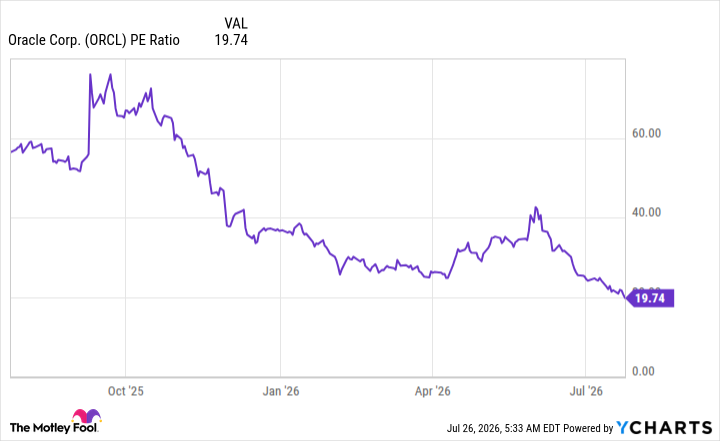
ORCL PE Ratio data by YCharts
But it's very hard to value Oracle at the moment due to uncertainty around its RPO. To make matters worse, the company is carrying over $122 billion in long-term debt and recently announced plans to raise a further $40 billion through a mix of debt and equity to fund more data centers. Therefore, if it fails to convert its RPO into revenue, it could be left with piles of toxic debt that can't be refinanced. That is a big reason why investors are shunning its stock.
As a result, I wouldn't be in a hurry to invest in Oracle right now.