In May, the U.S. government announced plans to invest $2 billion in nine different quantum computing companies to help America take a leadership position in this revolutionary industry. Rigetti Computing (RGTI +0.07%) will receive $100 million over three years, and the news sent its stock soaring by as much as 65%.
However, it has since given up all of those gains and then some. Although Rigetti produces some of the industry's best quantum systems, they still make too many errors to reliably solve most real-world problems, so it's difficult for the company to generate meaningful sales. It could take many years to overcome this challenge, and the U.S. government's support probably won't do much to speed up the timeline.
Rigetti will release its operating results for the second quarter of 2026 (ended June 30) after the stock market closes on Aug. 6, and here's why I predict it will lead to more downside for shareholders.

Image source: Getty Images.
Quantum computers have a long path to commercialization
Quantum computers can use a concept called superposition to simulate multiple solutions to a given problem simultaneously, so they are better at processing specific, data-intensive workloads in areas like science and cryptography than traditional computers.
Rigetti's flagship Cepheus-1-108Q quantum computer is the industry's largest multichip system. It features 108 qubits, which is three times as many as the company's previous Cepheus-1-36Q computer. It also boasts a single-qubit gate fidelity of 99.9%, meaning it makes one error per 1,000 quantum operations. However, its two-qubit gate fidelity is 99.1%, implying nine errors per 1,000 operations, which isn't ideal when trying to solve complex real-world problems.
Qubits are highly sensitive to noise and interference, so making several of them work together in harmony is one of the greatest challenges in quantum computing. Rigetti thinks it can upgrade Cepheus-1-108Q to achieve a two-qubit fidelity of 99.5% by the end of 2026, but the company thinks achieving 99.9% could take another three years.
The good news is that Rigetti has built its own supply chain, so it can bring new systems to market much faster than its competitors. It has a fabrication facility, a proprietary programming language called Quil, and a cloud platform where it rents computing capacity to other businesses for a fee.
Nevertheless, an estimate by Ark Investment Management suggests it could take at least 20 years for quantum computers to become accurate enough to disrupt areas like cryptography, so Rigetti shareholders might have a long wait ahead.

NASDAQ: RGTI
Key Data Points
Sales are gathering momentum, but remain small
Rigetti generated $4.4 million in revenue during the first quarter of 2026 (ended March 31), a whopping 198% increase from the year-ago period. According to Wall Street's average estimate (provided by Yahoo Finance), the company's revenue likely climbed by 184% to $5.1 million in the second quarter. The official figures will be released on Aug. 6.
That means Rigetti might have generated more revenue in the first half of 2026 than it did during all of 2025, when it brought in $7.1 million. But it gets better, because the company plans to deliver an $8.4 million order for Cepheus-1-108Q to India's Center for Development of Advanced Computing later this year, which will put its annual revenue comfortably in growth territory.
But there are a couple of issues. First, Rigetti is generating a tiny amount of revenue for a company with a market capitalization of $4.7 billion (more on that in a moment). Second, it's losing a truckload of money; it had operating expenses of $27.3 million during the first quarter of this year alone, which dwarfed its revenue and led to a net loss of $20.5 million.
Fortunately, Rigetti had $569 million in cash and equivalents on hand as of March 31, so it can sustain its losses for the foreseeable future. However, the company might need to raise more money if it isn't profitable within a couple of years. The U.S. government's $100 million investment over three years won't stretch very far based on the current rate of cash burn.
Rigetti's valuation opens the door to downside after Aug. 6
Given Rigetti's modest revenue and sizable market cap, its stock trades at a sky-high price-to-sales (P/S) ratio of 445. That means it's a staggering 74 times more expensive than the Nasdaq-100 technology index, which has a P/S ratio of just 6.1.
Even if we value the stock based on Wall Street's average 2026 revenue estimate of $23.5 million, its forward P/S ratio is still almost 200.
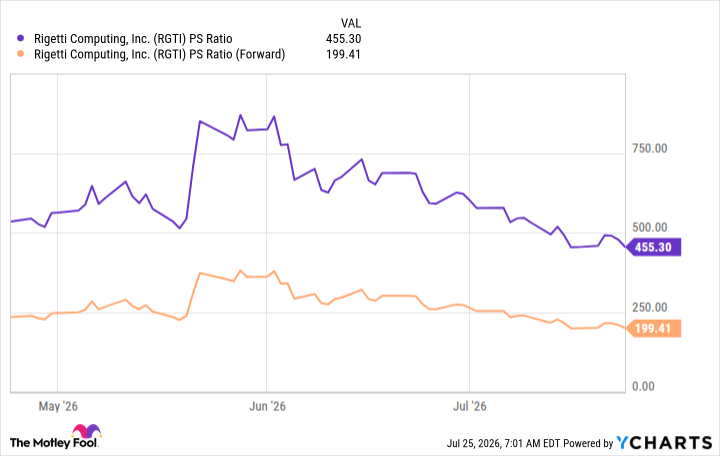
RGTI PS Ratio data by YCharts
Even if Rigetti stock plunged by 95% in the second half of 2026, it would still be more expensive than the Nasdaq-100.
Rigetti has already lost 40% of its value in 2026, and based on its valuation alone, I think the stock is likely to suffer further downside after it releases its second-quarter operating results on Aug. 6. In my opinion, not even a spectacular report will be enough to justify its substantial premium to the broader market.