Both Advanced Micro Devices (AMD -6.37%) and Intel (INTC -4.91%) have made investors significantly richer recently, driven by the growing demand for their artificial intelligence (AI) data center chips.
AMD stock has clocked impressive gains of 197% over the past year, while Intel's gains have been even more impressive at 343%. The good news for investors is that both of these semiconductor specialists can sustain their impressive momentum, as they have been making solid progress in product development to gain a larger share of the AI chip market.
But if you have to choose from one of these semiconductor stocks for your portfolio right now, which one should you be buying? Let's find out.
Image source: The Motley Fool.
Intel's AI business has stepped on the gas
When Intel released its second-quarter 2026 earnings report on July 23, it reported an impressive year-over-year increase of 59% in the data center and artificial intelligence (DCAI) segment revenue to $6.3 billion. This is a solid improvement over the 22% year-over-year growth reported by the DCAI segment in Q1.

NASDAQ: INTC
Key Data Points
The growing demand for server central processing units (CPUs) for agentic AI applications is becoming a major catalyst for Intel. The company noted on its latest earnings call that its "core server CPU franchise is growing faster than ever." Intel points out that the year-over-year growth in the server CPU business was the strongest on record in Q2. Its Xeon 6 server CPUs are witnessing such strong demand that they are now among the fastest-ramping products in the company's history.
Intel adds that it has landed more customers for its server CPUs through long-term strategic agreements and is ramping up capacity to meet the overwhelming demand. Importantly, Intel isn't just relying on the growth of server CPUs to fuel its growth. It is also designing custom AI processors, which are in high demand for their efficiency in inference-focused workloads.
Intel says that its custom AI processor business saw revenue jump almost 3x from the year-ago period. So, Intel is benefiting from the growing adoption of its AI chips on multiple fronts. This is why it anticipates an impressive 65% year-over-year increase in earnings per share in the current quarter to $0.38.
However, the healthy demand for server CPUs and custom processors, along with Intel's ability to reduce costs by improving production yields ahead of expectations, could eventually result in a bigger bottom-line jump. Not surprisingly, analysts are forecasting a terrific 264% year-over-year increase in Intel's earnings per share in 2026.
Consensus estimates project a 30% jump in Intel's earnings next year. It could easily surpass that mark owing to the company's focus on adding production capacity and ramping up output of advanced chips based on the Intel 18A node. So, Wall Street seems to be underestimating Intel's growth potential, and that could help it sustain its terrific momentum going forward.
AMD stands to gain from similar catalysts
Like Intel, AMD also sells server CPUs. However, the company's Instinct line of data center graphics processing units (GPUs) is also gaining popularity among customers. These two products are powering the growth of AMD's data center business, which reported a 57% year-over-year jump in revenue in Q1 to $5.8 billion.

NASDAQ: AMD
Key Data Points
The company has yet to release its Q2 report, though its guidance of $11.2 billion in revenue for the recently concluded quarter points to a 46% year-over-year increase. That would be an improvement over its Q1 revenue growth of 38%, suggesting the data center business is likely to deliver another strong performance.
It won't be surprising to see AMD's data center revenue growing at a faster pace than Intel's in Q2. After all, AMD has consistently taken market share from Intel in recent quarters. What's more, AMD recently noted at an investor event that it now expects the server CPU market to generate $220 billion in revenue in 2030, up significantly from its prior estimate of $120 billion.
AMD controls 46% revenue share of the server CPU market, according to Mercury Research. So, it stands to win big from the massive opportunity in server CPUs over the long run. Also, the company's Helios rack-scale server platform is poised to be another major catalyst for AMD, given its solid demand from major hyperscalers.
In all, the secular growth of the AI chip market is likely to fuel tremendous earnings growth for AMD. Analysts are anticipating a 79% increase in earnings per share in 2026, followed by an 84% increase next year. So, AMD's earnings growth is projected to be significantly stronger than Intel's in 2027. Does that make it a better buy?
Investors have an easy choice to make
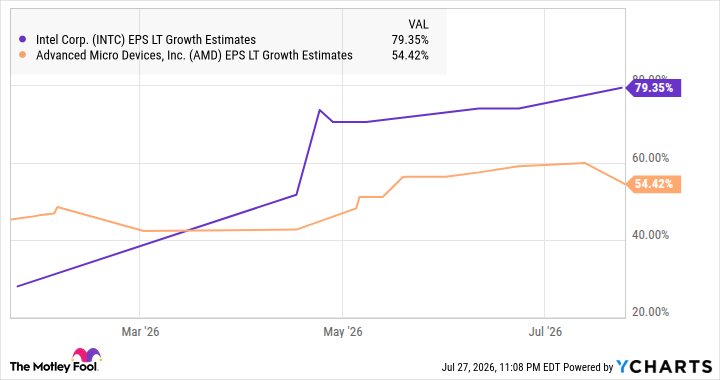
Investors should note that Intel's bottom-line growth significantly outpaces AMD right now, and that trend could continue in 2027 as Chipzilla boosts production capacity and brings down costs. In fact, analysts are more bullish about Intel's long-term growth potential.
Data by YCharts
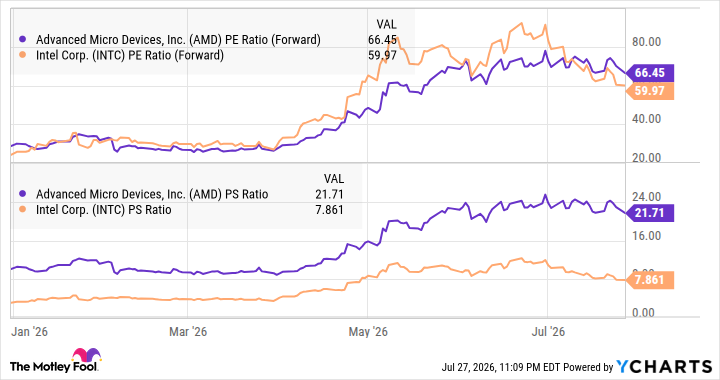
Another factor worth noting here is that Intel is cheaper than AMD when their price-to-forward earnings multiples and sales multiples are compared.
Data by YCharts
So, Intel stock could continue outperforming AMD over the next year and a half, and even in the long run, given its ability to sustain much faster growth and its attractive valuation.