Following what billionaire-run hedge funds are doing makes a lot of sense. It lets investors track some of the smart money on Wall Street, but only if it's done in the right way. Investors have access to what these funds are doing thanks to the Securities and Exchange Commission (SEC).
The SEC requires funds with more than $100 million in assets to file a Form 13-F every quarter, which discloses end-of-quarter securities holdings 45 days after the quarter is over. So, this information is a bit dated, but if you follow funds with a long-term holding mentality, it can provide some valuable insights into how the market is thinking about certain stocks.
Two stocks I follow closely are Nvidia (NVDA -0.74%) and Advanced Micro Devices (AMD -0.55%), or AMD. Both companies are wildly popular, mostly thanks to them being front and center in the artificial intelligence (AI) build-out. However, each has had a stark performance difference in 2026 so far, with AMD rising more than 110%, while Nvidia is up 12%.
Fortunately, one of my favorite hedge funds to follow recently made a move involving these two, but did that move make sense?
Image source: The Motley Fool.
Tiger Global Management bought AMD and sold Nvidia
Tiger Global Management, run by billionaire Chase Coleman, is a highly regarded hedge fund in the tech sector. It's had phenomenal performance during the past few years, and tracking its moves is a smart thing for investors to do. As of June 30, Tiger Global had dramatically reduced its position in nearly all stocks, likely due to the inflated market conditions the fund recognized at the end of June. During the sell-off that followed in July, the fund likely purchased shares in some of its highest-conviction holdings, but we won't know for sure until third-quarter 13Fs are available in mid-November.

NASDAQ: NVDA
Key Data Points
But there was one stock that deserve note: AMD. During the second quarter, Tiger Global initiated a new stake in AMD, and it now makes up about 1.6% of its portfolio -- a position worth nearly $400 million. However, Nvidia is still the fund's third-largest position, making up 9.3% of its holdings valued at $2.2 billion. During Q2, Tiger Global reduced its stake by about 7%.

NASDAQ: AMD
Key Data Points
That's not a huge decline, but the number of Nvidia shares sold does roughly coincide with the new AMD position. This could indicate that Coleman and his team sold Nvidia shares to establish its AMD position, but was that the smart move?
Nvidia looks like the better value
Although AMD has dominated Nvidia's stock this year, most of that dominance has come from its rising valuation, rather than underperformance from Nvidia. From a trailing price-to-earnings (P/E) ratio standpoint, AMD's stock is far more expensive than Nvidia's by a wide margin.
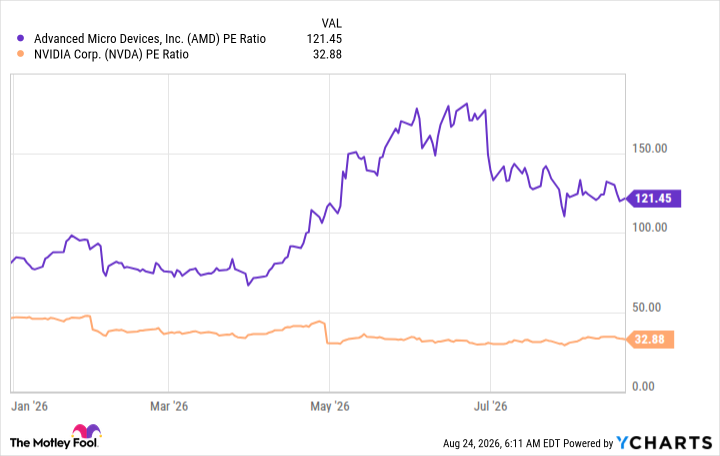
AMD PE Ratio data by YCharts.
If we incorporate next year's earnings projections into the equation, Nvidia's stock looks very cheap while AMD's only returns to a more reasonable valuation.
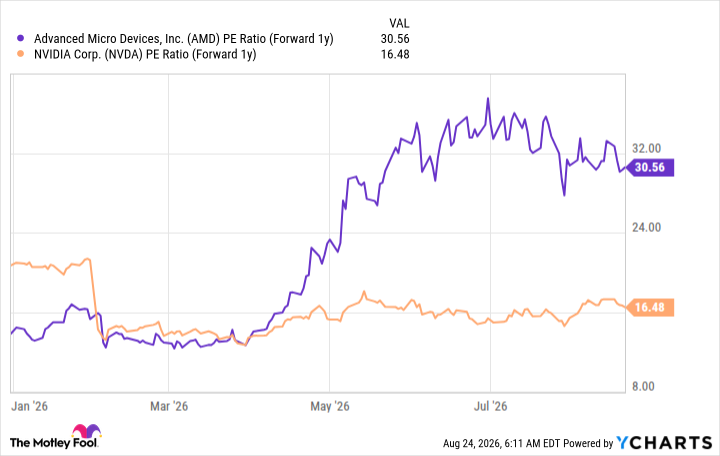
AMD PE Ratio (Forward 1y) data by YCharts.
This makes it a pretty cut-and-dried case as to which is the better value: It's clearly Nvidia. There is a lot less success priced into Nvidia's stock, and it's free to rise based on business performance. Meanwhile, AMD has a lot of success already priced in. Even if the company is doing great and growing rapidly, some of that performance will be absorbed by AMD's valuation declining to a normal level.
With Nvidia trailing AMD this year despite better growth, I'm in favor of investing in Nvidia's stock over AMD's. I think that Nvidia will continue to be the better stock pick during the next few years, even if AMD beats it out in 2026.