Amazon (AMZN -0.95%) stock has rebounded this year, and it's up roughly the same as the S&P 500. However, it's trading at it lowest P/E ratio ever, at only 21 times trailing-12-month earnings.
Why is the market pricing it so low? Here's my honest answer.
Does AI cost too much?
Amazon's stock started trailing the market after it announced that it was increasing its capital expenditures (capex) last year. Spending continues to rise, and management expects to spend $220 billion in 2026 alone.
Image source: Amazon.
The market has gotten on board with the spending after seeing some early results. In the 2026 second quarter, for example, revenue from cloud business Amazon Web Services (AWS) increased nearly 37% year over year, the highest level in 18 quarters.
CEO Andy Jassy believes that over time, AWS, which houses the AI operations, will become a trillion-dollar business. "As we get a few years out and the revenue growth outpaces the incremental capex growth, which will happen at some point," he said, "the resulting revenue, free cash flow, and return on invested capital is very compelling."
AMZN Amazon
NASDAQ · As of 4:00 PM ET 10/23/26

However, the metric to notice is free cash flow, because that's what's still bothering the market. Free cash flow has dipped into negative territory over the past few years as Amazon spends like never before.
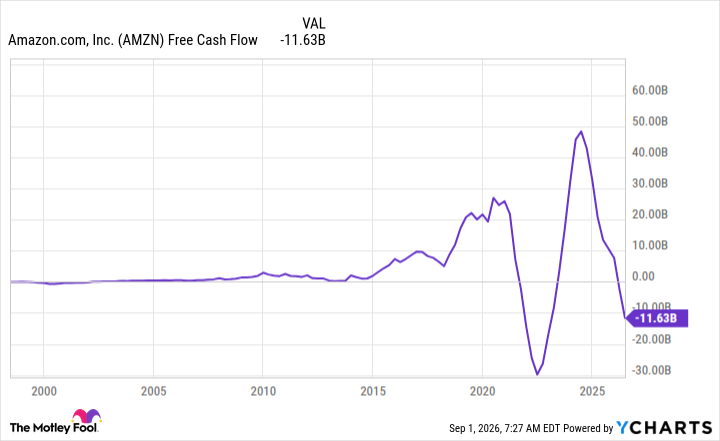
Data by YCharts.
Amazon stock may be cheap on a price-to-earnings basis, but it has become extremely expensive on a price-to-free-cash-flow basis in this situation.
Despite its excellent performance and otherwise positive views on its future opportunity, the stock may not soar too high until it gets back to reliable positive free cash flow.