The Consumer Price Index (CPI) measures U.S. inflation by tracking the changes in the aggregate price of a basket of goods and services over time. The latest data is released monthly by the U.S. Bureau of Labor Statistics, and the Federal Reserve closely analyzes it to inform its decisions on whether to hike, hold, or cut the federal funds rate -- the interest rate it charges banks for overnight loans. That rate influences a host of other interest rates across the economy.
In July, the CPI increased by 3.4% year over year, so inflation remains significantly above the Fed's long-established target rate of 2%. The central bank would normally hike interest rates in this situation, so Wall Street is on edge ahead of the Federal Open Market Committee's next policy meeting on Sept. 15 and 16.
On Thursday, Fed Governor Christopher Waller said the next interest rate decision could hinge on the August CPI report, which will be released on Friday, Sept. 11, at 8:30 a.m. ET. An interest rate hike might be on the table if the inflation reading is higher than expected, and if history is any guide, that would be bad news for the stock market.
Image source: Getty Images.
Soaring oil prices are stoking inflation
Energy prices are among the most important components of the CPI. The price of a barrel of oil significantly influences the costs of transporting goods by truck, boat, and plane, which in turn affects how much consumers pay for groceries and retail products. At the start of 2026, a single barrel of West Texas Intermediate crude oil traded for $57.42, but due to the war between the U.S. and Iran, prices surged above $100 a barrel this spring, and after a brief retreat this summer have rocketed back to over $90 in September.
When the conflict started in late February, Iran effectively closed the Strait of Hormuz, a key waterway through which roughly 25% of the world's seaborne oil previously traveled each day. Despite intermittent peace talks, the Strait of Hormuz remains mostly closed to commercial ships, so the upward pressure on energy prices isn't going away anytime soon.
The U.S. has been tapping its Strategic Petroleum Reserve to partially offset the falling global oil supply and rising crude prices, but it now sits at a 44-year low. With just 40% of its capacity remaining, the government will soon have to end that temporary stopgap measure, which could lead to a sharp spike in energy costs for American consumers and businesses.
S&P 500 Index
Key Data Points
The energy component of the CPI calculation surged by a whopping 14.7% year over year in July, and the gasoline component specifically soared by 24.6%. Therefore, it's clear that rising oil prices are having a significant impact on the inflation numbers overall.
To get a rough idea of where future CPI readings might be heading, we can look at the Producer Price Index (PPI) -- a different inflation metric that tracks the changes in input costs for businesses. (Those costs are often passed along to consumers, but at a time lag.) In July, the PPI jumped by 4.7% year over year, and the energy component was up by 18.2%.
Interestingly, oil prices have moved even higher since the July PPI report was released, so we can safely assume energy placed even more upward pressure on inflation in August.
According to the CME Group's (CME -0.11%) FedWatch tool, which analyzes the 30-day fed funds futures market to predict potential interest rate moves, Wall Street thinks there is a 50% chance the Fed will hike rates at the September meeting. That probability could spike if this Friday's CPI numbers are hotter than expected.
Rising interest rates are typically bad news for stocks
The Fed's last campaign of interest rate hikes started in March 2022 and ended in August 2023, when the central bank was trying to tame an 8% CPI. The S&P 500 index plunged by more than 20% from its peak during that 18-month hiking cycle, putting Wall Street into a bear market.
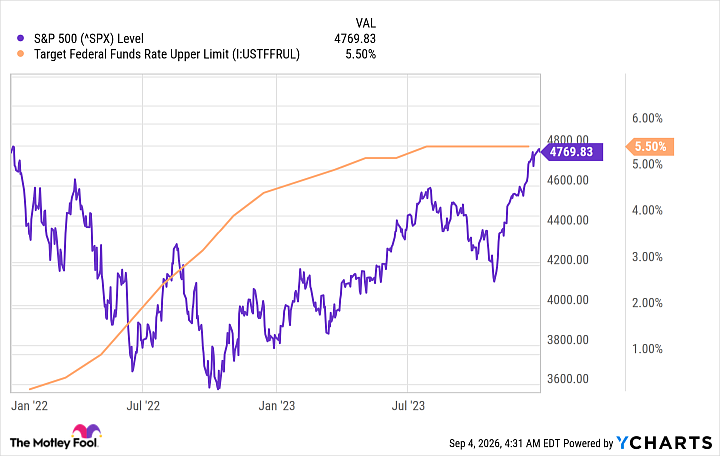
Rising interest rates are bad for stocks for a few reasons. First, they force consumers to allocate more of their household budgets to debt repayments, leaving them with less money for discretionary spending. Second, businesses have less borrowing power when rates are higher, so they can't invest as aggressively in growth.
Third, rising interest rates increase the yields on low-risk assets like U.S. Treasury bonds, giving investors some very attractive alternatives to the stock market.
I'm not suggesting one interest rate hike will plunge the S&P 500 into bear territory, but it could certainly spark a shift in sentiment, particularly because of the index's high valuation. The Shiller Cyclically Adjusted Price-to-Earnings (CAPE) ratio -- a broad measurement of the entire market's valuation -- is currently 41.2. The only period in history during which it reached higher levels was at the peak of the dot-com bubble in 2000.
Therefore, many investors might be tempted to take some money off the table if they see trouble on the horizon, which is why Friday's CPI report will be so critical.