The diversified S&P 500 (^GSPC -0.52%) and the technology-heavy Nasdaq-100 are two widely followed stock market indexes that are packed with America's highest-quality companies. They have returned 12.7% and 17% respectively so far in 2026, as of the market close last Friday, Sept. 4.
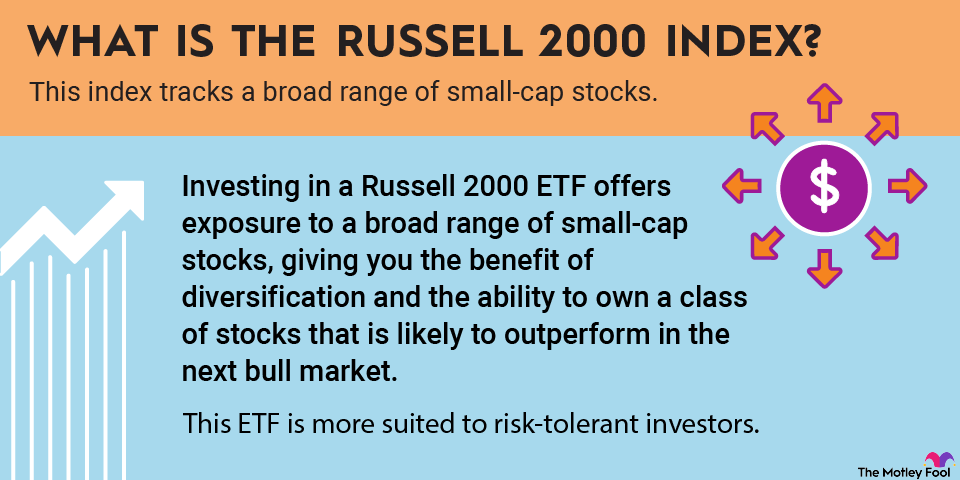
But then there is the Russell 2000 index, which is sitting on an even better year-to-date gain of 20.2%. It tracks the performance of approximately 2,000 of America's smallest listed companies, and since many of them generate most of their revenue domestically, they are more insulated from headwinds like the ongoing conflict in the Middle East compared to larger, multinational companies.
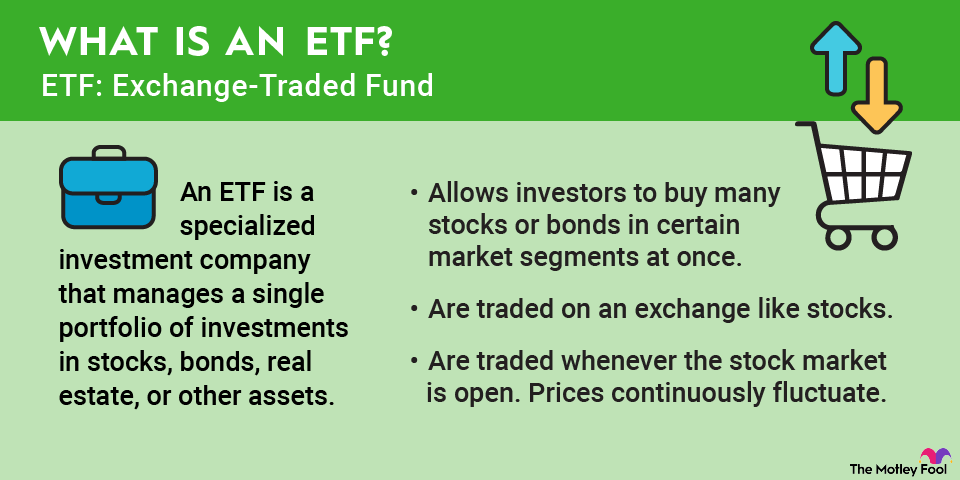
The Vanguard Russell 2000 ETF (VTWO -0.38%) is an exchange-traded fund (ETF) that mimics the Russell 2000. It could face a reckoning on Sept. 15 and 16, when the U.S. Federal Reserve holds its next policy meeting. The odds of an interest rate hike are increasing, and for reasons I'll soon explain, small American companies tend to be more sensitive to such policy adjustments than their larger counterparts.

Image source: Getty Images.
Small caps have enjoyed favorable conditions in 2026
The companies in both the S&P 500 and the Russell 2000 come from 11 different economic sectors, so both indexes are highly diversified. However, the technology sector alone accounts for over one-third of the value of the entire S&P, whereas the Russell is far more balanced. The five largest sectors (by weight) in the Vanguard Russell 2000 ETF are as follows:
- Healthcare: 19.8%
- Financials: 18.9%
- Industrials: 16%
- Consumer discretionary: 11.8%
- Technology: 10.8%
Moreover, the top five holdings in the Vanguard ETF represent just 1.67% of its portfolio, so its performance isn't beholden to a mere handful of stocks. That isn't true for the S&P or the Nasdaq-100, which are both very top-heavy.
|
Stock |
Vanguard ETF Portfolio Weighting |
|---|---|
|
1. Moog Inc (MOGA -0.11%) |
0.35% |
|
2. Hut 8 Corp (HUT -4.28%) |
0.35% |
|
3. UMB Financial (UMBF -0.48%) |
0.34% |
|
4. Cytokinetics Inc (CYTK -1.76%) |
0.32% |
|
5. Viasat Inc (VSAT +4.19%) |
0.31% |
Data source: Vanguard. Portfolio weightings are accurate as of July 31, 2026, and are subject to change.
While many of those stocks attract little attention compared to their much larger counterparts, they are loaded with potential. Moog stock has soared by almost 50% in 2026, thanks to strong financial results driven by its space and defense business. Hut 8 stock has rocketed higher by 82% this year, after signing billions of dollars worth of leases for its data center campuses, which are optimized for high-performance artificial intelligence (AI) chips.
Viasat stock has climbed by more than 100%, as investors continue piling into suppliers of satellite systems following the blockbuster initial public offering (IPO) of Elon Musk's Space Exploration Technologies company in June.
One thing many Russell 2000 companies have in common is their domestic operations. By generating most of their revenue inside the U.S., they are insulated from disruptive geopolitical issues around the world. They are also benefiting from favorable government policies. For example, the Trump administration continues to levy broad-based tariffs on imported products, making American companies more competitive with foreign entities. The administration is also slashing regulations to lower the cost of doing business for domestic enterprises.
VTWO Vanguard Russell 2000 ETF
NASDAQ · As of 4:00 PM ET 10/23/26
The Fed could throw a wrench in the works next week
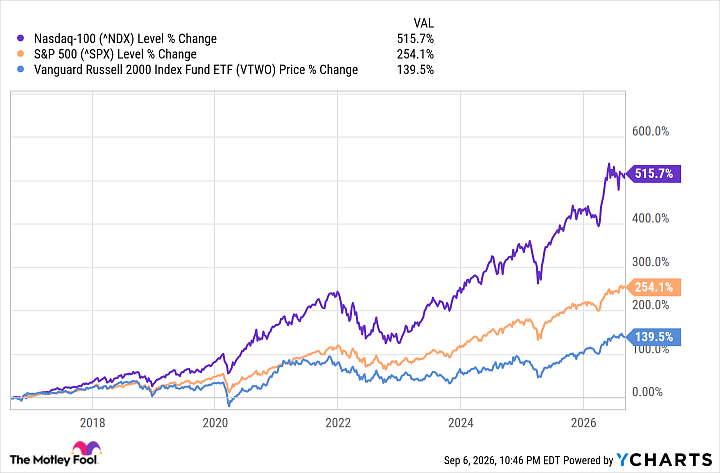
While the Vanguard Russell 2000 ETF is beating the S&P 500 and the Nasdaq-100 this year, it typically underperforms over the long term because it lacks exposure to America's biggest tech giants, which have become earnings powerhouses.
An investor who bought the ETF 10 years ago would be sitting on a respectable return of 139% today, but they would have earned much higher returns of 254% in the S&P and 515% in the Nasdaq.
The Fed could put the Russell on the back foot once again when it holds its September policy meeting next week, as it attempts to tame the elevated inflation rate. According to the CME Group's FedWatch tool, which calculates the probability of interest rate moves by analyzing the 30-day fed funds futures market, Wall Street thinks there is a 59% chance the central bank will raise interest rates.
Goldman Sachs says roughly 32% of the companies in the Russell 2000 hold floating rate debt, compared to just 6% of companies in the S&P 500. Therefore, an interest rate hike would be a massive headwind for small-cap earnings, so it could bring the Russell's recent outperformance to an abrupt end.
As a result, investors should think twice before piling into small caps right now, and those with a high degree of exposure already might want to consider cashing in some of their gains.