Nvidia (NVDA -2.13%) and Broadcom (AVGO -0.95%) reported very positive results in their most recent earnings statements. Not only are they seeing very strong demand for their artificial intelligence (AI) chips, but they both expect that growth to continue for the foreseeable future.
Indeed, demand for semiconductors appears to have a very long runway ahead, as a growing share of hyperscalers' budgets shifts toward buying more chips to outfit new data centers and replace old servers.
And while both of the biggest AI chipmakers have the potential to grow very quickly through the end of the decade, a smaller silicon slinger could grow even faster as its revenue accelerates during the next few years.

Image source: Getty Images.
The AI giants are getting even bigger
As mentioned, both Nvidia and Broadcom expect to keep producing very strong revenue growth.
Nvidia more than doubled its top line last quarter, producing a whopping $96 billion in revenue. Chief Financial Officer Colette Kress said she expects the company's annual revenue to increase by 70% next year, noting that the outlook is the result of limited chip supply. Its biggest bottleneck is memory, for which it made a significant up-front purchase commitment last quarter to facilitate supply expansion.
Likewise, Broadcom reported revenue growth of 86% last quarter, and management expects that growth to accelerate to 93% next quarter. Its AI chips are driving the gains, with AI-related revenue up 221% last quarter. Growing demand for custom silicon solutions instead of Nvidia graphics processing units (GPUs) is helping Broadcom's XPU processor business. Of course, Nvidia doesn't seem to be suffering too much.

NASDAQ: AVGO
Key Data Points
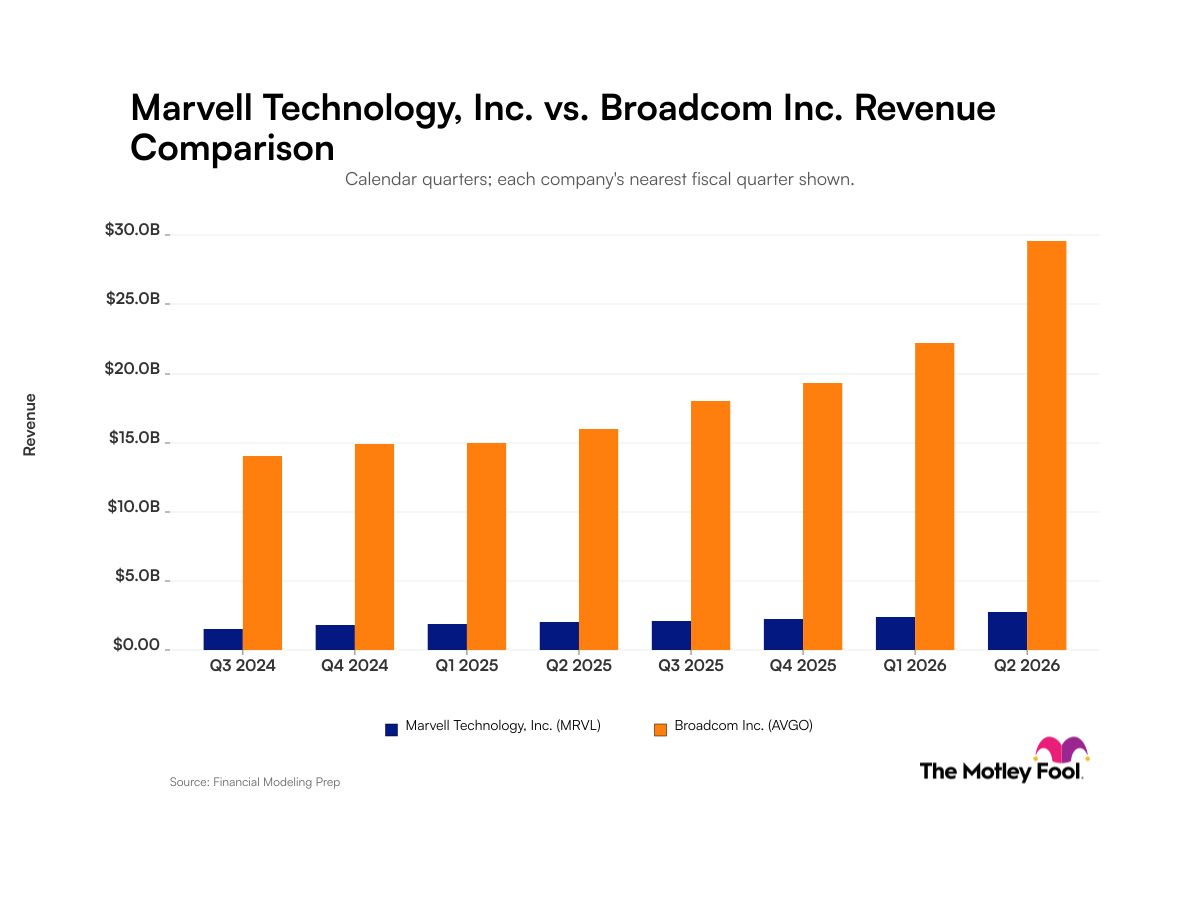
But another custom artificial intelligence chipmaker could end up growing faster during the next few years. Marvell Technology (MRVL -2.48%) expects a significant ramp-up in its XPU business along with related AI chips. While management is currently forecasting revenue growth of 45% for the current year, it expects that to accelerate to 50% next year and grow even faster in fiscal 2029 (which falls primarily in the 2028 calendar year).
With just $12 billion in expected revenue for fiscal 2027, the company is significantly smaller than Nvidia ($411 billion in expected revenue) or Broadcom ($106 billion in expected revenue). That means a few new deals with big tech companies can have a huge impact on its growth. And it's showing excellent progress in doing just that. As a result, I expect it to produce better overall average revenue growth through the end of the decade than either Broadcom or Nvidia.
Some big new deals in the pipeline
During Marvell's second-quarter earnings call, Chief Executive Officer Matt Murphy told analysts the custom AI chip business will accelerate in the back half of the year. "We remain confident that this business will more than double year over year in fiscal 2028 and accelerate significantly in fiscal 2029," he added.
The primary near-term driver is likely its deal with Microsoft (MSFT -0.02%), which includes designing the company's Maia line of chips. Microsoft is reportedly planning a big step up with Maia 300, using it for more of its internal AI workload. Microsoft is reportedly looking to fill an order of 300,000 chips in 2027.

NASDAQ: MRVL
Key Data Points
Alphabet (GOOG +0.60%) (GOOGL +0.62%) presents another big potential customer for Marvell. Marvell signed a deal with Google to expand its existing partnership to include a range of products, including "AI inference accelerators, storage controllers, network interface controllers, memory interface controllers, and near-memory compute." The deal also provides warrants to Alphabet to purchase shares of Marvell based on revenue targets totaling up to $120 billion through fiscal 2033.
The company is in active discussions with all the hyperscalers for custom chips, and what it calls XPU attach, chips that help make custom silicon chips even more efficient at scale (network interfaces, scale-up fabrics, and co-processors). With the expansive Alphabet deal and a growing relationship with Microsoft, it could find more of its chips in big data centers over the next few years.
The stock trades at a premium to both Nvidia and Broadcom. That reflects the expectations for revenue to accelerate and earnings to follow suit. Analysts on average expect earnings per share (EPS) to climb from $4.20 this year to $6.72 next year to $10.28 in 2029. The forward price-to-earnings (P/E) ratio of 53 for the stock reflects those expectations for accelerating earnings growth. And that EPS acceleration can continue through the end of the decade, making it an attractive opportunity for investors.