A checking account makes life much easier by allowing you to conduct financial transactions, such as paying bills. A bank account, meanwhile, is a place to safely store money until you need to use it. These are the core services that a bank like Bank of America (BAC +0.08%) provides its customers.
But what does Bank of America get out of these accounts? The answer is a lot, and a comparison to a mortgage real estate investment trust (REIT) like AGNC Investment (AGNC -1.29%) will help explain it.

Image source: Getty Images.
What does an mREIT do?
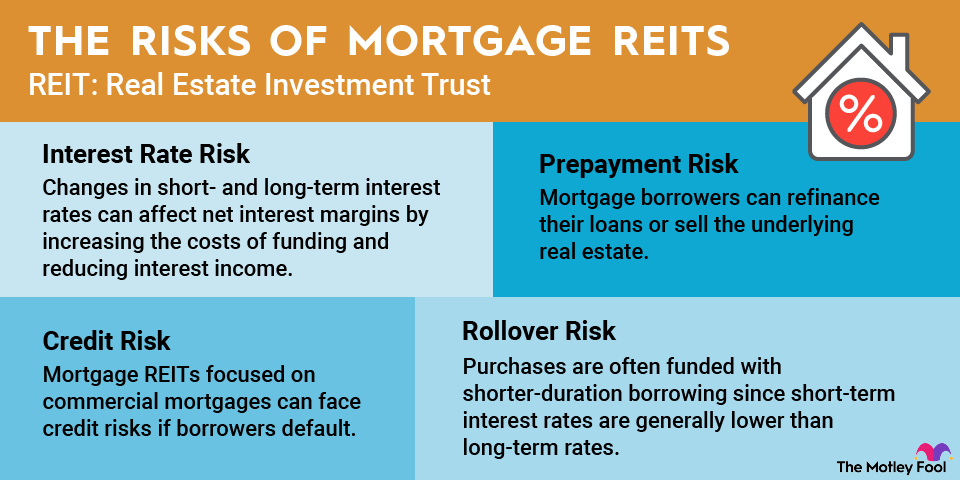
A mortgage real estate investment trust, such as AGNC Investment, sells stock and debt to raise capital. That capital is then used to buy mortgages that have been pooled together into bond-like securities. The company earns the difference between its cost of capital and the interest it collects on its portfolio of mortgage securities.
When interest rates rise, mREITs like AGNC Investment can buy mortgage-backed securities at higher yields. That's good, but they also face two distinct headwinds. First, the value of the mortgage securities they previously owned tends to fall, so the securities' yields match the market's yield. And at the same time, the cost of capital rises because the debt and loans the mortgage REIT has taken on have become more expensive. Both of these dynamics are subject to the market's ups and downs.

NASDAQ: AGNC
Key Data Points
Banks have a similar dynamic, but better
Bank of America reported average deposits of $957 billion in the second quarter of 2026, which, according to the company, made it "#1 in U.S. Consumer Deposits." That consists of a mix of accounts, including checking and bank accounts, as well as certificates of deposit. While Bank of America has to offer competitive interest rates and services, it controls the rates and services it provides.
Generally speaking, even when rates rise, banks ensure they earn more interest on the loans they make (such as mortgages) than on the interest they pay on deposits. They protect the spread to support their earnings. Checking accounts, because they provide an important service, generally have the lowest rates. Large banks like Bank of America, meanwhile, can move more slowly when increasing the rates they pay, given their extensive branch networks and well-known brands.
So rising rates can put pressure on a bank's earnings. However, given their control over the rates they pay, they have an advantage over a company such as an mREIT that is more subject to market rates. When interest rates were near zero, a bank's deposit base was effectively "free money" that could be used to make loans. Today, as rates are rising, deposits aren't "free," but they are very likely the lowest-cost source of capital a bank has at its disposal.

NYSE: BAC
Key Data Points
Adding material value here is the stickiness of financial relationships. Most customers don't open a checking account and then move to another bank just because it offers a slightly higher interest rate. There is far more involved than just the cost, since checking accounts often get linked to other accounts. Switching banks can be a major headache. Which is why banks compete so aggressively for new accounts, with Bank of America happily announcing that it has increased the number of checking accounts it holds for 30 consecutive quarters. Each new account is more low-cost capital that is highly likely to stick around for a long time.
Rising rates don't change the banking business model
Bank of America does a lot more than just provide basic banking services. But rising rates don't change the basic banking model that underpins its business. Checking accounts are still likely to be the lowest-cost source of capital the bank has access to, helping to support the spread between its cost of capital and the interest it earns on the loans it makes. And having greater control over interest paid on checking and other accounts gives banks greater flexibility.
And the value of that is highlighted by the mREIT model that AGNC Investment uses. Mortgage REITs also earn the spread between their cost of capital and the rates on the mortgages they own, but they have little control over their cost of capital, which changes along with market interest rates. So, the value of a checking account to a bank in a rising-interest rate environment is perhaps priceless.