Semiconductor equipment demand has boomed in recent years, driven by the strong demand for artificial intelligence (AI) chips, which explains why shares of Lam Research (LRCX -0.02%) and Applied Materials (AMAT +0.44%) have been in fine form this year.
While Lam stock has risen 84% in 2026, Applied Materials is sitting on slightly higher gains of 89%. However, both semiconductor stocks have pulled back over the past three months. Lam has retreated by 27% since reaching a 52-week high on June 30. Applied Materials stock also hit its 52-week high on that date, and it has lost nearly a third of its value since then.
Savvy investors can consider using their slide as a buying opportunity. After all, sales of semiconductor manufacturing equipment are estimated to jump by 23% in 2026 to $166 billion, according to industry association SEMI. Importantly, spending on semiconductor manufacturing equipment is expected to jump to $201 billion in 2027 and $229.5 billion in 2028.
So, the recent slide in shares of Lam Research and Applied Materials may not last for long. However, which one of these equipment suppliers is the better buy right now? Let's find out.
Image source: Getty Images.
Strong semiconductor demand has accelerated Applied Materials and Lam Research's growth
Both Lam Research and Applied Materials manufacture wafer and fabrication equipment (WFE). Not surprisingly, their growth rate has picked up recently.
LRCX Lam Research
NASDAQ · As of 4:00 PM ET 10/23/26

Applied Materials' revenue increased 25% year over year in the third quarter of fiscal 2026 (which ended on July 26) to $9.12 billion. The company's non-GAAP earnings per share rose 41% from the year-ago period to a record $3.50. For comparison, Applied Materials' revenue increased by just 8% in the same quarter last year, while non-GAAP EPS increased by 17%.
AI-fueled chip demand played a key role in boosting Applied Materials' growth. For instance, its revenue from sales of equipment used for manufacturing dynamic random-access memory (DRAM) increased by 52% from last year. Additionally, the company expects revenue from advanced packaging equipment to jump by 70% in 2026, as these tools enable chipmakers to integrate multiple specialized chiplets with memory onto a single platform, allowing AI workloads to run smoothly.
Applied Materials management noted on the August earnings call that "most leading edge logic and DRAM fabs are running at full capacity" at its direct customers. As a result, Applied Materials' customers have announced plans to develop over 10 new fabrication plants. The company has also started negotiating customer contracts for 2030, suggesting it could sustain healthy growth over the long run.
The favorable end-market developments explain why Applied Materials anticipates its fiscal Q4 revenue to increase by 51% year over year to $10.25 billion. Its non-GAAP EPS forecast of $4.02 points to an 85% increase over last year. So, Applied Materials' recent drop is clearly an opportunity for investors to buy a top AI stock before it steps on the gas once again.
Similarly, AI-driven semiconductor demand has been a tailwind for Lam Research. Its revenue in the fourth quarter of fiscal 2026 (which ended on June 28) increased 30% year over year to $6.72 billion. The company's earnings per share increased 37% year over year to $1.82.
The factors driving Lam's robust growth were similar to those of Applied Materials', with both memory and advanced packaging proving to be tailwinds. Moreover, Lam Research now expects stronger growth in WFE spending this year to the low $150 billion range compared to the prior estimate of $140 billion. Even better, Lam expects strong WFE spending to continue in 2027, which isn't surprising considering the points discussed earlier in the article.
So, it is easy to see why Lam expects a significant acceleration in growth this quarter. The company anticipates a 52% year-over-year increase in revenue to $8.1 billion. What's more, it expects a 71% jump in non-GAAP EPS to $2.15.
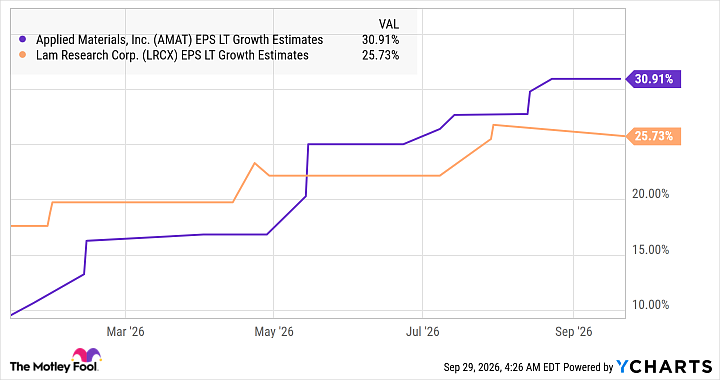
As such, there isn't much separating Lam Research and Applied Materials in terms of their financial performance and outlook. In fact, there isn't a major difference between the annual EPS growth that both companies are anticipated to deliver over the long run.
Data by YCharts
Can their valuations help decide the better buy?
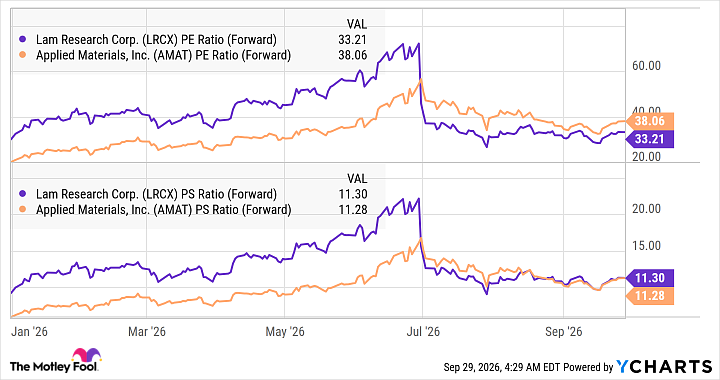
With almost identical growth rates and similar catalysts, investors may find it difficult to choose from one of these stocks. That's why we will now take a closer look at their sales and earnings multiples.
Data by YCharts
Again, there isn't much that separates Lam and Applied Materials even on the valuation front. Both have identical forward sales multiples, while Lam is slightly cheaper on the forward earnings multiple, though not by much. Also, Applied Materials' slightly expensive forward earnings ratio can be justified by the marginally higher long-term EPS growth it could deliver (as seen in the chart in the previous section).
So, investors looking to buy an AI stock to capitalize on the aggressive AI data center build-out can choose any of these semiconductor specialists for their portfolios, as both of them can soar higher in the long run amid a favorable semiconductor spending environment.