A company's choice of stock exchange has a significant financial impact, and there are many reasons why companies change exchanges. The exchange isn't just a matter of the letter in front of a company's stock ticker. It affects the company's visibility and credibility with investors and, ultimately, its access to capital.

Reasons companies switch stock exchanges
When a company switches stock exchanges, it's either because the company wants to be listed on a different exchange or because it no longer meets the listing requirements of its current exchange. The latter scenario is more common, but companies also change exchanges for their own benefit. These benefits can include:
- Lower fees: Stock exchanges charge an initial listing fee and ongoing annual fees. Fee amounts depend on the exchange, so some companies will switch exchanges to save money.
- Better visibility: Larger exchanges provide more visibility to investors than smaller ones. By switching exchanges, a company could attract more investors.
- Greater credibility and prestige: A listing on a major stock exchange is good for a company's reputation.
- Access to a new investor base: The prestige of the major stock exchanges can help businesses attract more institutional investors.
- Improved liquidity: Trading volume tends to be higher on larger exchanges, which makes it easier to buy and sell shares of a stock.
Stock exchange requirements
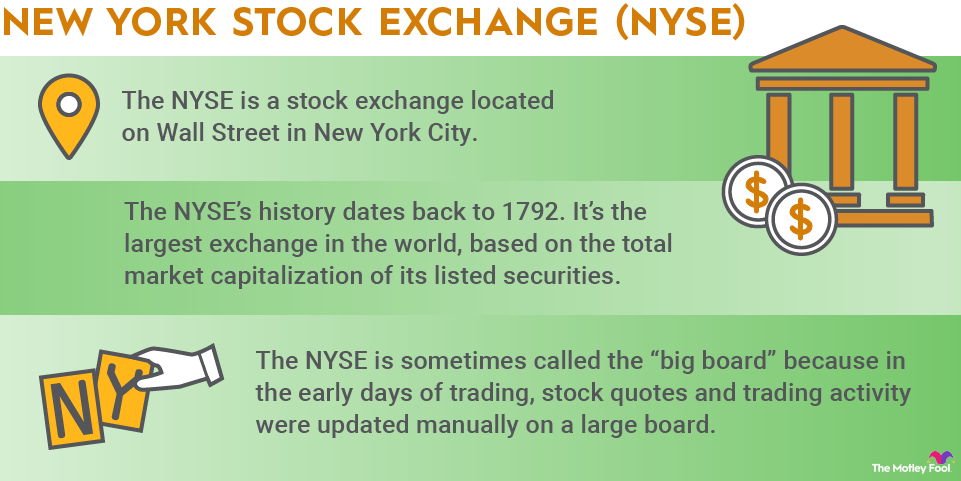
The two major stock exchanges in the U.S. are the New York Stock Exchange (NYSE) and the Nasdaq Stock Exchange. Each exchange has initial listing requirements that a company must meet to get listed on the exchange, as well as continued listing standards to remain listed.
The NYSE and the Nasdaq have similar requirements, although the finer details aren't exactly the same. They each require companies to meet financial standards and distribution requirements, meaning a minimum number of shareholders, publicly held shares, and a minimum share price.
Each exchange requires that a company meet at least one category of financial standards. With the NYSE, companies going for an initial listing must either have aggregate pre-tax income of at least $10 million for the past three fiscal years, with at least $2 million in each of the last two years and positive income all three years, or a market capitalization of at least $200 million.
The Nasdaq has a longer list of options, including market capitalization averaging at least $550 million over the past 12 months or revenue of at least $110 million over the previous fiscal year.
There are also the distribution requirements. The requirements for initial public offerings (IPOs) and spin-off companies are listed in the table below. To qualify, a company must meet all the requirements for the exchange where it wants to be listed.
Requirement | NYSE | Nasdaq |
|---|---|---|
Shareholders | 400 round lot | 450 round lot or 2,200 shareholders |
Minimum number of publicly held shares | 1.1 million | 1.25 million |
Market value of publicly held shares | $40 million | $45 million |
Minimum share price | $4 | $4 |
Examples of companies that have switched exchanges
Many companies have switched exchanges over the years. Here are a few of the most notable examples on the U.S. stock market.
PepsiCo
The largest switch between stock exchanges to date occurred on Dec. 19, 2017, after the market closed for the day. PepsiCo (PEP +1.53%), which had been listed on the NYSE for almost 100 years, switched to the Nasdaq.
Pepsi said it made the change for "greater cost-effectiveness and access to Nasdaq's unique portfolio of tools and services to connect with [their] investors more efficiently." Fees were certainly a factor. At the time, NYSE annual listing fees could be as high as $500,000, compared to a $155,000 cap for Nasdaq annual fees. (Fee amounts for both exchanges have since changed.)
The move didn't lead to an increase in Pepsi's share price. Over the next year after the switch, Pepsi dipped by 7%, slightly underperforming the S&P 500 over the same period.
Oracle
The NYSE's biggest win in its rivalry with the Nasdaq came on July 15, 2013. Oracle (ORCL +0.79%), one of the top tech companies, left the Nasdaq and jumped to the NYSE. The reason Oracle provided was that the switch would "be in the best interests of its stockholders, customers and partners." Before that, it had been listed on the Nasdaq since its IPO in 1986.
Oracle's annual listing fee jumped from about $100,000 with the Nasdaq to $500,000 with the NYSE at the time. It judged that the NYSE's trading volume and the exposure of being listed there were worth that additional cost.
If Oracle's share price is any indication, the move paid off. It increased by 27% over the next year, compared to the S&P 500's 17% return.
Key considerations for investors
When a company switches to a larger exchange, it's generally good news for investors. It will likely be taken more seriously by the market as a whole, and being on a major exchange could also increase liquidity. Greater liquidity typically means lower bid-ask spreads, so trading the stock becomes less expensive.
For switches from the NYSE to the Nasdaq, or vice versa, investors should evaluate why the company made that decision. It could reflect a change in the company's philosophy or overall business strategy -- the NYSE has traditionally been the home to more established, large-cap stocks, while the Nasdaq has traditionally been where you can find tech companies and other growth stocks.
Keep in mind that at this point, both the NYSE and the Nasdaq are highly regarded exchanges. If a company was a good investment at one exchange, that won't change should it decide to go elsewhere.