Are you fighting for every penny's worth of your retirement? It's easy to settle for "good enough," particularly when you feel like you've worked hard on your plan and process.
Unless you've made a point of extracting as much value as you can out of the market and your portfolio, though, you're probably shortchanging yourself, and more than you realize.
The math doesn't lie
In the grand scheme of most things, 1% isn't much. When it comes to a stock market that averages an annual gain of 10%, however, reducing that figure by just one full percentage point per year can take a sizable toll on your long-term performance.
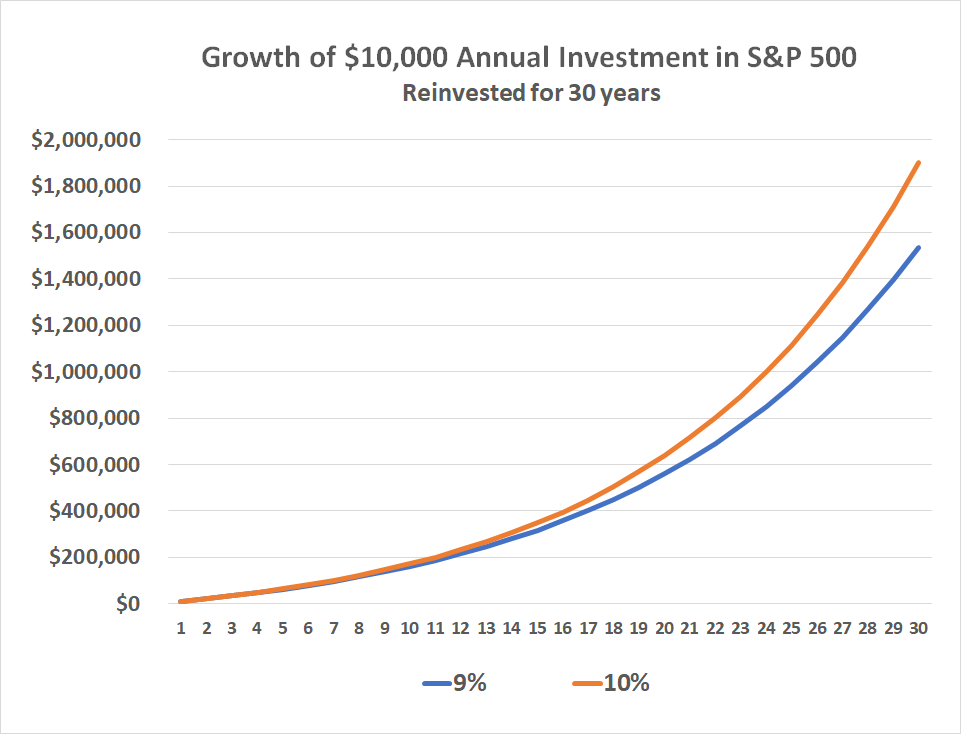
The graphic below puts things in perspective, comparing the cumulative growth of investing $10,000 per year in the S&P 500 (^GSPC -0.06%) for 30 years and achieving its average annual return of 10%, versus only earning an average of 9% per year on the same invested amount for the same time frame. After 30 years, even just giving up those 100 basis points of performance every year would leave you with $362,000 less than the nest egg you might have been able to build even with just a slightly better annual return.
Data source: Calculator.net.
Granted, both retirement portfolios are still respectably sized. While the one netting an average of 10% per year ended up being worth just under $1.9 million, the 9% earner is still worth a little over $1.5 million. That's just a bit more than the $1.46 million U.S. residents believe they'll need to retire comfortably (according to this year's annual survey on the matter from insurer and annuity outfit Northwest Mutual), using a very plausible savings plan as our hypothetical model.
Still, in an uncertain environment where inflation remains uncomfortably high, the difference in these two figures could mean the difference between a comfortable one and a stressful one... one where running out of money is a very real possibility.
It's the little things
It can happen with surprising ease, too. For instance, even though most of them historically underperform the S&P 500, plenty of actively managed mutual funds sport an annual expense ratio approaching 1% of their net asset value, effectively reducing their net returns by that amount. That's in contrast with simple exchange-traded index funds like the SPDR S&P 500 ETF Trust (SPY -0.06%) the Vanguard S&P 500 ETF (VOO -0.06%), each with expense ratios of less than 0.1%.

Image source: Getty Images.
Too much trading activity can also chip away at your net returns, even if you're consistently buying low and selling high. The selling (bid) price for any stock is always less than the buying price (ask). Even if it's only a few cents' worth of difference, those nickels and dimes add up. Plus, no one's market-timing is ever perfect.
These are just some of the common ways you can shave a percentage point off your yearly performance, of course. Others can as well, if you're not careful about keeping them in check.
So, resolve to squeeze a little more return out of the stock market every year just by paying closer attention to the little things. Given enough time, these little things can make a big difference.