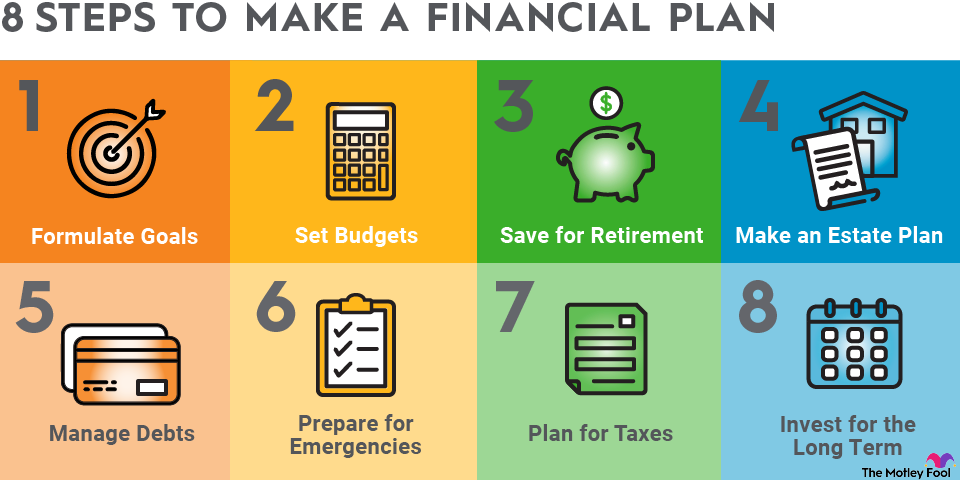
Having a financial plan is one of the most important factors in achieving long-term success with money.
Since the future is uncertain, we can communicate and document our beliefs, values, and assumptions through financial planning.
What is financial planning?
Financial planning is a process through which a person can evaluate their entire financial picture and prepare for short-term and long-term financial goals.
Financial planning doesn't involve only investment management -- such as deciding which stocks to buy -- but instead incorporates other elements such as tax, estate, and insurance planning, along with budgeting and everyday household expense management.

Financial planning could also be called holistic life planning. Money touches almost every aspect of modern life, which makes planning for both expected and unexpected events essential. Financial planning uses money as a tool to prepare for an uncertain future.
Eight Steps to Make a Financial Plan
1. Formulate goals
Setting realistic, achievable goals is a key part of creating a successful financial plan. After all, a plan isn't really a plan without end goals in mind.
Think carefully about the lifestyle you want and the financial means you need to achieve it. If you can estimate the annual cost of your lifestyle, you'll get a better sense of the actions required to achieve financial independence.
Achieving your goals -- especially the short-term ones along the way -- can empower you to reach even greater objectives down the line.
2. Budget carefully
Effective budgeting doesn't necessarily mean cutting out all fun spending from your life. But it does mean knowing the amount of money you have coming in every month, as well as the fixed and variable expenses that need to be paid every month.
To be clear, fixed expenses, such as rent and utilities, don't change much from month to month. You have some control over variable expenses, such as eating out, ridesharing, and recreational activities.
Tracking your money and monitoring your cash flow are two effective ways to set an initial budget and plan for the road ahead.
3. Save for retirement
One of the biggest savings goals most people have is to enjoy a long and secure retirement. Whether this means retiring early or having enough to retire as soon as Social Security becomes available, planning for retirement is essential -- and it's especially important to start as soon as you can.
By focusing on maxing out your retirement accounts -- for example, 401(k)s, 403(b)s, or IRAs -- you'll prepare for future needs. If maxing out these accounts isn't possible, try contributing at least enough to lock in your employer match. Because much of retirement planning hinges on the power of compound earnings and interest, it's critical to contribute as much as you can as early as possible.
4. Make an estate plan
While only a small percentage of people will owe estate taxes, everyone needs to decide how their property will be divided after their death
Whether this is through a traditional will or through a trust set up during your life, you'll need a well-thought-out estate plan that spells out how your money will be distributed -- and who is responsible for it -- if something happens to you.
Because family dynamics differ, it's often best to consult with an experienced estate planning attorney for this part of your plan.

5. Manage debts
While the amount of money and other assets you have matters a lot, it will only really matter to the extent it's stacked against your outstanding debt. If your debt exceeds your assets, you'll still have a net worth of less than zero, no matter how much money you have.
Unsecured debts are the most important debts to focus on, especially if they have high interest rates like credit cards. Carrying a lot of expensive debt can make it difficult to become financially independent. You can clear a path to financial freedom by paying high-interest creditors off first.
This is not to say all debts are bad. Low-interest, fixed-rate mortgage debt can be useful in becoming a homeowner and earning tax incentives. These debts -- also known as "strategic debts" -- can be useful in increasing your net worth through low-cost borrowing.
Related investing topics
6. Prepare for emergencies
Early on in your career, you're likely to be more dependent on your income than you will be later in life. You'll need to build in a margin of safety by holding at least some liquid assets as an emergency fund.
Having available cash reserves serves two main purposes: First, you'll be covered in the event of a job loss or other emergency. Second, you can avoid selling stocks at a loss if you need money immediately.
Many people criticize the emergency fund as a low-return option that loses to inflation in the long run. However, the purpose of the emergency fund isn't to generate a maximum return. It's to act as a rainy day fund in the event of unforeseen trouble. If you end up needing the money, you'll be glad to have cash ready.
7. Plan for taxes
Nobody needs to be a CPA to learn the basic tax concepts necessary to create a broad financial plan. Poor tax planning can lead to unnecessary -- and sometimes quite large -- expenses that can be a drag on your net worth. On the flip side, efficient tax planning can make your life a lot easier and guide your decision-making in a way that benefits you and your family over time.
Remember to factor in the tax consequences of any investing, budgeting, and savings plan. At the end of the day, taxes are an expense to be planned for like any other. Know what you're expected to pay!
8. Invest
When you create a financial plan, your investment portfolio should sit at the center. Whether you're using index funds, picking stocks, or working with a robo-advisor, you'll find that a diversified portfolio is a key element to financial success.
The Foolish investing style -- another way of saying "buy and hold for the long term" -- is a tried-and-true method for achieving financial gain over time. Trading in and out of stocks is unlikely to be a winning strategy in the long run, but buying high-quality stocks and never selling them is generally a recipe for wealth generation.
When you need financial planning help
Financial planning can range from extremely simple to extraordinarily complex. The variables depend on your choices as well as your circumstances, some of which are changeable, and some of which are not.
If you find yourself in a bind, it pays to consult with a financial advisor or consultant who can either walk you through a specific issue or build a broad-based financial plan along with you.
More specifically, it's a good idea to work with a fee-only financial planner who is a fiduciary at all times. This means they’re obligated to work in your interests and focus on providing quality, objective advice as opposed to selling a particular product or service.
You also don't need to fork over all your hard-earned money for an advisor to work with you. Many advisors now work on an hourly or as-needed basis, which has helped to fill the gap between people seeking advice and those who can competently offer it.