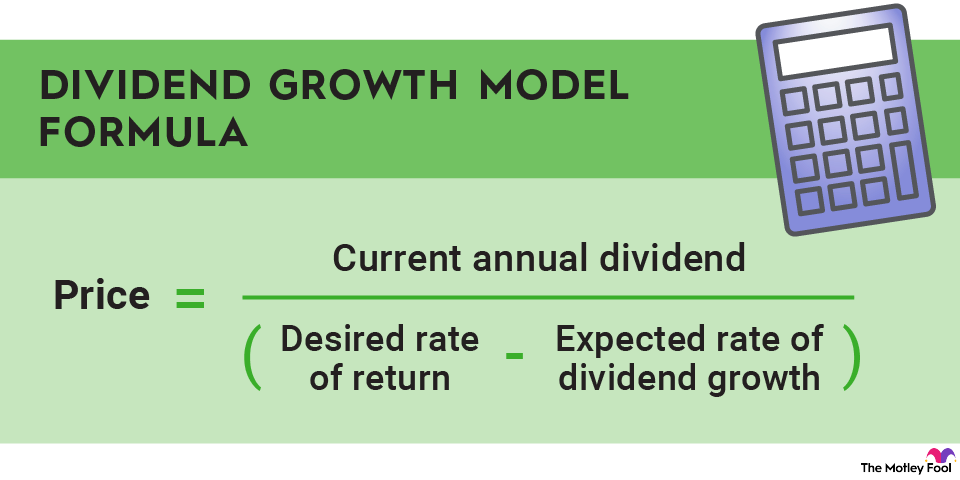
When using models such as the dividend growth model and the others discussed below, it's important to factor in a margin of safety. Using a margin of safety means you only buy a stock if it trades for significantly less than its valuation. Many value investors require a margin of safety of at least 20% or 30%.
Looking back at Wells Fargo in early 2020, it had a dividend of $2.04 per share. If we use an 11% required rate of return and its historical growth rate of 7.8%, its implied valuation was $63.75 ($2.04 / (11%-7.8%)).
While that may have looked attractive given that the stock price was around $53, the margin of safety was just under 16%. That's not quite high enough for a bank that had recently experienced issues and had been fined by the government over a scandal involving fake accounts. If the bank stock had been priced lower to begin with, it likely wouldn't have fallen after its dividend cut in 2020.
Dividend models
While using the dividend growth model can be a handy way to work through various scenarios to determine if a stock's current price represents a fair value, there are other formulas you can use to model the value of a company's future cash flows. These are often used with a cost-of-capital adjustment to discount the value of those future cash flows.
The Gordon Growth Model
The Gordon Growth Model is a means of valuing a stock entirely based on a company's future dividend payments. This model makes some assumptions, including a company's rate of future dividend growth and your cost of capital, to arrive at a stock price.
The Gordon Growth Model is a variation of the discounted cash flow model, which is widely used by investment analysts. The model forecasts future dividends based on the current amount and a growth rate, then discounts each dividend back to the present day. The sum total is an estimate of the stock's value.
The future dividends are discounted back to the present to determine their present value. Because money is worth more to you now (not only do you have it now, but you could invest it), potential future money needs to be discounted for conservative analysis.