Types of cycles that trigger sector rotations
Several different types of cycles can cause a sector rotation, including the economic cycle, the stock market cycle, and oversold and overbought cycles. Here's a closer look at each of these types of cycles and how they can trigger a sector rotation.
Economic cycles
The global economy moves in a cyclical pattern, known as the economic or business cycle, across the following four phases:
- Expansion: During the expansion phase — also called the mid-cycle phase — the economy grows as measured by increases in the Gross Domestic Product (GDP).
- Peak: A peak — also known as the late-cycle phase — occurs when the economy starts running out of steam, usually caused by higher levels of inflation that central banks try to tame by raising interest rates.
- Contraction: A contraction — also known as a recession —happens when trade and industrial activity declines, causing rising unemployment. Economists define a recession as a decline in GDP for two consecutive quarters.
- Trough: A trough represents the low point in the economic cycle — also known as the early cycle phase — as it shifts into a new expansion phase.
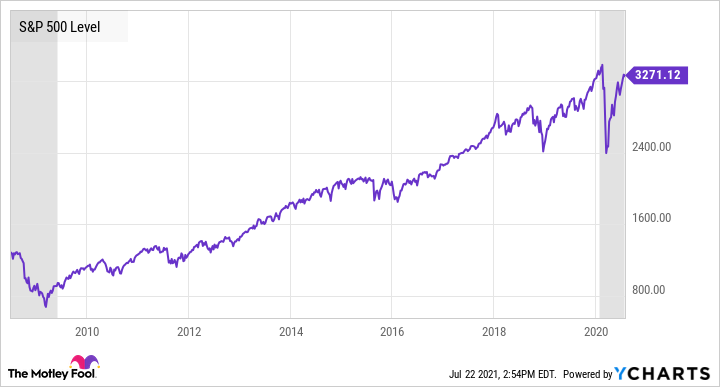
An economic cycle usually lasts several years. Historically, the economy goes through a complete business cycle every five years. The average expansion phase runs more than three years, and the typical recession lasts about a year and a half. However, economic cycles can be much longer. The expansion phase following the Great Recession of 2008 lasted more than a decade, while the shortest cycle in 1981-1982 lasted 18 months.