Image source: The Motley Fool.
DATE
Wednesday, June 3, 2026, at 5 p.m. ET
CALL PARTICIPANTS
- President and CEO — Hock E. Tan
- Chief Financial Officer — Kirsten Spears
- Incoming Chief Financial Officer — Amie Thuener
- President Semiconductor Solutions Group — Charlie Kawwas
- President Infrastructure Software Group — Ram Velaga
- Head of Investor Relations — Ji Yoo
Need a quote from a Motley Fool analyst? Email [email protected]
TAKEAWAYS
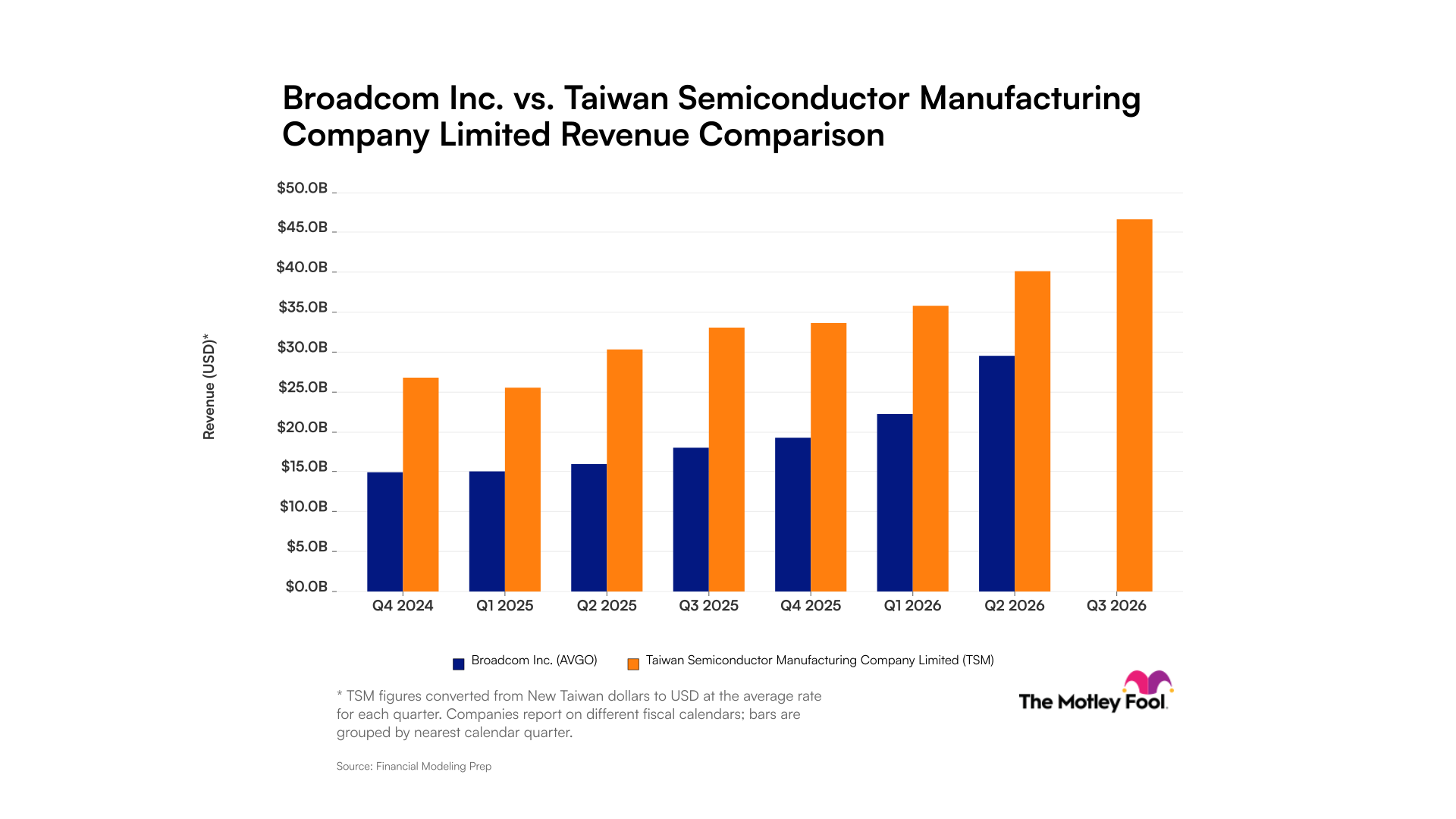
- Consolidated revenue -- The company reported $22.2 billion for fiscal Q2 2026 (ended May 3, 2026), up 48% year-on-year, driven by AI semiconductor demand.
- AI semiconductor revenue -- $10.8 billion, up 143% year-on-year; bookings for AI semiconductors exceeded $30 billion, providing extended demand visibility.
- Semiconductor Solutions revenue -- $15 billion, representing 68% of total revenue, up 79% year-on-year; AI semiconductors contributed 49% of total revenue.
- AI networking revenue composition -- Networking accounted for nearly 40% of AI semiconductor revenue in fiscal Q2 2026.
- Non-AI semiconductor revenue -- $4.2 billion, up 6% year-on-year; bookings surpassed $6 billion, indicating cyclical recovery.
- Infrastructure software revenue -- $7.2 billion, up 9% year-on-year, accounting for 32% of total revenue; annual recurring revenue increased 17% year-on-year.
- Operating margin -- 67% for the quarter, up 200 basis points year-on-year; adjusted EBITDA margin reached 69% of revenue, both at all-time highs.
- Semiconductor gross margin -- Approximately 70%; semiconductor operating margin rose to 62%, up 460 basis points year-on-year.
- Infrastructure software gross margin -- 93% in the quarter; software segment operating margin increased 310 basis points year-on-year to 79%.
- Free cash flow -- $10.3 billion, representing 46% of revenue; ending cash balance was $19.6 billion, up from $14.2 billion in the prior quarter.
- Inventory and days on hand -- Inventory stood at $4.3 billion with 86 days on hand, up from 68 days, in preparation for anticipated AI demand in the second half of the year.
- Dividend -- $3.1 billion in cash dividends paid during the quarter at $0.65 per share.
- Fiscal Q3 2026 guidance -- Consolidated revenue expected at $29.4 billion, up 84% year-on-year; semiconductor revenue forecasted at $20.5 billion, up 124% year-on-year; AI semiconductor revenue projected at $16 billion, up over 200% year-on-year; infrastructure software revenue expected at $8.9 billion, up 31% year-on-year.
- Gross margin outlook -- Fiscal Q3 2026 consolidated gross margin expected to decline to approximately 74% due to increased AI semiconductor mix; management emphasized this is product-mix driven, not structural.
- Long-term AI commitments -- Full-year AI semiconductor revenue guidance reaffirmed at $56 billion (approximately 180% growth) for fiscal 2026; for fiscal 2027, management reiterated expectations of more than $100 billion in AI semiconductor revenue, supported by multi-year contracts and major hyperscaler customer orders.
- Key customer agreements -- Long-term supply deals in place with Google, Anthropic, OpenAI, and Meta for multi-gigawatt AI compute, with significant new deployments beginning in fiscal 2027; $6 billion in AI orders booked from two additional customers as of the call.
- AI XPU platform initiative -- Partnership with Apollo, Blackstone, and others to deploy over 20 gigawatts of AI compute capacity; first tranche valued at $35 billion in rollout by Apollo.
SUMMARY
Broadcom (AVGO +2.33%) management highlighted record-setting quarterly revenues and margins, attributing performance to rapid expansion in AI semiconductors and unprecedented order visibility extending into 2028 from hyperscaler and LLM customers. The company achieved substantial operating income and free cash flow growth without a corresponding increase in operating expenses, demonstrating operational leverage. The shift toward AI semiconductors elevated the product mix and resulted in a gross margin decline, which management stated was not due to margin erosion at the segment level. Bookings for AI semiconductors now exceed three times quarterly shipments, reflecting structural demand acceleration and a growing backlog. Multi-year agreements with leading industry customers underpin long-term expectations of $100 billion-plus in annual AI semiconductor revenue starting in fiscal 2027.
- CEO Hock E. Tan said, "bookings for AI semiconductors were over $30 billion against the $10.8 billion we shipped," confirming order levels far in excess of near-term supply.
- Management stated, "Our visibility runs all the way to 2028 right now," indicating extended demand certainty.
- Orders are being placed further in advance, with management explaining, "They are placing their orders early and they are placing their orders now and they are placing orders in fairly huge demand."
- CFO Kirsten Spears said, "Decline in gross margin does not represent a structural change in semiconductor margin."
- Current AI compute deployments for Anthropic, OpenAI, Meta, and Google are governed by large contractual commitments, with shipment ramps concentrated in the back half of fiscal 2027 and into 2028.
- Management confirmed, "Networking represented almost 40% of our Q2 AI revenue," but anticipated this proportion to normalize closer to 30% of total AI revenue as custom AI accelerators ramp further.
- The company initiated the AI XPU Platform with investors to ensure "more than 20 gigawatts of compute capacity through 2020," creating new financial vehicles to support LLM customers' expansion.
INDUSTRY GLOSSARY
- XPU: Broadcom's term for heterogeneous compute accelerators, including custom AI chips and associated architectures distinct from standard CPU or GPU devices.
- Gigawatt (AI compute context): A metric used to quantify aggregate power capacity allocated for AI data center compute infrastructure.
- SerDes: Serializer/Deserializer technology enabling high-speed, low-latency data transmission, critical for AI networking switch design.
- CPO (Co-Packaged Optics): Integration of optical transceivers within network switch silicon packages to increase data throughput and efficiency in data centers.
- Tomahawk 6: Broadcom's current generation 100-terabit Ethernet switch leveraged for AI cluster and data center build-outs.
- VCF 9.1: VMware Cloud Foundation version 9.1, a private cloud software platform for managing diverse workloads, released during the quarter with enhanced support for AI applications.
Full Conference Call Transcript
Ji Yoo: Thank you, operator, and good afternoon, everyone. Joining me on today's call are Hock E. Tan, President and CEO; Charlie Kawwas, President, Semiconductor Solutions Group; and Ram Velaga, President, Infrastructure Software Group. Also joining is Kirsten Spears, chief financial officer. As we announced, Kirsten will be retiring June 12, And today, we have joining us our incoming Chief Financial Officer, Amy Teiner. Thank you, Kirsten for your leadership over the past 12 years. Broadcom distributed a press release and financial tables after the market closed describing our financial performance for the second quarter fiscal year 26. If you did not receive a copy, you may obtain the information from the investor section of Broadcom's website at broadcom.com.
This conference call is being webcast live and an audio replay of the call can be accessed for 1 year through the Investors section of Broadcom's website. During the prepared comments, Hock and Kirsten will be providing details of our second quarter fiscal year 26 results, guidance for our third quarter fiscal year 26 as well as commentary regarding the business environment. We will take questions after the end of our prepared comments. Please refer to our press release today and our recent filings with the SEC for information on risk factors that could cause our actual results to differ materially from the forward-looking statements made on this call in addition to U.S.
GAAP reporting, Broadcom reports certain financial measures on a non-GAAP basis. A reconciliation between GAAP and non-GAAP measures to the extent possible is included in the tables attached to today's press release. Comments made during today's call will primarily refer to our non-GAAP financial results. I will now turn the call over to Hock.
Hock E. Tan: Thank you, Ji. In Q2, revenue was a record $15 billion as we grew 79% year-on-year. Driving this growth was AI semiconductor revenue at a record $10.8 billion, a 143%-- Oops. Sorry. Well, let me respond, guys. Thank you, Ji. Thank you everyone for joining today. In our fiscal Q2 2026, total revenue reached a record $22.2 billion, up 48% year-on-year, above our guidance, on strength in AI semiconductors. Q2 operating margin was a record 67% and adjusted EBITDA was a record 69% of revenue, above our guidance. Even as our revenue scales up massively, driven by AI, our operating and EBITDA margins remain strong and stable.
Turning to semiconductors, Q2 revenue was a record $15 billion, as I said before, as we grew 79% year-on-year. Driving this growth was AI semiconductor revenue at a record $10.8 billion, up 143% year-on-year, and above our outlook. Networking represented almost 40% of our Q2 AI revenue. Demand for XPUs and networking is simply insatiable. During the quarter, bookings for AI semiconductors were over $30 billion against the $10.8 billion we shipped. In the second half of 2026, we expect AI semiconductor revenue to double from the first half we shipped last from the ship this year. Consistent with this trend in Q3, we expect AI semiconductor revenue to accelerate to $16 billion up over 20 to up over 200% year-on-year.
For the full year 2026, we expect to achieve AI semiconductor revenue of $56 billion, up approximately 180% from fiscal 2025. Now we expect this momentum to continue into fiscal year 2027, and we reiterate our AI semiconductor revenue guidance to be in excess of $100 billion. We expect AI semiconductor revenue growth to continue in fiscal 2028 based on the following initiatives we have with our six core customers. As you are aware, with Google, we announced in April that we entered into a long-term agreement to develop and supply multiple generations of TPUs and AI networking.
Our relationship continues to be strategic and very substantial as we continue to deliver vastly superior technology and execution compared to other alternatives. This ability to provide differentiated value to Google ensures that our business will sustain and grow for the foreseeable future. For Anthropic, as you know, for 2026, we are providing access to Broadcom for TPU-based compute of over 1 gigawatt. In April, we entered into an agreement to enable Anthropic to access another 5 gigawatts of next-generation TPU-based compute beginning in 2027. For OpenAI, we have delivered silicon and we are on track for production late 26.
We have a contractual commitment to deploy 1.3 gigawatts in 2027 as part of the larger 10-gigawatt that 2029 agreement we announced last year. For Meta in April, we announced a partnership to deliver multiple generations of MTIA X XPUs. And under this agreement, we expect to deploy 3 gigawatts through the end of 2028. An initial order for 1 gigawatt, which includes XPUs and our networking, has been received and will start delivery in the second half of 2027. For our other two customers, we expect shipments to begin in late 2026 and accelerate into 2027. To date, we have received purchase orders totaling $6 billion.
While we have significant IP and execution leadership in XPUs, networking is key to building scalable XPUs and GPU clusters. And here in networking, we have at least one generation of technology and product leadership for scale-up within racks, enabling direct attach copper based on an industry-leading 200G and 400G SerDes driving co-packaged copper with Ethernet and PC Express switches. For scale out between the racks, we have been shipping the industry's only 100 terabit Ethernet switch, the Tomahawk 6, for over one year. We will now be taping out our next-generation 200-terabit switch this quarter.
And in CPOs, which is co-packaged optics, 1.6T DSPs, CW and EML lasers, we are the de facto standard in the industry to extend AI clusters across data centers. We remain the industry leader with our Jericho 3 and Jericho 4 fabric solutions. And enabling the world's largest deployments of multiple hyperscalers. Our strategic vision is to bring together Broadcom's leading technology and investor partners with the strongest balance sheets to deliver at scale sufficient compute capacity at the lowest cost and power for the leading AI frontier labs, including Anthropic and OpenAI.
To deliver this vision, we are creating the AI XPU platform with Apollo and Blackstone and other leading investors to deploy more than 20 gigawatts of compute capacity through 2028. The first trench of this platform, valued at $35 billion, is in fact currently being launched by Apollo.
Now, turning to non-AI semiconductors, Q2 revenue of $4.2 billion was up 6% year-on-year. Bookings during the same period exceeded $6 billion, which is a clear indication we are on the path towards a full cyclical recovery. Broadband, server storage, and enterprise networking together were up, partially offset by seasonal decline in wireless. Consistent with this trend, in Q3 we forecast non-AI semiconductor revenue to be approximately $4.5 billion, up 12% year-on-year. In summary, we expect Q3 semiconductor revenue to be $20.5 billion, up 124% year-on-year.
Let me turn to the infrastructure software segment. Q2 software revenue of $7.2 billion was up 9% year-on-year, in line with our guidance. Bookings continued to be strong as we sustained ARR growth of 17% year-over-year. For Q3, we forecast software revenue to be approximately $8.9 billion, up 31% year-on-year.
We just released VMware Cloud Foundation 9.1, focused on improving infrastructure efficiency, security, and support for enterprise AI inferencing workloads. With strong server demand globally, the deployment of VCF 9.1 for on-prem cloud computing is extremely strong, driving robust revenue growth. This release adds heterogeneous compute support across GPUs and CPU architectures, including AMD, Intel, and Nvidia platforms, enabling customers—enterprise cloud customers—to run AI Kubernetes and traditional virtualized workloads on a common private cloud environment.
So to sum it up for Q3 2026, we expect our consolidated revenue to grow to $29.4 billion, up 84% year-on-year. We expect operating margin to be stable at approximately 67% of revenue, and adjusted EBITDA to be at approximately 68% of revenue. And with that, let me turn the call over to Kirsten.
Kirsten Spears: Thank you, Hock. Let me now provide additional detail on our Q2 financial performance. Consolidated revenue was a record $22.2 billion for the quarter, up 48% from a year ago. Gross margin was 77.1% of revenue in the quarter, down 230 basis points year-on-year, as semiconductor became a larger proportion of our product mix. Consolidated operating expenses were $2.2 billion, of which $1.6 billion was R&D. Q2 operating income was a record $14.9 billion, up 52% year-on-year. Note that even with the decline in gross margin, operating margin increased 200 basis points year-over-year, and expenses remained relatively flat, to 67.3%, and operating adjusted EBITDA of $15.2 billion, or 69% of revenue, was above our guidance of 68%.
Now, a review of the P&L for our two segments, starting with semiconductors. Revenue for our Semiconductor Solutions segment was a record $15 billion, with growth accelerating to 79% year-on-year driven by AI. Semiconductor revenue represented 68% of total revenue in the quarter, and AI semiconductor revenue represented 49% of total revenue. Gross margin for our Semiconductor Solutions segment was approximately 70%. Operating expenses of $1.2 billion reflected increased investment in R&D for leading-edge AI semiconductors and represented 8% of revenue. Semiconductor operating margin of 62% was up 460 basis points year-on-year, reflecting our strong operating leverage.
Now moving on to infrastructure software. Revenue for infrastructure software of $7.2 billion was up 9% year-on-year and represented 32% of revenue. Gross margin for infrastructure software was 93% in the quarter, and operating expenses were $1 billion in the quarter. Q2 software operating margin was up 310 basis points year-on-year to approximately 79%.
Moving on to cash flow. Free cash flow in the quarter was a record $10.3 billion and represented 46% of revenue. We spent $231 million on capital expenditures. We ended the second quarter with $19.6 billion of cash compared to $14.2 billion in the prior quarter. We ended the second quarter with inventory of $4.3 billion as we continue to secure supply to support strong AI demand.
Our days of inventory on hand were 86 days in Q2, compared to 68 days in Q1, in anticipation of accelerating AI semiconductor growth in the second half of the year. Turning to capital allocation. In Q2, we paid stockholders $3.1 billion of cash dividends based on a quarterly common stock cash dividend of $0.65 per share.
Now moving to guidance. Our guidance for Q3 is for consolidated revenue of $29.4 billion, up 84% year-on-year. We forecast semiconductor revenue of approximately $20.5 billion, up 124% year-on-year. Within this, we expect Q3 AI semiconductor revenue of $16 billion, up over 200% year-on-year. We expect Q3 infrastructure software revenue of approximately $8.9 billion, up 31% year-on-year.
Moving on to margins, as the proportion of AI revenue significantly grows in Q3, we expect Q3 consolidated gross margin to be down to approximately 74%. This decline in gross margin does not represent a structural change in semiconductor margin. Rather, it reflects product mix between semiconductors and infrastructure software. Regardless of the impact to gross margin, we expect Q3 operating margin to be 67%, which is flat quarter on quarter, demonstrating our strong operating leverage. We highly recommend that investors model semiconductor and infrastructure software margins separately to properly reflect the impact of changes in total revenue mix going forward.
We expect the non-GAAP tax rate for Q3 and fiscal year 2026 to be approximately 16% due to the impact of the global minimum tax and the geographic mix of income compared to that of fiscal year 2025. We expect the non-GAAP diluted share count in Q3 to be approximately 4.94 billion shares, excluding the impact of potential share repurchases. That concludes my prepared remarks. Operator, please open up the call for questions. Thank you.
Operator: Due to time constraints, we ask that you please limit yourself to one question. Please stand by while we compile the Q&A roster. And our first question will come from the line of Harlan Sur with JPMorgan. Your line is open.
Analyst (Harlan Sur): Yes, good afternoon. Thank you for taking my question. Thanks for all your support, Kirsten. And Amie, welcome to the team. First, just a quick housekeeping item. Hock, on this fiscal year, AI sort of 2x growth second half over first half. That would put AI revenues over $60 billion with sequential growth in fiscal Q4, but you gave us the $56 billion number, which is only 1.5x half-over-half growth, with Q4 AI actually being down sequentially. So if you could just help us kind of square the numbers there.
And then for my real question, back in December of last year, you talked about an AI backlog over the next 18 months of $73 billion. The market sort of took that number, spread that linearly over six quarters, but we know that the backlog is always more front-loaded over the first four quarters. Right? And sure enough, you are gonna deliver around 80% or more of that backlog in the in this fiscal year or first four quarters.
Just given the strength of all your programs, the broadening of the customer base, accelerating year-over-year trends in your AI shipments, all the multi-gigawatt partnerships that you just articulated today, which is most of it, which is set to start to fire next year, is it fair to assume that your 18-month backlog second half of this year is through first half through all of fiscal 2027 sits at $200 billion or better.
Hock E. Tan: That is a very complicated set of number questions. To begin with, let's start with 2026. If you are doing the math, basically, 2x to 2x, the first half we shipped, in total AI revenue, something in the range of $19 billion. You wanna be precise. So if it is and if you do what I indicate and 2x that the second half, you get to pretty much in the range of what we are talking about. Which is fifth around $56 billion, Harlan. So that set of numbers still does tie up very well.
Now the only pick up question on the second, which you are going to need a very deep, detailed analysis of, is yeah, we keep the momentum going, as we expect to see in 2027. What we will see in 2027 is continued growth of the level we are talking about. And if you drive on that basis of what we are seeing here, almost 2x, what 2000 in the range of 2x, what 2026 will be. I think you will easily see that 2027 will exceed very easily $100 billion in 2027. Which is pretty much what we indicated last quarter, and we are continuing to say that it will be over $100 billion in 2027.
So in that sense, if anything else, it might be based on what we are doing. Very much on track, if not stronger. But we are not trying to guide you every quarter what 2027 would be like. So we basically say, we continue to be in excess of 100 billion in 2027. But it is on a same trajectory as we are seeing in the back half of 2026.
Operator: Got it. Okay. Thank you, Hock. One moment for our next question. And that will come from the line of Blayne Curtis with Jefferies. Your line is open.
Analyst (Blayne Curtis): Hock, I wanted to ask you, in quarter, you had that 8-Ks with the long-term agreement with Google. I think, obviously, you are probably not gonna tell me what the total value is there, but I think there is a lot of concern about share within that customer. I was just kind of curious, now that you have this agreement, maybe you could speak to it a little bit more in terms of your confidence and if there is upside to that customer. You know, is it a fixed amount or are there shares? Is there any way you can kind of add some color to that agreement?
Hock E. Tan: Oh, well, you know, it is a very, very strong agreement. And it basically reflects the strength of the partnership we have simply because of the products we do, the multi-general products, and then any intellectual property we deploy into this whole program. To answer your question, specifically, it is a commitment that is very substantial in dollars, very, very substantial amount of dollars.
Now, we also accept the fact that while we like to win every design in that program, we also accept the fact that, given the rate of the growth of consumption and development and consumption of AI compute by our partner Google, that we fully expect that there will be some diversity of sources for them. But our commitment from them is a very substantial dollar amount. Thank you.
Operator: One moment for our next question. And that will come from the line of Ross Seymore with Deutsche Bank. Your line is open.
Analyst (Ross Seymore): Hi, thanks for allowing the question and congrats to both Kirsten and Amie. Question on the gross margin side of things. I know, Kirsten, you talked about it going down due to the mix dynamics within the semis versus the software side. But given the strength on the software side in the quarter, it seems like gross margin is falling a little bit harder. So behind the scenes, can you just talk a little bit about what the drivers within semis are? Is that the XPU versus the networking side of things? And is that trend likely to continue next year? Are there rack-scale versus chip-scale?
All those sorts of dynamics, any color you could give on that would be helpful.
Kirsten Spears: Yes. Certainly, as our semiconductor business grows, just to reiterate, on a consolidated basis relative to our software business, you are going to have a decline in margins, right? You will have compression. But remember that we are it is accretive of this. Because we have strong operating leverage, right? So our operating margins will stand up a bit over time to that. Within semiconductors, we have always said our ASICs, TPUs, some of the wireless business has lower margins. So as the TPUs continue to accelerate, there will be pressure overall on margins.
But the connectivity side, the AI networking side of the business, has very rich margins, so it will offset it somewhat as we go.
Hock E. Tan: I mean, Ross, as Kirsten said in her remarks, structurally, the semiconductor margins remains very stable and very solid. It is the mix, particularly the mix between software and non AI to the very, very high rapidly growing AI semiconductor, that is just diluting gross margin. In the rack versus chip side of things, is that all clarified now? No, no, no. No racks. It is all a chip business only. We only chips. Only chips. Perfect. Thank you.
Operator: One moment for our next question. And that will come from the line of Benjamin Reitzes with Melius. Your line is open.
Analyst (Ben Reitzes): Yeah. Hey, guys. Thanks. Appreciate it. Wanted to ask about 2027, Hock. With regard to, you know, previously, you talked about the TAM being tended well, it is kind of a longer-term question, actually. You have talked about the TAM being 10 to 20 in whatnot. It seems that one of your competitors talked recently about the TAM per gigawatt going up a lot as we go throughout the decade. And it seems, you know, it was not just due to infrastructure; it was due to the compute and networking components and other things. Perhaps you are familiar with that comment that Jensen made, where the overall infrastructure is going from something around 50-something towards 100.
And the compute content going way up. Are you seeing the same thing as you go throughout the long term? Is that potentially being an accelerator to what you have already outlined in terms of your TAM per gigawatt? And how are you thinking about that?
Hock E. Tan: Sure. Well, I think the accelerating part, or if you talk about power, realize one thing, it is the dollars per gigawatt, the content dollars are per gigawatt, it is not accelerating that much because you are creating chips that are drawn such that each individual chip is driving higher and higher power, so you are driving less chips though the price, the ASP of each chip is going up in price. So dollars per gigawatt, billions of dollars per gigawatt, is relatively stable. But the number of gigawatts will accelerate, as I think some of our remarks indicate. And that is what we are saying, that the amount of gigawatts required to measure compute capacity, as measured by number of gigawatts, is growing very fast. And we are seeing that particularly to the point where for even two of our customers we are talking about — which is Anthropic and OpenAI, which we are creating this platform to enable them to run sufficient compute power — talking about comp capacity as measured by gigawatt power that are way ahead of what we fully, what we have expected, say, six months ago. And that is just these guys. We do not talk about the consumption beyond the XPU platform we have announced here from our other customers, which is Google-owned internal workloads, Meta's workloads, and any other customer and the other two customers that we have. So fold that in and you are talking about gigawatts in totality. If you ask about 2027 or 2028, that will continue to grow. We expect, in fact, 2028 to be a substantial growth from what we are forecasting in 2027. Thank you, Harlan.
Operator: One moment for our next question. And that will come from the line of Arcuri with UBS. Your line is open.
Analyst (Timothy Arcuri): Thanks a lot, Hock. I wanted to ask you about supply and kind of your ability to get incremental volume of wafers and HBM. As I look at some of your competitors, I mean, they are kind of able to drop, you know, $20 billion out of thin air and get incremental wafer supply. So I am wondering, do you feel pretty good about, like, if a customer comes to you, are you able to get up in terms of wafers and HBM? And are you beginning to consider maybe using other foundries to add more optionality to your supply? Thanks a lot.
Hock E. Tan: Getting supply is not just about dropping money, even though that does well. We are very comfortable that we have been able to secure supply of the types you mentioned for our needs for 2026 and 2028. Working on 2028 and 2029 right now.
Analyst (Timothy Arcuri): But if a customer comes to you and wants supply, are you able to go to your suppliers and get it the way that it seems like some of your competitors--
Hock E. Tan: Oh, customers have been coming to us incrementally over the last few months. We expect that to continue. And by and large, yes. Okay. Thank you.
Operator: One moment for our next question. And that will come from the line of Stacy with Bernstein Research. Your line is open.
Analyst (Stacy Rasgon): Hi, guys. Thanks for taking my question. Hock, you gave some gigawatt shipment targets for next year for your various customers. I just want to know, are those any different? Do they contemplate any change from what you said last quarter? I think you said that was close to 10 gigawatts you would be shipping in 2027. And can you just sort of help us shape the year? It sounded to me like you expect that to be more back-half loaded in 2027, given the shape of the ramps.
But most importantly, is there any change that … is it more gigawatts or less gigawatts or the same gigawatts versus what you were suggesting last quarter?
Hock E. Tan: Well, that is a good question. Yeah, for 2027, we indicated about 10 gigawatts shipment in 2027. That is still very much intact. They will be shipping 10. We are planning to ship 10 gigawatts in 2027, and nothing has changed. Back-half loaded, to that extent, yes. And which really provides an interesting trajectory into 2028, with this back-half trajectory. So in 2028, we expect a lot more gigawatts.
Analyst (Stacy Rasgon): Got it. That is helpful. Thank you.
Operator: One moment for our next question. And that will come from the line of Jim Schneider with Goldman Sachs. Your line is open.
Analyst (Jim Schneider): Good afternoon. Thanks for taking my question. Was wondering if you could comment a little bit on the profile of your networking business, Hock, as we head through fiscal 2026 and 2027. About 40% of AI revenue this quarter. Will you expect that to sort of fall back down as some of these custom ramps into the end of the year into early next year? Or would you sort of expect it to stay at the upper end of that range? And maybe talk about when you see some of the optical and CPO revenue becoming meaningful. Thank you.
Hock E. Tan: That is a hell of a great question, Jim. It is just very difficult to answer because of how do we predict that. There are quite a few moving parts there, one of which is, to start with, is as more as a volume as more and more of our customers turn to XPUs. Obviously, XPUs use a lot of our networking components across the board. So that is great for us. And then that drives increase in consumption. But it also means that we have been able to sell networking to non-XPU footprints. So that part of it would dilute the growth rate.
And this 40%, I consider as a very well, almost a situation where stars are aligned, and we are shipping a lot of networking to non-XPU, while the growth of XPU are obviously allowing us to grow this networking business with our XPUs, and we get to 40%. But I see that as probably as high as that percentage of total AI revenue would go. Not the first time I indicated that. The more expect the percentage as a share of total AI revenue for networking would be closer to around 30%.
Operator: One moment for our next question. That will come from the line of Tom O'Malley with Barclays. Your line is open.
Analyst (Tom O'Malley): Hey, Hock. Thanks for taking the question. So I noticed with the most recent deal with Anthropic that you guys are using Broadcom chips as a backstop for the deal. You expect more deals to come like this in the future? And then, as you start to see the AI environment, is there any way you are thinking about financing in the future? You are gonna continue to do it with chips or anything that you can offer on that? Thank you.
Hock E. Tan: Can you repeat that question, especially at the front end? I did not quite get what you are saying here. I do not want to answer the wrong way.
Analyst (Tom O'Malley): Sorry, Hock. Essentially, the most recent deal with Anthropic is being backstopped by Broadcom chips. Do you think that in the future, you will see more deals done this way? And then any comments on the future financing of deals with the large AI models? Thank you.
Hock E. Tan: Oh, I have to correct you on that. Our deal with Anthropic and that we basically talk about a release disclosing our 8-K recently.
The deal we did with Anthropic is we use our TPU chips that we develop to provide the compute capacity to Anthropic. It was not backstopped in that sense. We were the ones providing the chips to Anthropic. We were the ones providing the compute capacity to Anthropic.
Operator: Thank you. One moment for our next question. That will come from the line of CJ Muse with Cantor Fitzgerald. Your line is open.
Analyst (CJ Muse): Yeah, good afternoon. Thanks for taking the question. I guess, Hock, in recent years, you have talked about really focusing your efforts on very large XPU platforms. And I am just curious, we are seeing many kinds of XPU attached derivatives across interconnect storage, other. And I am wondering if there is any sort of programs there that are more niche that are whetting your appetite.
Hock E. Tan: Well, no. I do not think so. I think our business model is actually very, very straightforward. Which is we are developing XPUs, customer AI accelerators, for use by our customers, who are pretty much all LLM developers. Whether it is for training or inference. We are also creating a portfolio of critical components to enable these XPUs and even GPUs to be clustered and form better performance. And that continues to be the model we do, which is we provide chips, technology in the form of chips, whether they be AI compute accelerators we call XPUs or networking chips that cluster them together, be it switches, PCI Express, connectors, DSPs, lasers, NICs, and routers.
And that is very much still the model we employ in semiconductors and we still as you can see, our financial model and the program will go with drive towards a chip business model through the technologies we provide. What we are doing to enable some of these LLM players to be able to get access to the volume of compute capacity, the large gigawatt of compute capacity they need to scale up their models, is we are, as I announced here today, creating, in partnership with guys with the best balance sheets around, a vehicle to basically have these chips funded for these LLM players, who otherwise might have difficulty getting access to our technology, which provides them with the lowest power and the lowest cost.
Operator: One moment for our next question. That will come from the line of AT Malik with Citi. Your line is open.
Analyst: Hi, thank you for taking my question. I have a question on Infrastructure Software business. Are you guys seeing any impact of AI, generative AI, on your software growth and renewals? And if you can, just talk about some sort of long-term growth for that business.
Hock E. Tan: Well, we are not seeing it. If anything else, as I reported, does the high volume of core count of CPUs selling together with GPUs, it is driving some accelerated growth of our VMware business. And as you can see in Q3, we are seeing an accelerated growth, and we expect that to continue, I guess, for the next multiple quarters as this demand picks up.
Long term, given the kind of products we do in infrastructure software, very, very close to literally the hardware, the tech, as basically the hypervisor, which is where our products are, we do not expect to see any impact on software products.
Operator: And one moment for our next question. That will come from the line of Edward Snyder with Charter Equity Research. Your line is open.
Analyst (Edward Snyder): Thanks a lot. Hock. This is very interesting because the gigawatts that you have got laid out for the different customers makes it very clear that the two that are offering kind of CSCs, I do not wanna say CSC, but consumer versions of AI, Anthropic and OpenAI have very large gigawatt commitments in the out years. I know part of that is catch up because they have just started late, where your oldest customer has been doing this for quite some time. But even part of Google’s is offering cloud services to other folks, too. So are we seeing a shift here?
I know that initially, a lot of the XPUs and the AI services were through the hyperscalers for their own customer workloads we have talked about ad nauseam. And now you are seeing AI finally hit the enterprises, and you are seeing cloud take off with the programming, which is sweeping everybody. Can we expect then that there is gonna be this big second wave of demand that is driven as AI starts hitting enterprises and its consume start getting access to it or finding usable tools? Because the numbers you are saying here are significantly different for the two classes of customers.
Hock E. Tan: Well, that is a very interesting thought here. And you may be very well right that enterprise consuming AI is still relatively at an early stage of the game. But having said that, what we are also seeing is a lot of what the enterprise is consuming on tokens. They are buying a lot of these tokens from the platforms, the product API platform. API they pull from the platform of these same-named customers we talked about, which is Anthropic, OpenAI, Gemini. Like, these are the large guys they are pulling it from and that is where I think a high substantially most of these tokens consumption are tied to those LLMs.
And these LLM guys, as they productize their frontier models, whether it is the Opus 4.7, ChatGPT 5.5, or Gemini 3.5, comes back to the same end demand on compute capacity we provide to all these guys. And so even a growth of enterprise demand that we are now starting to see as enterprise starts to consume AI tokens for their own workloads for their own productivity users, as consumers do, they are buying from the same source, these same few guys. And that is what is driving this very large, I call it, insatiable growth in compute capacity that we are experiencing. And we see that continuing to happen now through 2027, and what we are seeing now through 2028 as well. So this is getting to be quite a sustainable and steepening trajectory of demand.
Analyst (Edward Snyder): So if I could, does not this change the dynamic that we have talked about before? And you talked about six or seven or so customers for your XPUs, but it is actually happening. You have already seen it. Google offering cloud services for GPUs. It opens up XPU access to all those smaller companies that do not meet the criteria for doing their own ASICs that you could not partner with. To Broadcom's technology through these platforms? Is it why would that not be the case?
Hock E. Tan: Well, I guess the answer to that is it is possible, but the reality of the whole issue is this: The compute capacity most of AI generated provided in the form of SaaS models. APIs are pulled from the clouds, whether they are from Bedrock, Vertex, Azure, or the first party, it is still provided in the cloud. So most of all that demand, at the end of the day, in terms of compute capacity, which is what we are doing, comes from those few large frontier model developers and the products they generate to supply to consumers and enterprises globally.
Source of demand comes from those frontier model labs who are developing the products which consumer and enterprises like you and us and our companies are consuming. And what we are doing is providing that capacity to that demand source, as opposed to going to a company or bank and trying to provide them XPUs, and then they having to try to build and run as well, create a software stack to then write applications and run it themselves. I am sure there are a few enterprises doing it now, but there are not many. It is early stage in that whole game.
Right now, most of the demand are coming from the frontier model players who are creating products. Things, as I said, like code assistance, like engineering verticals, which are really coming from the same source of guys who are doing all those, those few guys doing the frontier models. It's not really coming from 100,000 companies directly trying to buy XPUs or, for that matter, GPUs. It's not.
Operator: One moment for our next question. That will come from the line of Joe Moore with Morgan Stanley. Your line is open.
Analyst (Joe Moore): Thank you. You talked about $30 billion of AI bookings in the quarter. Which is a lot, I guess, relative to this quarter and next quarter shipments. Can you talk about the dynamic? Why is there so much backlog now? Or is there you sort of said you can react to upside supply. Just, why so many bookings this quarter relative to revenue?
Hock E. Tan: Well, that is a huge demand of compute. See, a lot of our large, these six customers, now they realize that lead time to get compute. You need lead time. You need to be thoughtful. And there is not just asking for wafers, to get the chips or memory, to ensure that HBMs are available or DRAM is available. They are also talking about, hey, I have got to have the power, the power shell. So all this is planning ahead. And what we are seeing, the bookings that are coming, it is not for immediate delivery.
Some hope to have, but the reality they all accept is they need to align quite a few other things in place before they can deliver. But they are placing their orders early and they are placing their orders now and they are placing orders in fairly huge demand. Which basically gives us a lot more visibility than we normally otherwise would have in semiconductors. Our visibility runs all the way to 2028 right now. Just three months ago, I can tell you visibility ran pretty much to 2027. Today, it runs to 2028.
And that is a big part of the reason why we are creating this XPU platform as really the platform to plan to build up this put in place such capacity for those Frontier model customers of ours who are seeing as you guys are seeing in some of financials they are telling you in term I mean, the experiences you have which is driving huge amount of consumption of tokens from those compute capacity we are giving them. We have the benefit now of a lot of lead time. And we are planning that.
And it is not because of shortage of our components; it is also the other elements that need to be put in place, which particularly relates to power. And brought connection into an infrastructure globally or through America at least that enables inference to be distributed through to consumers and enterprises throughout the country. So we are just getting a lot of lead time. Very helpful. Thank you.
Operator: Thank you. We do have time for one final. And that will come from the line of Joshua Buchalter with TD Cowen. Your line is open.
Analyst (Joshua Buchalter): In the past, you have talked about sort of $15 billion to $20 billion per gigawatt of compute. And given the 10 gigawatts that you implicitly implied is be doing next year implies a much larger number than $100 billion. You have also mentioned that the value per gigawatt does vary per project. So I guess how should we think about the evolution of your revenue per gigawatt over time? As I would expect on one hand, gen-to-gen pricing to increase on programs you are already shipping, also there are other projects that are entering the model. Thank you.
Hock E. Tan: Our revenue, our content per gigawatt will increase, put simply, our content from the fact that our compute chip, an XPU, will go up in price very dramatically. Particularly when you not only put SRAMs into it, at fastest cost, you start putting a lot, you start putting, embedding CPU cores into the same XPUs and making those chips basically multi die with lots of HBM. So that the trajectory of content increase will go on. It just does not go up every month, every six months, or every quarter. But it will follow one generation to the next that the content will grow per gigawatt. Thank you.
Operator: Thank you. I would now like to turn the call over to Ji Yoo, Head of Investor Relations, for closing remarks.
Ji Yoo: Thank you, operator. Broadcom currently plans to report its earnings for the third quarter of fiscal year 2026 after close of market on Wednesday, Sept. 2, 2026. A public webcast of Broadcom's earnings conference call will follow at 2 p.m. Pacific Time. That will conclude our earnings call today. Thank you all for joining.
Operator: Sherry, you may end the call. This concludes today's program. Thank you all for participating. You may now disconnect.
Editor’s note: A previous version of this article contained several errors. It has been updated.