Self-storage real estate investment trusts (REITs) are companies that own, operate, and manage mini-warehouse storage facilities. These properties enable businesses and individuals to securely store items in individual storage units.
Here's a closer look at the self-storage REIT business. We will explore its advantages and risks, as well as some leading self-storage REITs investors should consider.

Understanding self-storage REITs
Self-storage properties are small warehouses with multiple units of varying sizes. Owners lease storage units in these buildings to businesses and individuals who need space to store inventory or household items. Some self-storage operators also rent parking spaces for boats, RVs, and other vehicles.
Most self-storage units rent on a month-to-month basis. That differs from the lease structure of many other REITs, which typically own properties that lease space for a year or more. The shorter-term lease structure enables self-storage REITs to raise rents more frequently to market rates. However, a drawback is that they might have to reduce rents during a down market.
In addition to generating rental income, self-storage REITs have several other potential revenue sources, depending on their business model. These can include tenant reinsurance income, late fees, management fees, and the sale of moving materials (boxes, packaging, tape, etc.).
Top self-storage REITs to buy right now
There were only a handful of publicly traded self-storage REITs in 2026 due to sector consolidation. Here are the three biggest self-storage REITs.
| Name and ticker | Market cap | Dividend yield | Industry |
|---|---|---|---|
| Public Storage (NYSE:PSA) | $51.8 billion | 4.07% | Specialized REITs |
| Extra Space Storage (NYSE:EXR) | $29.3 billion | 4.67% | Specialized REITs |
| CubeSmart (NYSE:CUBE) | $8.8 billion | 5.40% | Specialized REITs |
Here's a closer look at these top self-storage REITs.
1. Public Storage

NYSE: PSA
Key Data Points

NYSE: EXR
Key Data Points
3. CubeSmart

NYSE: CUBE
Key Data Points
Risks of investing in self-storage REITs
While self-storage REITs have been excellent long-term investments, they're not without risk. There are two notable sector-specific risks:
- Oversupply risk: Because self-storage facilities are cheap to build and operate, there are low barriers to entry. Developers can quickly build new capacity, increasing competition for customers in a market and weighing on occupancy levels and rental rates at existing facilities.
- Economic risk: Due to the short-term nature of self-storage leases, the sector has more exposure to an economic downturn. If the economy takes a hit, fewer people will move. Businesses might also cut expenses, which could impact occupancy and rental rates.
In addition to those sector-specific risks, self-storage REITs face two intertwined potential headwinds common to the entire REIT sector:
- Financing risk: As interest rates rise, borrowing money becomes more expensive. If a REIT has significant floating-rate debt or near-term maturities, rising rates can increase its interest expense. Higher interest rates can also affect a REIT's ability to finance acquisitions and development projects.
- Interest rate risk: Rising interest rates tend to weigh on REIT stock prices. That's because it makes lower-risk alternatives, such as bonds, more attractive investments, since their yields rise. As a result, REIT stock prices tend to fall, pushing up their dividend yields to compensate investors for their higher risk profiles.
Factors to consider when choosing self-storage REITs
Investors need to evaluate a few things before adding a self-storage REIT to their portfolio, including:
- Size: Whether to invest in a larger-scale REIT or a smaller one with more growth potential.
- Development strategy: Some REITs invest only in stabilized operating properties, while others engage in ground-up development, a higher-risk, higher-reward strategy.
- Portfolio mix: Some REITs focus more on owning self-storage properties, while others have a third-party management platform.
- Geography: Some REITs only own properties in certain U.S. markets, while others are more broadly diversified, including internationally.
Key Trends in the Storage Industry
Demand for self-storage space was muted in early 2026. Rates declined by a modest 0.3% year-over-year in February 2026, according to Yardi Matrix. Meanwhile, the pipeline of new self-storage supply remained strong at 48.4 million net rentable square feet under construction, equivalent to 2.4% of the existing inventory in February. These factors could put pressure on occupancy levels and rental rates in 2026.
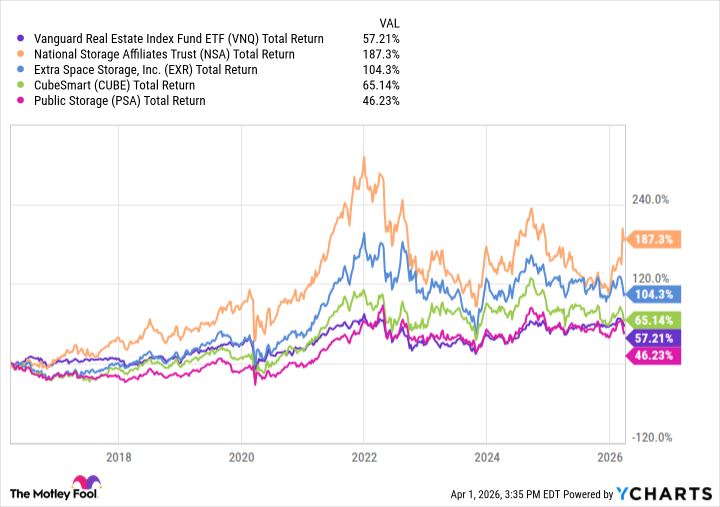
Self-storage REITs have historically been great investments
Self-storage REITs benefit from a combination of lower costs, high demand, and short-term lease structures, which have enabled the sector to steadily increase income. That has helped the industry generate above-average total returns over the years. The ability to earn high returns makes self-storage REITs attractive options for real estate investors.
Related investing topics
FAQ
FAQ on self-storage REITs
About the Author

Matt DiLallo has positions in Public Storage. The Motley Fool has positions in and recommends Vanguard Real Estate ETF. The Motley Fool recommends Extra Space Storage. The Motley Fool has a disclosure policy.