If you're looking for a high-yield investment to add to your portfolio, you will definitely find Energy Transfer's (ET +0.28%) lofty 7.5% distribution yield to your liking. But can it set you up for a lifetime of income? That's a harder question to answer, given the history behind this midstream master limited partnership (MLP). Here's what you need to consider before you buy it.
What does Energy Transfer do?
As noted, Energy Transfer is a midstream master limited partnership. MLPs are designed to pass income on to unitholders in a tax-advantaged manner, since some of the income is likely to be classified as a return of capital. That reduces the cost basis of the investment, delaying taxes until the units are sold. Effectively, you will likely pay lower capital gains tax rates when taxes are eventually paid on the distributions, because they lowered your cost basis.
From this perspective, Energy Transfer is a fairly attractive income investment. But it's important to note that MLPs don't play nicely with tax-advantaged retirement accounts, and they require unitholders to deal with a special tax form, known as a K-1.

Image source: Getty Images.
On the business side of things, Energy Transfer operates in the most stable segment of the energy sector. It owns infrastructure assets that connect the upstream (energy production) to the downstream (chemicals and refining) and the rest of the world. Think things like pipelines, though the list also includes storage, transportation, and processing assets. The key feature is that Energy Transfer largely charges fees for the use of its assets, so the price of the commodities flowing through its system isn't hugely important to its financial results. Roughly 90% of adjusted earnings before interest, taxes, depreciation, and amortization (EBITDA) is derived from fees.
Energy Transfer is one of the largest midstream operators in North America, with a nearly $60 billion market cap. The business is also well diversified, with operations across natural gas, oil, and refined products. That said, it is also the general partner for two other public MLPs, which adds a bit of complexity. But the relationship with those two businesses only represents about 15% of adjusted EBITDA.
From a business perspective, Energy Transfer looks like an attractive investment. To add to the allure, it is growing its operations. It has multiple expansion projects in the works as part of a roughly $5 billion capital investment program in 2025.

NYSE: ET
Key Data Points
The problem with Energy Transfer
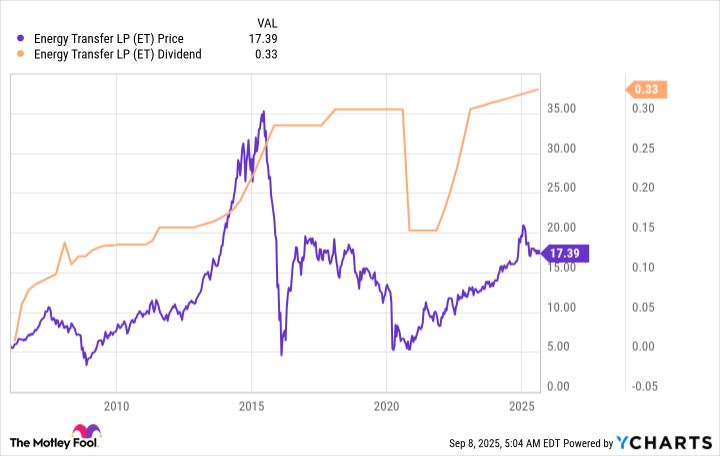
There is absolutely no reason to believe that Energy Transfer's distribution is at risk of being cut. In fact, given the fact that second-quarter 2025 adjusted funds available for distribution covered the distribution by 1.7x, it seems far more likely that the distribution will be increased. Yet investors still have to tread with caution.
In 2020, during the energy downturn that occurred at the time of the coronavirus pandemic, Energy Transfer cut its distribution by 50%. During the 2016 energy sector downturn, Energy Transfer ended up initiating a merger and then getting cold feet. It managed to scuttle the deal, which management said could lead to a dividend cut, but it requires issuing troubling convertible securities.
Those securities, which the CEO at the time bought a lot of, appear as if they would have protected the holders from a dividend cut if it was needed. A cut never took place, but given both events, conservative investors might have questions about the priority the board of directors places on the interests of unitholders.
Overall, Energy Transfer's current business looks well positioned. But this investment comes with material baggage that similar investments don't. For example, Enterprise Products Partners (EPD -0.59%) has a nearly 6.9% yield, has increased its distribution for 26 years, and has no history of troubled mergers similar to what has happened with Energy Transfer.
Energy Transfer could pay you for life
Energy Transfer will likely provide unitholders with a lifetime of income. But that doesn't mean it will be a smooth ride, or that you wouldn't be better off with a different investment. Enterprise Products Partners will require you to give up some yield, but more conservative income investors will probably be happier owning it. If you do buy Energy Transfer, just make sure you pay close attention to the investment -- it has a history filled with distasteful surprises.