Palantir Technologies (PLTR 1.90%) has been on an unbelievable run over the past few years. Its stock rose 167% in 2023, 341% in 2024, and about 120% so far in 2025. Few stocks can double year after year, but that's exactly what Palantir has done.
Despite three consecutive years of impressive growth, investors are still expecting Palantir to move higher over the next five years, as its growth has been nothing short of incredible. Some are even calling for it to be worth $1 trillion or more. But where will Palantir's stock price end up by 2030? Let's find out.
Image source: Getty Images.
Palantir's software platform is becoming quite popular
Palantir's artificial intelligence (AI)-powered data analytics platform originally started off intended to be used for government purposes only. Eventually, Palantir expanded its software into the commercial realm, where it has seen fantastic adoption as well.
Although government revenue is still Palantir's largest segment, the commercial sector is growing at a faster clip. In Q3, commercial revenue rose at a 73% pace to $548 million, while government revenue rose at a 55% pace to $633 million.

NASDAQ: PLTR
Key Data Points
Those are impressive growth rates for any company, let alone one of Palantir's size. A lot of Palantir's success has to do with its AIP product line, which allows users to integrate generative AI technologies into workflows. This allows full automation of some tasks and partial automation of others, dramatically improving the productivity of companies that deploy it.
Palantir has relatively few clients, with 530 U.S. commercial customers. That leaves plenty of room for expansion, which gets investors excited about the future of Palantir.
With a huge growth runway and a leading product in one of the most important technological revolutions mankind has ever experienced, Palantir seems like a no-brainer investment. But after looking at what kind of growth is needed to sustain its stock price, investors may want to think twice about investing in it.
Palantir has several years' worth of growth baked into its stock price
Over the past 12 months, Palantir has generated $3.89 billion in revenue. During its most recent quarter, its revenue growth rate totaled 63% with a net income margin of 40%. If we project that Palantir can sustain a 60% growth rate and achieve a 40% profit margin at the end of 2030, that would indicate Palantir's revenue would total $40.8 billion, and profits would be $16.3 billion.
That's incredible growth if Palantir could sustain it over the next five years, but what would that indicate its stock price will be?
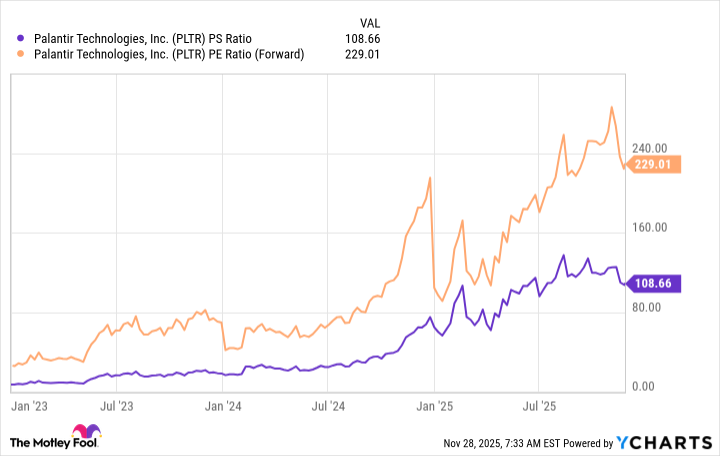
First, we need to assign a reasonable valuation multiple to the stock. Right now, Palantir trades for 109 times sales and 229 times forward earnings.
PLTR PS Ratio data by YCharts
Those are valuation levels seldom reached by any stock, let alone one that is only growing its revenue 60% year over year. Normally, those levels require revenue to double or triple year over year, so to say Palantir's stock is overvalued may be an understatement.
Companies like Nvidia trade for 45 times trailing earnings, which I think is a fair end valuation for Palantir's stock. Should Palantir grow at a 60% pace for five years and achieve a 40% profit margin trading at a 45 times trailing earnings multiple, that would make Palantir's market cap about $733 billion. At today's current $395 billion market cap, it has a $165 stock price. That means, if the bull case comes true, Palantir's stock price would be $306.
While that may sound like a solid gain, it indicates 85% growth at a compound annual growth rate (CAGR) of 13%. That's slightly ahead of market pace, but it requires incredible growth that nobody is projecting.
For next year, Wall Street analysts project 40% growth. If Palantir falls short of the projected growth rate, the stock may underperform the market over the next five years (assuming 10% growth). It's also short of the $1 trillion threshold we're looking for.
As a result, Palantir's stock is incredibly risky, and I think investors should shy away from it, unless its price corrects to a more reasonable level in the short term.