Nvidia (NVDA 1.84%) is currently the world's largest company with a market cap nearing $4.4 trillion, followed by Apple (AAPL 0.31%) at around $4.2 billion, as of this writing. However, I think Alphabet (GOOGL 0.11%) (GOOG 0.06%) will take the top spot by the end of 2026.
Alphabet is currently the world's third-largest company with a market cap of around $3.9 trillion, just ahead of Microsoft (MSFT 1.19%) at $3.6 trillion. They are the only four companies with market caps above $3 trillion.
Let's dig into why Alphabet is poised to become the world's largest company by the end of next year.
Image source: Getty Images.
Alphabet is a market leader
Alphabet is actually already the world's most profitable tech company. Its trailing 12-month earnings of $124.5 billion and quarterly earnings of $35 billion are both tops among megacap tech names. From a trailing price-to-earnings (P/E) basis, it's also the cheapest of the group.
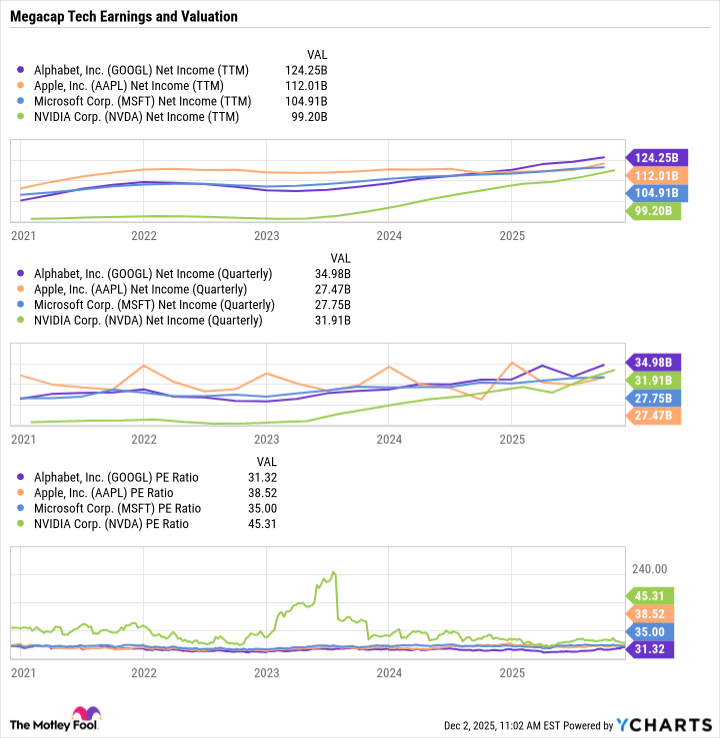
Data by YCharts.
However, stock prices are often about the future, and Alphabet has one of the brightest futures in big tech. What is so exciting about Alphabet is that it's the company that developed the best artificial intelligence (AI) tech stack. The company has taken a vertically integrated approach, which gives it an advantage that should only grow wider in the future.
Alphabet's big edge is that it has developed both its own top-tier custom AI chips and a world-class foundational large language model (LLM). No other company has a tech stock in these areas that is as far along as Alphabet.
In addition, it also has a top machine learning software platform in Vertex AI that helps create, train, and deploy custom AI models, usually based on its Gemini model, although it also supports third-party open-source models like Meta Platforms' Llama. It's also a storage and data analytics leader with Colossus and BigQuery, and it even has its own fiber network to reduce latency. Its pending acquisition of cloud security leader Wiz will only add to its full-stack solution.

NASDAQ: GOOGL
Key Data Points
The company's biggest advantage, though, is its custom AI chips, called tensor processing units (TPUs), which entered development more than a decade ago, and they are now in their seventh generation. The chips were optimized for Google Cloud's TensorFlow framework, and have been battle-tested running Alphabet's internal workloads. Having its own custom AI ASICs (application-specific integrated circuits) gives Alphabet a huge cost advantage both over rival cloud computing and AI model companies like OpenAI. It can just train models and run inference more cost-effectively both for itself and for customers.
This all helps Alphabet achieve a better return on its capital expenditure (capex) than competitors, who depend on Nvidia's more expensive graphics processing units (GPUs) to train their LLMs, creating a virtuous cycle. Lower costs and a better ROI (return on investment) lead to better products and solutions, which allow it to invest more into them, continuing to make them better.
Meanwhile, by developing its own world-class AI model, Alphabet captures a larger portion of the revenue and can integrate it into other products like Google Search. Today, AI-powered features, such as AI Mode and AI Overviews, are helping drive queries and search revenue growth. At the same time, with its massive ad network, few companies are as capable as monetizing search and AI discovery.
On top of that, Alphabet has other huge advantages. First and foremost is the huge distribution advantage the company has through its ownership of the Chrome browser and Android smartphone operating system, which both have over 70% market share. Throw in its revenue-sharing deal to be the default search engine on Apple devices, and Google is essentially the gateway to the internet for most people. It also has a data advantage, given its decades of search queries and YouTube video uploads.
The road to becoming the world's largest company
Alphabet is already the world's most profitable tech company, and as more investors start to recognize its position as the AI company to beat, the stock should have strong upside from here. Its valuation is reasonable, and it should be able to outpace its growth expectations next year.
That should help propel it to become the world's largest company by next year.