On Oct. 29, the S&P 500 hit an all-time high, reaching just over 6,890 (indexes are measured in points and not dollars like stocks or ETFs). As of the opening bell on Dec. 8, the index sits at 6,870, flirting with its all-time high.
On one hand, this has been great news for investors who've owned shares of an S&P 500 ETF along the way, and some have leaned into the momentum. On the other hand, some are growing concerned that the index's high valuation puts it at a higher risk of a correction or pullback.
As we head into 2026, should investors be excited or worried about where the S&P 500 stands? For most investors, it should be the former.

Image source: Getty Images.
Focus on consistency, not timing the market
Even if you're concerned about the S&P 500 experiencing a downturn soon, I wouldn't let that deter you from investing. Holding off may sound reasonable, but it can often be counterproductive. If anything, I would recommend using dollar-cost averaging.
When you dollar-cost average, you set a fixed amount to invest in a stock, put yourself on an investing schedule, and then make those regular investments regardless of the stock price at the time.
For example, if you decide you can invest $400 in an S&P 500 ETF, you may decide to invest $100 every Monday, $200 every other Friday, or the whole $400 on the first day of every month. The amount and intervals will depend on your personal situation and what makes sense for you, but the most important thing is to remain consistent.
It can be tempting to try to time the market -- waiting when you think prices are going to drop or rushing to invest when you think prices are going to rise -- but it's virtually impossible to do successfully on a consistent basis. When you dollar-cost average, you'll inevitably invest when stock prices are rising as well as falling. However, the idea is that it will even out over time and remove much of the stress along the way.
Being at an all-time high isn't inherently a reason for caution
Let's use the Vanguard S&P 500 ETF (VOO +0.04%) to show why the S&P 500 being near all-time highs isn't something to be worried about. This year alone, VOO has hit all-time highs numerous times, yet it has continued to grow after each one (except the latest on Oct. 29). Below are VOO's past five all-time high closing prices.
| Date | VOO's Closing Price |
|---|---|
| Oct. 29 | $631.95 |
| Oct. 8 | $618.77 |
| Sept. 22 | $614.76 |
| Aug. 28 | $596.52 |
| Aug. 14 | $592.85 |
Source: Google Finance.
When you're worried about investing in stocks while they're at or near all-time highs, think about it like stairs: You can't go up without stepping on the highest step up to that point. Just because a stock is at or near all-time highs doesn't mean it's destined to fall.
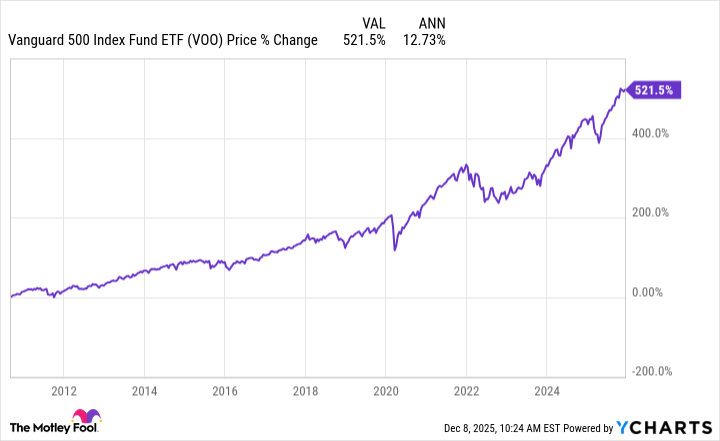
When you zoom out, you can see why focusing strictly on the current price instead of the long-term trajectory isn't a wise move in most cases, especially when investing in an S&P 500 ETF like VOO.
A great long-term investment regardless of price
VOO is my largest holding going into 2026, and it'll likely always be my largest holding, barring some extreme, unforeseen event. The reason I'm a believer in VOO long-term is that it checks three major boxes for me: diversification, proven results, and low cost.
When I invest in VOO, I know I'm getting exposure to blue-chip stocks and some of the world's top companies from many sectors and industries. And I get to do so while only paying an expense ratio of 0.03%.

NYSEMKT: VOO
Key Data Points
I'm well aware of the volatility that comes with investing in any stock, and that the S&P 500 is at one of its highest valuations in history. However, my focus is on the long term. When you approach investing with that mindset, it makes it much easier not to focus on whether current prices are cause for concern and instead to be excited about the long-term potential.