Oracle (ORCL 4.57%) got pummeled after reporting earnings on Dec. 10.
The tech giant reported an impressive 54% increase in non-GAAP earnings per share and record remaining performance obligations (RPO) of $523 billion.
The results were excellent, but still weren't enough to overcome investor concerns about Oracle's aggressive spending on artificial intelligence (AI) infrastructure.
Here's why Oracle's spending is so extreme, and whether investors should buy the growth stock in 2026 anyway.

Image source: Getty Images.
Oracle's spending is overshadowing its excellent results
In its latest quarter, Oracle booked $7.98 billion in cloud (application and infrastructure) revenue and $5.88 billion in software revenue (legacy database services). With $3.99 billion in cloud and software operating expenses, its operating margin there is sky high at 71.2%. And 14% of Oracle's revenue came from hardware and services.
Cloud is Oracle's fastest-growing segment and now makes up over half of revenue. But it's a mistake to overlook the strength of Oracle's legacy software business, which continues to contribute a significant amount of reliable earnings.
Yet what has Oracle's investors concerned is the company's spending.
In the first half of 2025, Oracle spent a mind-numbing $20.54 billion on capital expenditures (capex) -- leaving Oracle with negative $10.33 billion in free cash flow (FCF). Oracle is also spending over $1 billion a quarter on interest expenses due to its mounting debt.

NYSE: ORCL
Key Data Points
The future of cloud infrastructure for AI applications
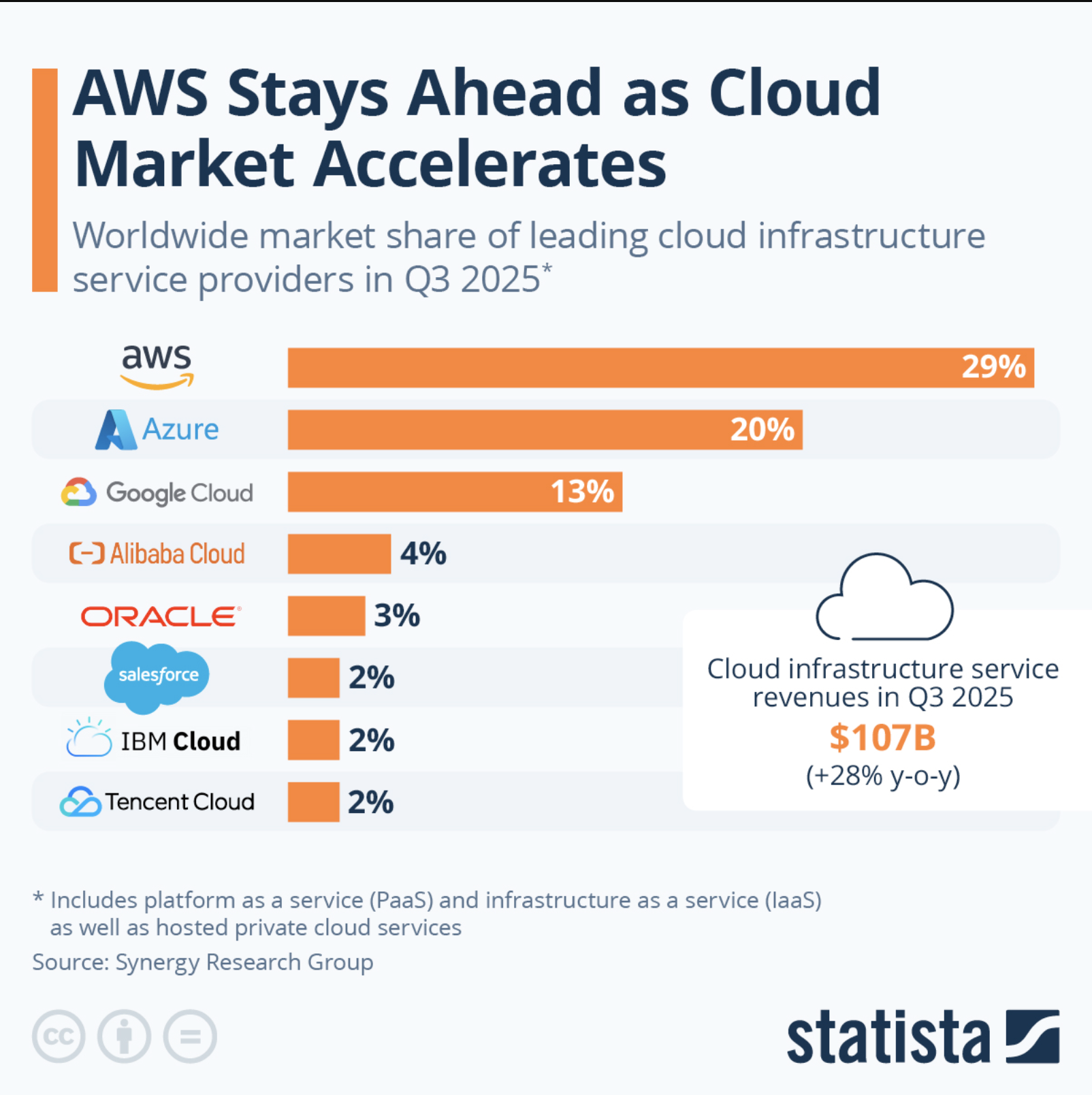
Oracle's business model is drastically different from other cloud giants. Amazon, Microsoft, and Alphabet generate gobs of FCF. They don't need to turn to the debt markets to fund AI capex. While Amazon Web Services is Amazon's main growth driver, Microsoft's Intelligent Cloud segment contributed 35.3% of operating income in its latest quarter. Meanwhile, Google Cloud is a minor contributor to Alphabet's cash flow, as AI investments are primarily funded from services such as Google Search and YouTube.
Oracle's spending on cloud is so massive that it can't rely on cash flows from its legacy software business alone. In other words, Oracle is spending out of its weight class as it both competes with and works with its bigger peers by embedding Oracle database services into AWS, Azure, and Google Cloud. On its latest earnings call, Oracle stated that it is more than halfway through building 72 multicloud data centers. With tons of spending still left, some investors may feel that Oracle is burning through cash unnecessarily quickly and taking on more than it can handle.
Oracle has fallen far enough
Oracle soared to new heights after its September earnings blew investors away with record cloud deals and a five-year runway for becoming the top cloud for AI by 2031. The stock has reversed course as investors realize the cost and uncertainty associated with those targets.
The good news for long-term investors is that Oracle's risks are already being factored into its valuation. If Oracle can convert RPO into real revenue, the stock could be a coiled spring for a recovery.
With Oracle, investors are getting a proven software-as-a-service company that is knocking on the door of transforming the big three cloud titans into the big four with OCI. With the stock beaten down big, now is a great time to scoop up shares just in time for the new year.