The semiconductor industry is highly cyclical, with profits soaring in the up years and then slumping in the down years. Consequently, it makes sense to keep a close eye on the cycle, as nobody wants to buy just before the down part of the cycle begins, and everybody wants to buy just before the up part of the cycle begins. There's reason to believe that Aehr Test Systems (AEHR 5.22%) is in the latter group, and it could be set for many years of growth. Here's why.
Near-term growth, long-term growth
Aehr Test Systems provides test solutions for "testing, burning-in, and stabilizing semiconductor devices in wafer level, singulated die, and package part form," according to its filings at the Securities and Exchange Commission. It has traditionally provided wafer-level burn-in (WLBI) test solutions to silicon carbide (SiC) chip manufacturers.

NASDAQ: AEHR
Key Data Points
Given that the SiC chip end market is dominated by electric vehicles (EVs), Aehr Test Systems' revenue has typically come from EV chipmakers, with ON Semiconductor (ON 1.66%) a key customer. It's a concentrated market, and Aehr's traditional customer mix has reflected that with five large customers accounting for 97%, 93% and 77% of total sales in fiscal 2023, 2024, and 2025, respectively.
It's also a market that experienced a boom when automakers rushed to accelerate investment during lockdowns and in response to government regulations aimed at encouraging EV adoption. Unfortunately, the market has slowed significantly as EV adoption hasn't picked up as the industry expected, and many automakers have scaled back their EV development plans.
This can be observed in the sales trajectories of ON Semiconductor and Aehr Test Systems.
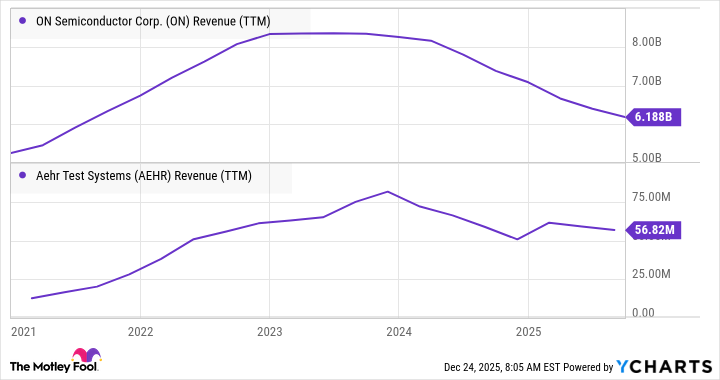
ON Revenue (TTM) data by YCharts
But here's the thing. Aehr is rapidly developing and growing a new line of business in WLBI test solutions for artificial intelligence (AI) processors, which will diversify its revenue stream and expose it to the fast-growing AI/data center end market.
An AI-related stock
Indeed, the company already has what management describes as "a world-leading hyperscaler" placing multiple orders, and "this customer has already outlined plans to expand capacity for this device and introduce new AI processors over the coming year to be tested and burned in on our Sonoma platform," according to Aehr's first-quarter 2026 earnings release (ending Aug. 29). Aehr also has a role to play in testing chips made for AI applications, such as in robots.

Image source: Getty Images.
There are three key arguments for buying Aehr stock now:
- Early stage semiconductor testing companies, such as Teradyne and Advantest, continue to report stronger-than-expected earnings and raise guidance, implying that later-stage companies like Aehr will see benefits in due course.
- The long-term demand is coming from Aehr's AI processor testing business.
- Stabilization and recovery in the traditional core EV SiC market are likely.
While stock price bubbles do have an impact on companies' ability and willingness to spend, it's far from clear that just because some AI-related companies trade at nosebleed valuations, there is a bubble in AI spending that will pop.
Regarding the EV SiC spending market, ON Semiconductor's management recently said the market was stabilizing, and the company's stock could appreciate substantially in 2026.

Image source: Getty Images.
Aehr Test Systems in 2026 and beyond
Teradyne and Advantest manufacture automated test systems to validate chips in the early production phases, making their performance a leading indicator of semiconductor spending. Both companies reported better-than-expected earnings in their last reports and raised guidance, with Teradyne citing strong growth in AI-application-led demand.
That's excellent news for Aehr, whose automated test solutions are used later in the cycle (when chipmakers want to test wafers for quality and reliability), and indicates strong growth down the line.
Wall Street analysts agree: They have revenue growing at 35% and 26% in fiscal 2027 and 2028, respectively, and if EV spending comes back and AI spending remains in growth mode, there could be more growth to come.