Dividend stocks might not grab the headlines like high-powered tech stocks or "the next big thing," but they can be just as lucrative for investors. With dividends, you're rewarded regardless of how a company's stock performs.
Instead of relying on one or just a few companies, investing in a dividend exchange-traded fund (ETF) can provide instant diversification without sacrificing returns. They can match the yields of some of your favorite stocks, while simultaneously being broad and reducing the risk that comes with investing in individual stocks.
If you have $2,000 available to invest, consider investing $1,000 into each of these two dividend ETFs that complement each other well.
Image source: Getty Images.
1. Charles Schwab U.S. Dividend Equity ETF
The Charles Schwab U.S. Dividend Equity ETF (SCHD +0.04%) has been a go-to dividend ETF for many since it hit the market in October 2011. It focuses on companies that generate reliable cash flow and pay stable dividends, acting as an effective stock filter for investors and ensuring it's not chasing high yields. Below are this ETF's top five most-represented sectors and notable companies in those sectors:
- Energy (19.34% of the ETF): Chevron, ConocoPhillips
- Consumer staples (18.50%): Coca-Cola, PepsiCo
- Health care (16.10%): Merck, AbbVie
- Industrials (12.28%): Lockheed Martin, United Parcel Service
- Financials (9.37%): Fifth Third, Regions Financial
At the time of this writing, The Schwab U.S. Dividend Equity ETF's dividend yield is around 3.6%, slightly above its average for the past five years. That's fairly high for a dividend ETF and more than three times the S&P 500 average.
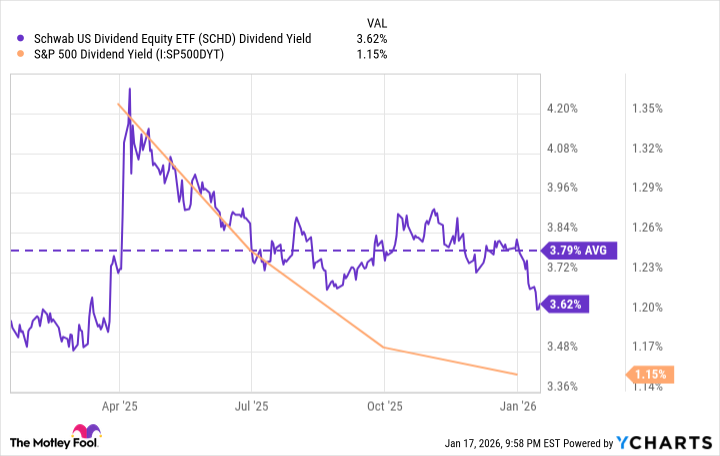
SCHD Dividend Yield data by YCharts.
The dividend will inevitably fluctuate, but if that yield were to stay consistent, it would pay out $36 annually per $1,000 invested. It might not be much on its own, but if you continue to reinvest it to buy more shares, it will accelerate the compounding effect.

NYSEMKT: SCHD
Key Data Points
2. Vanguard Dividend Appreciation ETF
While the Schwab ETF focuses on companies with strong fundamentals, the Vanguard Dividend Appreciation ETF (VIG +0.19%) focuses on companies that have consistently increased their annual dividend payouts (which often indicates strong fundamentals). The minimum number of consecutive years to make the cut is 10.
Since the ETF isn't solely focused on maximizing present-day income, it can include more high-growth companies than the Schwab ETF. That's why 27% of its holdings are tech companies, compared to 8% in the Schwab fund. These companies may not have average or above-average dividend yields, but they often grow payouts at a faster rate. Below are Vanguard Dividend Appreciation's top 10 holdings:
- Broadcom: 6.66% of ETF
- Microsoft: 4.41%
- Apple: 4.15%
- JPMorgan Chase: 4.06%
- Eli Lilly: 3.92%
- Visa: 2.54%
- ExxonMobil: 2.36%
- Johnson & Johnson: 2.29%
- Walmart: 2.25%
- Mastercard: 2.17%
The ETF's current dividend yield is only around 1.6%, slightly lower than its 1.8% average for the past decade. That's not much to brag about, but the actual payout has increased by 115% in that time. The actual payout will fluctuate quarter to quarter, but you can trust that, over time, its general direction will be up.
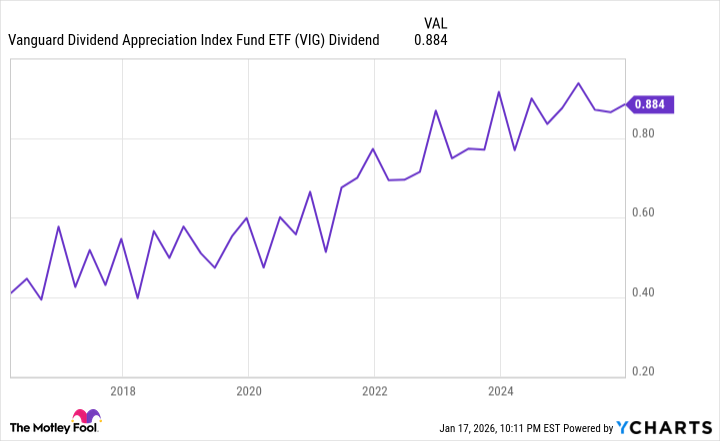
VIG Dividend data by YCharts.
A lot of ground covered with two ETFs
A good thing about these two ETFs is that there isn't as much overlap between them, so you can invest in both without worrying about being redundant. Between the Schwab ETF's 102 holdings and the Vanguard ETF's 342 holdings, only 29 overlap.
With the Schwab ETF, you know you're investing in vetted, high-quality companies. With Vanguard's, you know you're investing in companies that have committed to growing their dividends. That's a good 2-for-1 in the dividend world because it provides attractive immediate income and a path for that income to increase annually.

NYSEMKT: VIG
Key Data Points
If you're holding onto these ETFs for the long haul (which you should definitely consider), that's an attractive pairing.