Once a hot artificial intelligence (AI) stock, SoundHound AI (SOUN 5.18%) has cooled off. Shares reached a 52-week high of $22.17 in October, but the stock has since lost more than half its value.
SoundHound's high stock valuation last year contributed to its share price decline. So does this create a buy opportunity?

Image source: Getty Images.
A look into SoundHound's technology
SoundHound aspires to make voice conversations with AI easy and intuitive. The company has made great strides in this goal, resulting in compelling technology that's applied in interesting ways.
For instance, its agentic AI can be tailored to the unique business requirements of each client, such as by learning company-specific jargon. Customers include Walmart-owned TV manufacturer Vizio and restaurant chain Chipotle.
In January, SoundHound unveiled that its AI agents can be embedded in a variety of devices, such as cars and TVs, and can execute various voice commands, including ordering food and booking flights, hotels, and restaurant reservations.
In addition, SoundHound's platform can be integrated into a vehicle's camera system. This allows AI to "see" its surroundings and assist the driver with tasks such as calling a phone number on a billboard or identifying a nearby landmark.
The evolution of SoundHound's AI platform is a good sign, as it needs to keep pace with the changes happening in artificial intelligence. Tech companies, such as OpenAI, are pushing to make AI as potent as possible.
In fact, OpenAI seeks to achieve artificial general intelligence (AGI), a theoretical level of AI capable of thinking like a human in terms of creativity and problem-solving. OpenAI expects AGI systems to be smarter than humans. With that kind of technological advancement on the horizon, the long-term success of SoundHound's AI platform relies on continued, rapid innovation.

NASDAQ: SOUN
Key Data Points
Examining SoundHound's financials
A key part of SoundHound's strategy to build up its tech and business has been to acquire companies operating in voice AI. For instance, last September, it purchased Interactions, which specializes in agentic AI. These acquisitions contributed to third-quarter revenue rising 68% year over year to $42 million.
However, the acquired businesses added to operating expenses, resulting in a Q3 operating loss of $115.9 million, a 243% increase over the year-ago period. This becomes a concern if losses continue to mount.
SoundHound CFO Nitesh Sharan tried to reassure investors by explaining, "We are crossing the chasm to where we expect our inflows to exceed outflows."
He went on to say, "our early expectations for 2026 are to continue delivering high growth ... and we expect to do so with near break-even profitability levels." If Sharan's estimates are accurate, then SoundHound could be close to turning a corner with its financial health.
On the plus side, the company exited Q3 with a solid balance sheet. Total assets were $702.2 million with $268.9 million in cash and equivalents. Total liabilities were $303 million with no debt.
Is now the time to buy SoundHound stock?
Given its tech advancements and promise of improving financials, combined with its stock price drop, is SoundHound now a buy? To gain insight here, let's look at the stock's price-to-sales ratio (P/S), which measures how much investors are willing to pay for every dollar of revenue produced over the trailing 12 months.
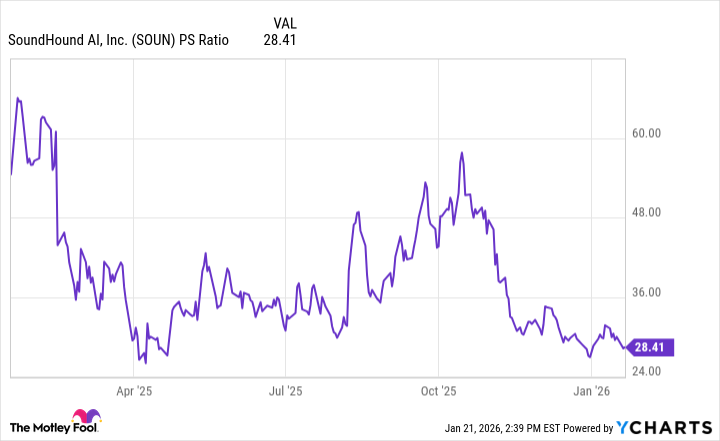
Data by YCharts.
The chart shows SoundHound's P/S multiple has dropped, and is now hovering around levels seen last April after the Trump administration's tariff announcement caused the stock market to plunge.
This suggests that now is not a bad time to consider picking up SoundHound shares, although a P/S ratio around 28 is still not cheap. Moreover, the stock is very volatile, as evidenced by its high beta of nearly three.
Therefore, SoundHound is not for the faint of heart. Only investors with a strong risk tolerance should consider buying shares.
Even then, because of its excessive operating costs, SoundHound is a high-risk, potentially high-reward stock. If it gets its financial health in shape and maintains technological progress, it could be an AI winner for investors over the long run.