Investors didn't seem to know what to think about ASML's (ASML +2.20%) fourth-quarter earnings report.
After the world's largest maker of semiconductor equipment reported that bookings more than doubled sequentially in its fourth quarter and gave bullish commentary, the stock jumped 5% in premarket trading. However, those gains quickly evaporated in the regular market session. It wasn't clear why, though valuation concerns may have played a role, as the stock had doubled in the last six months coming into the report.
While investors may have been unsure about what the news meant for ASML, the report was unequivocally bullish for the semiconductor industry.

Image source: Getty Images.
ASML's role in the chip industry
ASML represents the most upstream position in the chip sector. The company sell the machines that manufacturers like Taiwan Semiconductor use to make chips. Therefore, demand for its machines should be a leading indicator for production downstream, and that seems to be what's happening here.
Bookings in the quarter jumped from 5.4 billion euros in the third quarter to 13.2 billion, and full-year bookings rose 48% to 28 billion euros, outpacing full-year revenue growth at 16% to 32.7 billion euros.
CEO Christophe Fouquet said, "Over the past quarter, we have seen a notable increase and acceleration of capacity expansion
planning across the large majority of our customer base." He noted favorable dynamics in both logic and memory, the two segments the company serves, and said revenue from extreme ultraviolet lithography (EUV), its most advanced machine, would be up significantly due to growing demand for advanced logic and DRAM, a type of memory.
ASML shared a chart that shows how AI-driven growth is building momentum in the sector.
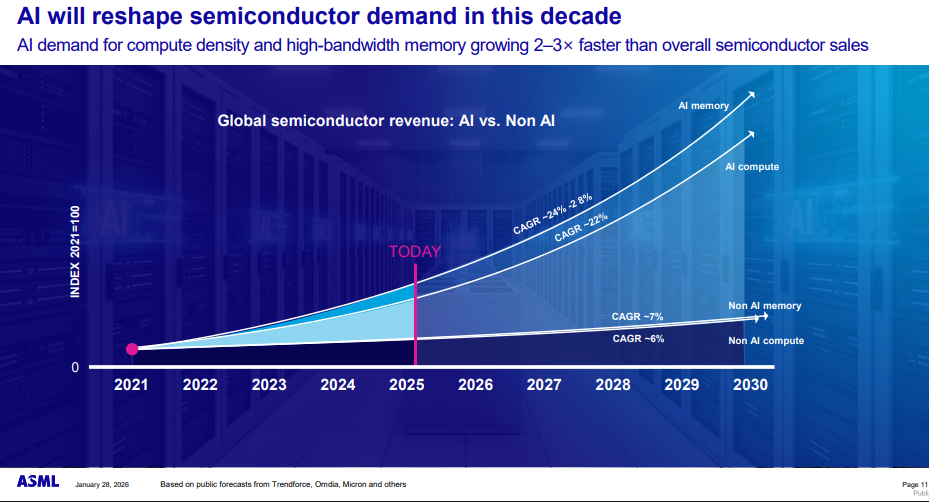
Image source: ASML.
As you can see, it's still very early in the expected impact from AI demand for both compute power and memory, and both segments are expected to be significantly larger in five years.
Why it's bullish for the chip sector
ASML's machines cost tens of millions, or even hundreds of millions of dollars, and its customers aren't going to buy them until they see demand tied to those chips, and that's exactly what we have now.

NASDAQ: ASML
Key Data Points
There's a supply shortage taking place in memory, and other corners of the chip sector, especially those related to AI, are constrained.
More advanced chips will require more advanced manufacturing equipment in a virtuous cycle that should flow through the semiconductor sector. While naysayers may bring up concerns about a bubble, ASML's demand is real and being driven by rapidly growing demand for AI computing power.