Autonomous driving and fully driverless robotaxis could be the future of automotive transportation -- and that future is coming fast. A recent report from McKinsey predicts that 2030 could be the year when robotaxis achieve mass deployment around the world.
McKinsey defines a robotaxi as a "vehicle on demand" operating in urban areas with autonomous driving capabilities of Level 4 (able to function without a human driver ready to take over) or Level 5 (fully autonomous in any environment and conditions).
Several companies in the U.S. and internationally are developing driverless technologies. Alphabet (GOOGL 0.50%)(GOOG 0.29%) subsidiary Waymo and Tesla (TSLA +0.22%) are two of the most prominent domestic players trying to take the lead in the robotaxi race -- and one of them already has a big head start.

Image source: Getty Images.

NASDAQ: GOOGL
Key Data Points
More of Waymo's robotaxis are already on the road
Waymo is already serving lots of real customers in several metropolitan areas, including Atlanta, Los Angeles, and the San Francisco Bay Area, delivering over 1 million paid fully autonomous rides per month. In 2025, Waymo says it made over 14 million trips, more than tripling its ride volume from the previous year. The company plans to expand the service to 20 additional cities in 2026.
Tesla has gotten a lot of investor attention (and praise from its customers) for the Full Self Driving (FSD) technology it has installed in its cars, and it has started to roll out its own ride-hailing service, which it calls Tesla Robotaxi. S&P Global research predicts that Tesla could get $75 billion of revenue from robotaxis by 2030, which it forecasts would be 45% of the company's total vehicle-related revenue.
But as of January, Tesla's robotaxi service was only available in Austin, Texas, and in the San Francisco Bay Area, and most of those cars still had human safety supervisors on board ready to take the wheel if necessary. It says it intends to expand its service next to cities in Texas, Arizona, Florida, and Nevada. But at the moment, Waymo has more actual autonomous robotaxis in more markets.
Waymo might be a premium brand
On Monday, Waymo announced that it had raised $16 billion of new investment funding that puts a valuation of $126 billion on the company. Bloomberg reported that $13 billion of this investment round came from its parent, Alphabet. Other investors included venture capital firms Dragoneer Investment Group, DST Global, Sequoia Capital, and Andreessen Horowitz.
Waymo says it intends to use the funds to expand internationally to cities such as London and Tokyo. In its press release, the company describes itself as "a technology leader in the trillion dollar transportation market" that's ready to serve "exploding global demand for autonomous mobility."
A January study from Obi, a real-time aggregator of rideshare data, found that Waymo appeared to be building a reputation as a premium brand. The study noted that its rides in the San Francisco Bay Area are more expensive than those of rival services, but that people are still choosing it. The median Waymo ride was $17.25, compared to $14.94 for Uber, $12.99 for Lyft, and $7.39 for Tesla.
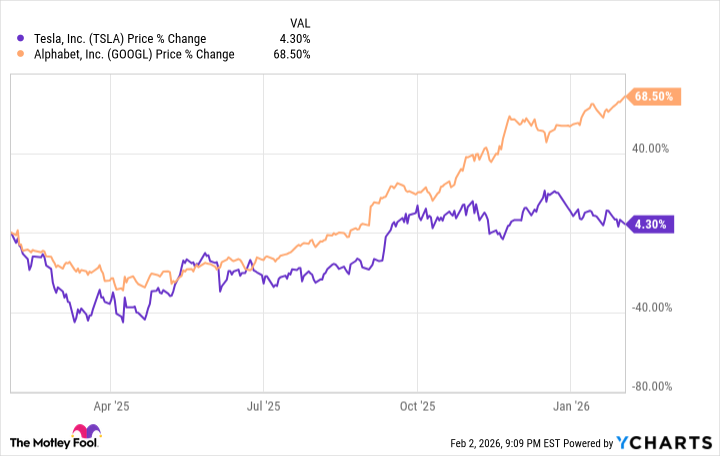
This early advantage in the robotaxi space isn't the only reason for Alphabet's strong stock performance recently, but it's worth noting that it has strongly outperformed Tesla in the past year.
Can Waymo ride out the possible risks?
There are still many risks and uncertainties on the road to a future where human drivers share the roads with large numbers of fully autonomous vehicles. All would-be robotaxi companies will have to meet exacting federal and state regulatory requirements. In addition, it's not clear yet how profitable robotaxi businesses will be, nor how long it will take them to reach profitability.
Bloomberg Intelligence estimates that "Waymo's per-vehicle costs are roughly two or three times higher than Tesla's," which could be holding back the Alphabet subsidiary's growth. Higher costs could also make it harder for Waymo. And people may lose some of their willingness to pay more for its rides as a premium experience. It's certainly possible that as competition intensifies, it will find it necessary to bring its prices and profit margins down. According to the Obi survey, the price gap between Waymo rides and traditional rideshare platforms has narrowed meaningfully this year.
But customers are quickly getting comfortable with robotaxis. In an Obi poll of people who live in states where at least one autonomous rideshare service operates, 63% of respondents said they're comfortable with autonomous vehicles (up from 35% in spring 2025), and nearly half said autonomous vehicles could become their primary rideshare choice in the future (up from 24% previously).
If I had to choose one of these stocks to buy today, it would be Alphabet. Waymo seems like a better bet than Tesla to wind up leading the way to the robotaxi future.