I wouldn't blame anyone for being confused by the tech sector's recent whipsaw movements. From shares of Microsoft cratering 10% on the same day that it reports a 60% jump in year-over-year profits, to shares of Apple falling despite the company beating analysts' expectations, the outlook for tech stocks feels especially murky today.
One solution, in the words of legendary investor John Bogle, would be to "buy the haystack" rather than trying to just find the needle. The Vanguard Group founder, whose teachings on the advantages of low-cost index funds created legions of fans, preached simplicity and diversification in capturing the market's long-term upside.

Image source: Getty Images.
It may seem counterintuitive, but casting a wide net and having exposure to hundreds of companies can position you for tremendous returns. After all, the S&P 500 index -- which tracks the performance of America's 500 largest public companies -- has returned 667% so far this century.
This approach will expose investors to plenty of losers, of course. But while the farthest that a stock can fall is 100%, others go on to return hundreds of thousands of percent or more. It's very rare, but that's where buying the haystack comes in. Anyone buying the S&P 500 in November 2001 would have gained exposure to Nvidia's 40,630% rise (ironically, it joined the index back then by replacing Enron).
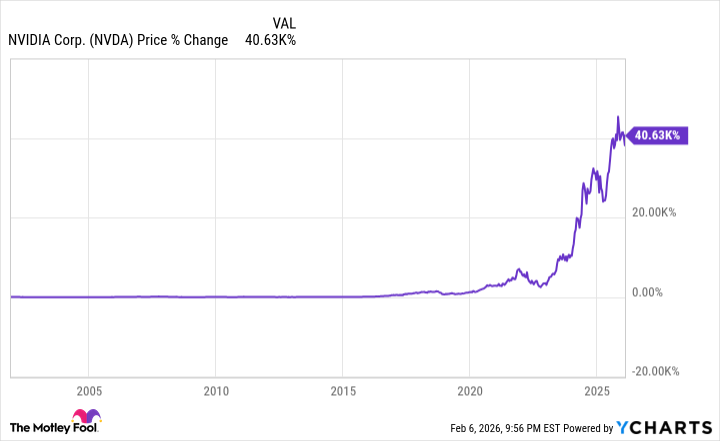
Data by YCharts.
Of course, the S&P 500 contains companies across every sector. For investors seeking exposure to technology, a fund to consider is the Vanguard Information Technology ETF (VGT 1.63%).
Buy the haystack for just 0.09% per year in fees
The Vanguard Information Technology ETF offers broad exposure to the information technology sector, with some of its biggest holdings including Nvidia with 17.5% of funds invested, Apple with 14.89% of funds invested, and Microsoft with 12.19% of funds invested.

NYSEMKT: VGT
Key Data Points
Despite these sizable positions, the fund counts 320 information technology stocks among its holdings. For this broad exposure, it charges an expense ratio of just 0.09%, meaning it takes $9 in fees annually for every $10,000 invested. For context, the average index equity ETF expense ratio 0.15% in 2023.
For long-term shareholders, this arrangement has paid off. The fund's average annual return of 13.96% since its 2004 inception would have turned every $10,000 invested into $177,236.
For investors who value simplicity, diversification, low fees, and the prospect of powerful long-term upside as the ongoing tech boom plays out, this fund is a buy.