Walmart (WMT +1.47%) has never been known as a high-margin company, but one fact has long been clear: The company brings in tons of revenue. With thousands of stores globally and a brand that resonates with all types of consumers, Walmart has been a premier cash cow for some time.
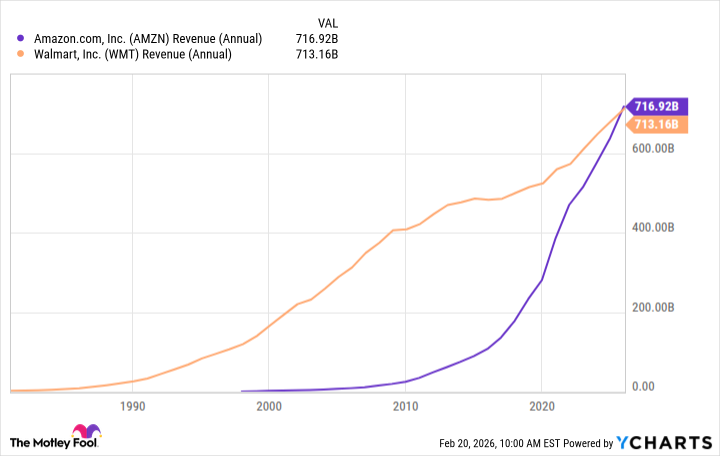
For the first time since 2009, though, Walmart's reign as the highest-revenue-generating company on the market has ended. In its fiscal year 2026 (ended Jan. 31), Walmart brought in $713.2 billion in revenue, just below the $716.9 billion that Amazon (AMZN 1.52%) brought in its latest fiscal year.
Image source: Walmart.
Should investors be worried?
The simple answer is no, investors shouldn't be worried. Amazon has also been a cash cow for a while, and with its revenue growth rate compared to Walmart's, it was bound to happen at some point. Walmart's revenue rose 4.7% year over year, while Amazon's rose 12.4%.
AMZN Revenue (Annual) data by YCharts
At Walmart's size and maturity, the difference in revenue growth isn't surprising. Retail growth naturally slows with size.
Walmart is more than just a retail store
In-store sales will always be Walmart's bread and butter, but it has been making impressive strides in higher-margin, non-retail businesses. Its membership and advertising businesses (Walmart Connect) are both becoming reliable sources of income.
Walmart's membership service, Walmart+, is its Amazon Prime competitor and gives it reliable recurring revenue. It will be hard for Walmart+ to compete with Prime's scale, but it's still a good segment for Walmart.
Walmart Connect is its advertising platform that businesses use to target customers across Walmart's website, app, and stores. It's the company's fastest-growing segment, with its U.S. arm reporting 41% year-over-year revenue growth in the past quarter.

NASDAQ: WMT
Key Data Points
One thing Amazon can't compete with is Walmart's retail footprint. The sheer number of stores across the country has allowed Walmart to gain ground in same-day deliveries (an area it can win and potentially convert Amazon customers). The company is expanding same-day deliveries to around 95% of the U.S., using its stores as fulfillment centers.
Investors should be excited about Walmart's working "pivot."
Investing in Walmart doesn't come cheap
As of Feb. 20, Walmart is trading at around 41.3 times its projected earnings for the next 12 months. It's no longer priced like a retail store; it's priced like a high-growth tech stock. In fact, the only "Magnificent Seven" stock that's more expensive is Tesla (198.2), and the next closest is Apple at 30.7.
Walmart is still a great long-term investment, but it's worth noting how expensive it is because that could slow near-term upside or make it more volatile.