Even the most dedicated income investors often avoid healthcare titles, especially those in the high-capital-expenditures pharmaceutical sector. As ever, though, we can find exceptions.
Here's a brief look at two that buck the sector's general trend by not only paying dividends regularly, but also raising them on a consistent basis. Say hello to AbbVie (ABBV +0.17%) and Bristol Myers Squibb (BMY +1.81%).
1. AbbVie
AbbVie is not only a steady and reliable dividend raiser, it's also a Dividend King -- one of the rare stocks that has done the raise dance at least once annually for a minimum of 50 years running -- albeit with an asterisk, as it's a spinoff from storied pharmaceutical company Abbott Laboratories.
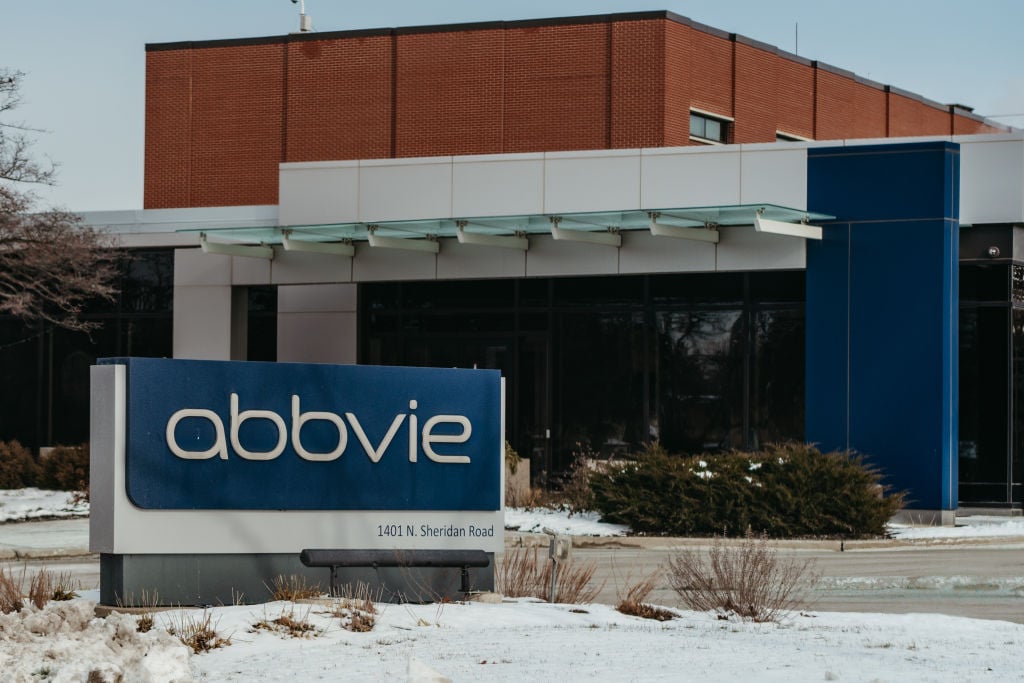
Image source: Getty Images.
Earlier this decade, investors were worried about AbbVie, since it was soon to lose patent exclusivity on the most successful product in its history: Humira, the blockbuster autoimmune drug. But AbbVie has a very effective and clever management team, and years before that patent cliff loomed, it prepared by bolstering its pipeline and making strategic acquisitions. Most notably, it brought to market a pair of next-generation treatments for autoimmune disorders, Skyrizi and Rinvoq, to supplant Humira.
These days, those two drugs are blockbusters in their own right, together comprising almost $7.4 billion in net revenue in AbbVie's fourth quarter alone. That was 44% of the company's total take for the period.
The company is hardly a two-trick pony. For example, its neuroscience portfolio, anchored by antipsychotic treatment Vraylar, rose a sturdy 18% year over year to produce net revenue of just under $3 billion.
With such fundamentals, AbbVie's free cash flow is strong and robust, and more than sufficient to keep its long dividend-raising streak alive. Said payout, dispensed quarterly at $1.73 per share, currently yields 3.4%.

NYSE: ABBV
Key Data Points
2. Bristol Myers Squibb
Bristol Myers Squibb (BMS) is facing some of the same patent-cliff challenges as AbbVie, particularly with cancer drugs like Revlimid and Opdivo. Its response is to innovate, particularly with that oncology lineup. Such drugs are part of the company's aptly named growth portfolio, a collection of medications that had its collective revenue zoom 16% year over year in the fourth quarter to almost $7.4 billion.

Image source: Getty Images.
This mitigated the performance of those approaching-the-cliff products, known as the legacy portfolio. Legacy's revenue shrank by 15% to $5.1 billion.
That portfolio will remain a drag. Management is guiding for annual revenue of $46 billion to $47.5 billion this year, down from 2025's $48.2 billion. Its estimate for net income not based on generally accepted accounting principles (non-GAAP) is $6.05 to $6.35 per share, which would be at best 3% higher than last year's figure. Yet those forecasts are well above the average analyst estimates.
Better, even if BMS experiences a pronounced slide in free cash flow (FCF), it shouldn't compromise the dividend. Last year's FCF was $12.8 billion, more than twice the $5 billion and change it needed to fund the disbursement. That, by the way, currently yields a (relatively) very high 4.4%.
Bristol Myers Squibb will surely survive the cliff, and the growth portfolio should get its key fundamentals heading north again. This isn't a stock for a quick rise anytime soon, but it's a great buy for patient, buy-and-hold investors.