I've been closely following the oil market for over a decade. Despite my extensive industry knowledge, I have no idea where oil prices will go from here. I can easily see a scenario where oil tops $200 a barrel if the war escalates and there are indefinite closures to the Strait of Hormuz and the Bab el-Mandeb Strait. However, I can also see a glimmer of hope for a peace deal that could send crude prices plunging toward $50.
Given all the uncertainty about where crude prices could head this month, I plan to focus on investing in energy stocks that will thrive in either scenario. Topping my list is Energy Transfer (ET 0.57%). Here's why it's the first energy stock I plan to buy in April.

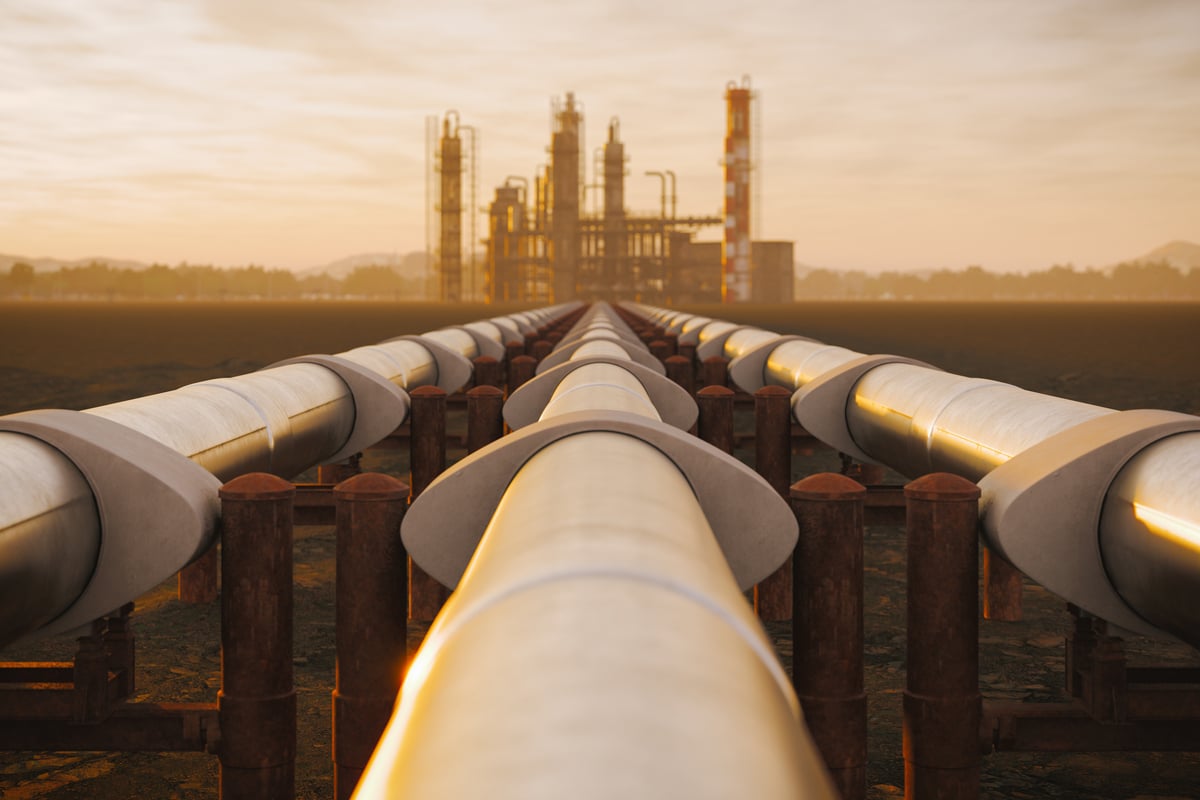
Image source: Getty Images.
Two catalysts if the war continues
Energy Transfer is in the volume business. The energy midstream company primarily collects fees as hydrocarbons flow through its pipeline system. Given the disruption to global energy supplies caused by the war with Iran, Energy Transfer should see higher volumes this year. Notably, the company's terminals should benefit from volumes flowing out of the Strategic Petroleum Reserve (SPR) to help meet global supply shortfalls. If oil prices continue rising, the U.S. could release more oil out of the SPR, while U.S. producers would likely ramp up their drilling activities, further boosting Energy Transfer's volumes.
The master limited partnership (MLP) had also been trying to develop a liquefied natural gas (LNG) export terminal at its Lake Charles site for years. It suspended development late last year to focus on higher-return natural gas pipeline expansion projects. However, the company has said it remains open to discussions with third parties interested in developing the project. That interest will likely grow the longer the war continues, especially if Iran damages additional LNG infrastructure in Qatar.

NYSE: ET
Key Data Points
Stability if crude prices fall
Energy Transfer also provides strong downside protection against lower oil prices. The midstream company primarily generates fee-based earnings (90% of its expected total this year). As a result, even if oil prices cratered on news of a Middle East peace deal, Energy Transfer's earnings wouldn't see much impact from those lower prices. The MLP's stable cash flow supports its high-yielding distribution (6.3% current yield).
Meanwhile, most of the company's growth is from natural gas. The MLP currently has several gas pipeline projects underway, including the $2.7 billion Hugh Brinson Pipeline, the $5.6 billion Transwestern Pipeline expansion project, and several projects to supply gas to new power plants and AI data centers. These commercially secured projects will grow the MLP's cash flow over the next several years, even if oil prices collapse and remain low. That supports its plan to increase its distribution by 3% to 5% per year.
Energy Transfer can win no matter where crude prices go
Energy Transfer generates stable cash flows, which support its high-yielding distribution. It can grow that payout at a 3% to 5% annual rate even if crude prices crash. Meanwhile, the company has a couple of upside catalysts if the war with Iran worsens. Energy Transfer's ability to thrive no matter what happens with the war is why it's the first energy stock I plan to buy this month.