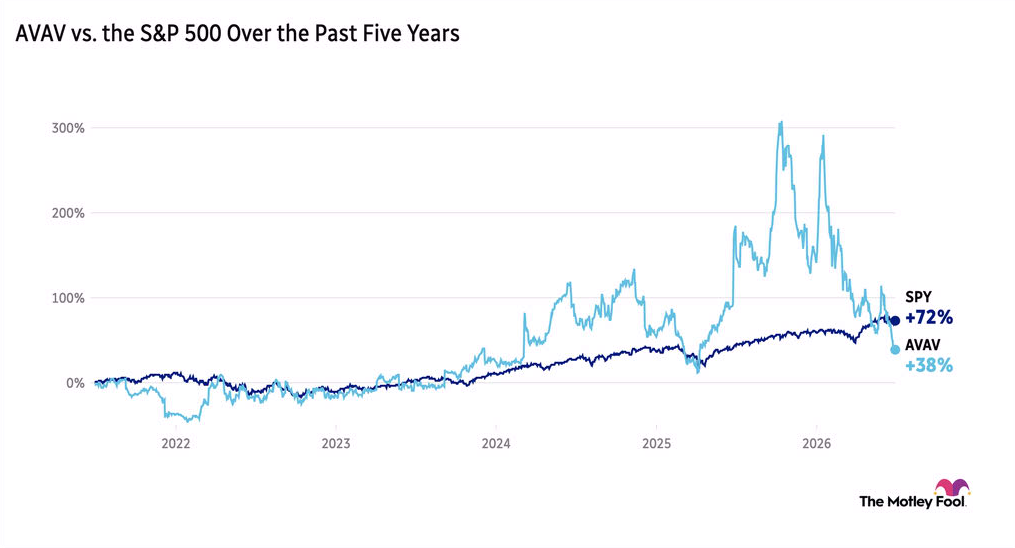
If you were asked what type of exchange-traded funds (ETFs) have beaten the S&P 500 over each of the past three years, you'd probably say one focused on AI stocks or semiconductors. While some of those funds would certainly qualify, there's one ETF that's pulled off the feat that doesn't play in that sandbox at all.
No tech. No semiconductors. No "Magnificent Seven." It invests almost exclusively in small- and mid-cap industrial stocks. And it's one of the best-performing ETFs in the entire marketplace over the past five years.
Image source: Getty Images.
How has manufacturing delivered huge returns?
The First Trust RBA American Industrial Renaissance ETF (AIRR +1.46%) focuses on a theme that's gotten big this decade -- reshoring. It's the idea that American companies will continue to bring their operations back to the United States in order to capture advantages in cost, quality, and timing.
This theme really got a lot of attention during the COVID-19 pandemic. As demand for goods rose and supply chains became strained, there was a strong push to bring manufacturing back home to reduce reliance on global trade partners.
Tariff policies under the second Trump administration significantly raised the cost of goods for U.S. importers. The intention there was to again bring manufacturing back to the United States.
Those efforts have increased some domestic manufacturing activity. U.S. manufacturing PMI readings, which largely showed contracting activity in 2023 and 2024, are showing steady expansion again in 2025 and the early part of 2026.

NASDAQ: AIRR
Key Data Points
AIRR captures the reshoring theme
This ETF tracks the Richard Bernstein Advisors American Industrial Renaissance Index. Beginning with the Russell 2500 index, which includes mid- and small-cap companies, it focuses only on infrastructure, manufacturing, transportation, and related service companies.
Companies must derive at least 75% of their revenue from U.S. companies, have a positive 12-month forward earnings estimate, and meet certain size and liquidity requirements. RBA then uses a proprietary portfolio optimization method to weight each individual qualifying component.
The fund consists mostly of industrial companies with a 7% allocation to community banks. Current top holdings include Argan, MasTec, Comfort Systems, Sterling Infrastructure, and EMCOR Group.
The focus on smaller companies makes sense. These are the companies that traditionally rely more heavily on cheap foreign manufacturers for inputs. They also have greater flexibility in moving their supply chains than large multinationals do.
AIRR vs. SPY: Comparing two ETFs
A breakdown of how the First Trust RBA American Industrial Renaissance ETF looks compared to the Vanguard S&P 500 ETF (VOO +1.60%) shows the following:
| Metric | AIRR | VOO |
|---|---|---|
| Strategy | Small- and mid-cap reshoring | Large-cap core exposure |
| 2023 return | +31.4% | +26.3% |
| 2024 return | +33.5% | +25% |
| 2025 return | +27.9% | +17.8% |
| Number of holdings | 52 | 504 |
| Expense ratio | 0.69% | 0.03% |
| Top sectors | Industrials (92%), financials (8%) | Tech (32%), financials (13%) |
Data sources: AIRR website and VOO website.
As with any niche ETF that has a long stretch of outperformance, there's a risk that future returns could be more moderate. Geopolitical risks are high right now, which supports the case for further reshoring, although the Supreme Court's ruling against most of the Trump tariffs may mitigate some of the financial appeal.
Overall, this could be a theme that has legs as the global economic and political environments grow more fractured over time.