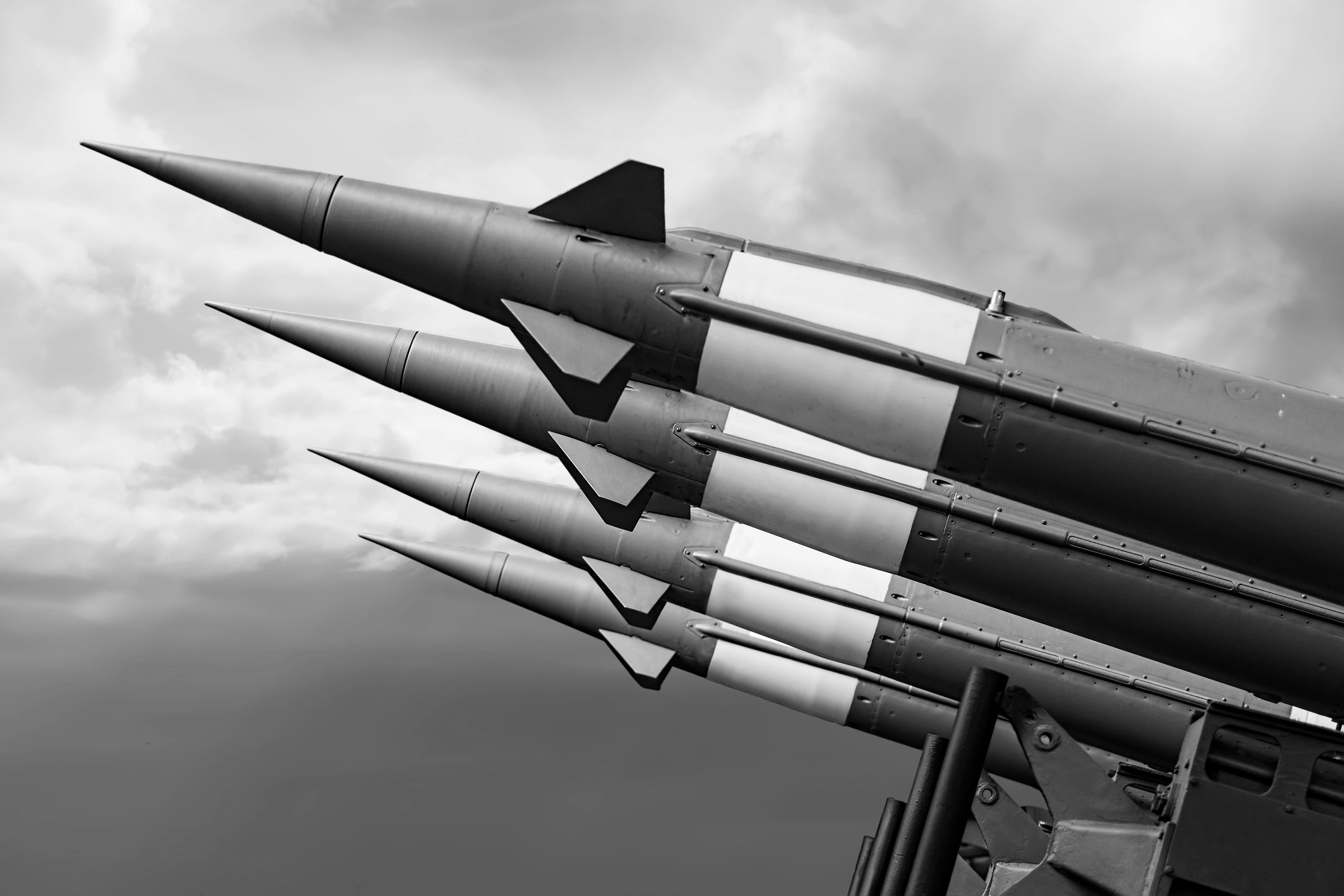
Wars aren't cheap. Thus, it may not surprise many people that President Donald Trump submitted his proposed 2027 budget this month, calling for a huge $500 billion increase for the Department of Defense. The proposed increase is to be partially offset by a 10% cut in non-defense spending. That would bring the sum allotted to the military to $1.5 trillion for the 2027 fiscal year.
Whether the military has $1 trillion or $1.5 trillion to spend in 2027, it's likely that a lot of money will flow to defense companies -- in this year, next year, and beyond. Here, then, are several promising defense stocks to consider for your long-term portfolio.

Image source: Getty Images.
1. Lockheed Martin
Lockheed Martin (LMT 0.94%), with a market cap of nearly $140 billion, is a major defense company. It's been around for more than 100 years (in one form or another) and employs more than 120,000 people around the globe. It rakes in around $20 billion annually from aeronautics, $14 billion from missiles and fire control, $17 billion from rotary and mission systems, and $13 billion from space projects.
One reason you might consider the company for your portfolio is that it pays a dividend yielding 2.2%. That shareholder reward rises to 4.3% when you add in the effect of stock buybacks. Another reason for consideration is its massive contract backlog, which hit a record value of $194 billion at the end of 2025.
Global unrest can result in increased orders for products such as the popular F-16 and F-35 fighter jets. For example, Greece is considering spending upwards of $4 billion on fighter jets from Lockheed.
2. Northrup Grumman
Northrup Grumman (NOC 0.80%), with a market cap of around $96 billion, notes that "As a national resource, our industry plays a critical role in supporting the warfighter to maintain global and economic stability and protect the security of America and its allies." The company employs more than 40,000 "mission-driven" engineers, and its operations include stealth bombers, nuclear missiles, and submarines, among other things. Its drones are another key product, including the MQ-4C Triton, which has an effective range of more than 8,000 nautical miles.
It, too, is a dividend payer yielding 1.4%, and its total yield, including share repurchases, totals 3%. It has upped its payout annually for more than 20 years in a row, raising it by 11% in 2025.
The company's fourth quarter featured revenue rising 10% year over year, and its backlog of orders also hit a new high of $96 billion.
3. iShares U.S. Aerospace & Defense ETF
My last suggestion is not exactly a stock -- it's an exchange-traded fund (ETF), which trades like a stock: the iShares U.S. Aerospace & Defense ETF (ITA +0.99%). This fund is a great choice if you're not that skilled at assessing the promise of defense stocks and you don't know which ones will perform best going forward. Buy some shares of this ETF, and you'll quickly be a part-owner of more than 40 defense and aerospace stocks, including Lockheed Martin, Northrup Grumman, GE Aerospace, RTX, Rocket Lab, and more.
The ETF has averaged annual gains of close to 16% over the past 10 and 25 years, and has averaged 28% over the past three years.
If military spending increases, these two stocks and this ETF are likely to do well. Of course, no one knows exactly what will happen in the coming few years.