It's hard for any individual stock or exchange-traded fund (ETF) to beat the market over the long-term. Trends change, investors move money around, and today's hot stock or must-buy ETF might fall out of favor and see its price decline. For that reason, most investors would do well to buy an S&P 500 ETF like the State Street SPDR Portfolio S&P 500 ETF (SPYM +1.66%).
But sometimes, investors want to have a sense of safety and earn steady income from stocks that pay dividends. If that's your investment strategy, you might consider buying the ProShares S&P 500 Dividend Aristocrats ETF (NOBL +0.11%). (The term Dividend Aristocrats® is a registered trademark of Standard & Poor's Financial Services LLC.)
Let's look at a few ways to choose between SPYM and NOBL -- and which stock ETF is the better buy for most long-term investors.

Image source: Getty Images.
SPYM: Buy the S&P 500 with a shockingly low fee
Sometimes keeping your investments simple, low-cost, and "plain vanilla" is a great way to build wealth. The State Street SPDR Portfolio S&P 500 ETF is a straightforward low-cost index fund that tracks the S&P 500 index. When you buy this ETF, there are no guarantees that it will make you rich anytime soon -- but you are guaranteed to earn almost exactly the same return as the S&P 500 index of America's 500 largest publicly traded companies.
The long-term average return of the S&P 500 is about 10% per year, with some big ups and downs along the way. If that sounds like a good enough deal for your long-term savings, this ETF will deliver it at a remarkably low fee. The fund's expense ratio is only 0.02%. That means that out of every $1,000 you invest in this fund, you'll only owe an annual fee of $0.20.
When you buy SPYM, you are effectively buying into all 500 stocks of the S&P 500. One criticism of the S&P 500 in recent years is that it's become too top-heavy with major tech names. However, if you look at the sector-by-sector breakdown of SPYM, about 66% of the fund's holdings are in non-tech stocks. This includes Financials (12.4% of the fund), Communication Services (10.6%), Consumer Discretionary (9.9%), and Industrials (9.2%).
SPYM has delivered slightly better returns than the S&P 500 long-term average. Since its inception in November 2005, SPYM has earned average annual returns (by net asset value) of 10.7% and 14.2% over the past 10 years.
NOBL: A stock ETF focused on dividends
Some investors are getting nervous about tech stocks and high valuations of the companies that lead the S&P 500. If you want to focus more on steady, well-established companies that pay consistent dividends, the ProShares S&P 500 Dividend Aristocrats ETF can deliver. The fund has a dividend yield of 2.55%.
This dividend stock ETF lets you own companies that have paid and grown their dividends for at least 25 years in a row. The fund owns 69 stocks. Its top holdings include Caterpillar, Target, Linde, ExxonMobil, and Air Products and Chemicals.
If you want an alternative to tech stocks, NOBL can provide it. This fund's top sector weightings are Consumer Staples (23.5% of the fund), Industrials (21.4%), Financials (12.2%), Materials (12.1%), and Health Care (9.96%). Information Technology stocks make up only 2.4% of the NOBL fund holdings.
Why buy SPYM instead of NOBL?
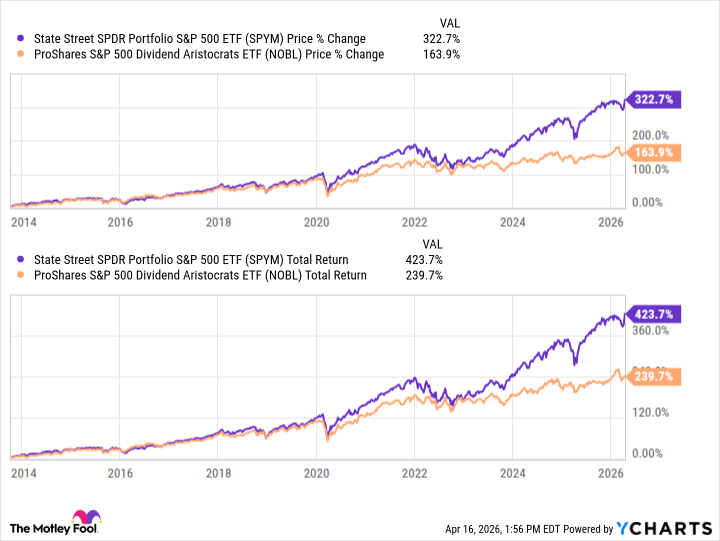
Past performance is no guarantee of future results, but for as long as it's been around, this dividend ETF has underperformed SPYM. Ever since NOBL was first launched in October 2013, it has gained about 164%. But during that time, SPYM has gained 323%. Given that NOBL is a dividend-focused investment, another measure for comparison better suited to these two would be total return (which includes dividends). But here too, SPYM outperforms with a total return of 424% compared to NOBL's 240%, over the same time frame.
Data by YCharts.
Since the fund's inception in October 2013, NOBL has delivered average annual returns of 10.4%. That's not bad, but it's lower than the long-term average of SPYM, which has gained an average of 10.7% per year since its inception in November 2005.
NOBL charges a higher fee -- its expense ratio is 0.35%. It hurts to pay extra for lower performance.
SPYM is also more diversified than NOBL. No matter how steady and reliable this collection of dividend stocks might be, it seems unlikely that 69 stocks will outperform 500 stocks over the long run. Based on past performance, low fees, and its diversified holdings, SPYM is likely a better buy than NOBL for most long-term investors.