It has been a decent start to the year for the S&P 500, up 7% as of Tuesday. Most of those gains have come since March 30 (it's up over 15% since then), but it's nice to have the index flirting with all-time highs again instead of approaching correction territory.
Although the S&P 500 and its performance rightfully get a lot of attention, one popular dividend exchange-traded fund (ETF) has delivered more impressive returns this year: the Schwab U.S. Dividend Equity ETF (SCHD 0.50%). It's up more than 15% at Tuesday's prices, and its appeal may be getting stronger by the day.
If you're looking to add a dividend ETF to your portfolio, it's one of the best options on the market.

Image source: Getty Images.
Finding value in a blue chip dividend ETF
SCHD is one of the gold standard dividend ETFs on the market because it applies stricter criteria to eligible companies than other dividend ETFs. Many dividend ETFs place a huge emphasis on dividend yield when selecting companies. SCHD emphasizes dividend stability and a company's financial health.
To be included in the Dow Jones U.S. Dividend 100 Index (which SCHD tracks), a company needs 10 consecutive years of dividend increases, good debt ratios, and reliable cash flow.
With many investors concerned about expensive tech stocks (which dominate the S&P 500), a potential artificial intelligence bubble, and the uncertainty surrounding the war in Iran, they have been seeking value in the stock market and turning to dividend stocks.
SCHD's top two holdings are tech stocks (Texas Instruments and Qualcomm), but the rest of its top holdings come from sectors like healthcare (Merck), consumer staples (Coca-Cola, PepsiCo), and energy (ConocoPhillips). These are industries that tend to be "safer" during economic uncertainty, making them good go-tos right now.
Here's how SCHD is divided by sector:
- Consumer staples: 19.39% of the ETF
- Healthcare: 18.82%
- Energy: 16.87%
- Industrials: 11.46%
- Information technology: 11.07%
- Financials: 9.01%
- Communication services: 6.92%
- Consumer discretionary: 6.42%
- Utilities: 0.04%
This makeup is very different from that of most major indexes, which has led to its overperformance so far this year.

NYSEMKT: SCHD
Key Data Points
Don't expect this year in and year out
Although it has outperformed so far this year, SCHD doesn't routinely outperform the S&P 500. In the past 10 years, SCHD's total returns (which take into account dividends) have been higher only three times:
| Year | S&P 500 Total Returns | SCHD Total Returns |
|---|---|---|
| 2025 | 17.9% | 14% |
| 2024 | 25% | 16.2% |
| 2023 | 26.3% | 4.5% |
| 2022 | (18.1%) | (3.2%) |
| 2021 | 28.7% | 29.9% |
| 2020 | 18.4% | 15.1% |
| 2019 | 31.5% | 27.3% |
| 2018 | (4.4%) | (5.6%) |
| 2017 | 21.8% | 21.1% |
| 2016 | 12% | 16.2% |
Data source: Slickcharts and YCharts.
The S&P 500 generally outperforms in years when the tech sector is flourishing, which has been most years over the past decade. Even so, you don't invest in SCHD expecting the gains of a growth ETF. It's an ETF you invest in when you want an attractive dividend yield and exposure to high-quality companies.
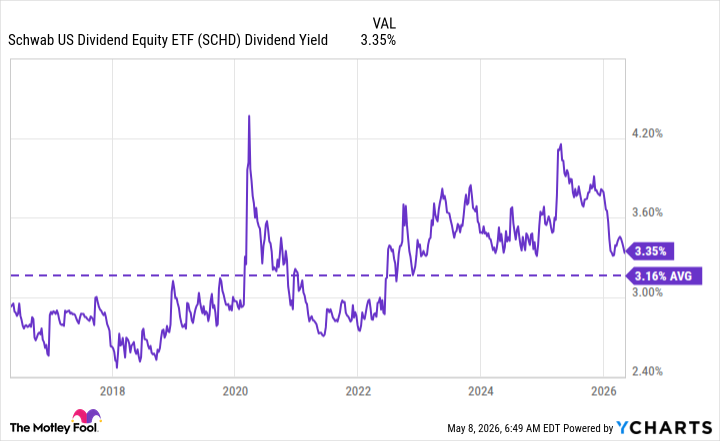
SCHD's dividend yield at recent prices was just above its 3.2% average over the past decade.
SCHD Dividend Yield data by YCharts
Is now a good time to invest in SCHD?
If you're looking for an ETF that routinely beats the market and invests in high-risk, high-reward stocks, then SCHD likely isn't a good choice for you. However, if you're a long-term investor seeking consistent income, it's a good time to invest in SCHD. It's a trifecta: attractive dividend yield, designed for stability, and cheap (0.06% expense ratio).
Since its October 2011 inception, SCHD has averaged 13.1% annual total returns. Past results don't guarantee future performance, and we can't predict its returns going forward, but that's an impressive track record for a broad ETF. If it were to continue at that average, consistent investments could snowball quickly into a nice nest egg.
If you don't need the cash payouts now, SCHD is a good dividend stock to reinvest payouts and focus on increasing shares, so your eventual payouts can be more lucrative.