April's inflation data is landing a lot like a brick through a window. Per the Consumer Price Index (CPI) data published May 12, prices rose 3.8% year over year, driven by a 17.9% surge in energy costs from the U.S.-Iran conflict, which is blocking oil shipments through the Strait of Hormuz. The official reading for core inflation, which strips out food and energy from the comprehensive inflation data, climbed to 2.8%, a bit above expectations.
These figures are, broadly speaking, bearish for the crypto sector, but Bitcoin (BTC -1.90%), Ethereum (ETH -3.34%), and Solana (SOL -5.97%) will each face the consequences somewhat differently, so let's dig in and analyze the situation.
Image source: Getty Images.
The liquidity picture just got uglier
Crypto thrives on cheap capital. When it's inexpensive to borrow money and investors have a glut of cash that's hunting for returns, riskier assets tend to benefit. But right now, the spigot could soon tighten.
The Federal Reserve has held its benchmark interest rate steady at 3.5% to 3.75% for three consecutive meetings. Traders are calculating that the probability of a rate hike is around 30% by this year's end, and analysts at Bank of America have pushed their first expected cut to mid-2027.

CRYPTO: BTC
Key Data Points
That matters a bit more for Ethereum and Solana than for Bitcoin. Both of those coins typically trade as risk-on assets, with no credible inflation-hedging narrative to lean on, like Bitcoin has.
But this is likely a case where perception is more important than reality. With the crypto sector's sentiment close to all-time lows over the most recent months, investors are, for the moment, fairly liable to believe anything that sounds bearish.
Bitcoin's "digital gold" exam isn't going well so far
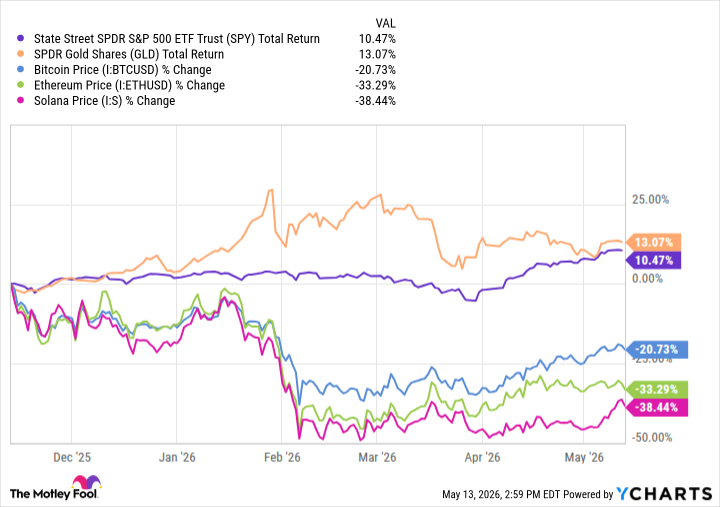
One added complication for crypto is that with the 2026 brand of inflation, driven by an energy supply shock rather than monetary expansion, gold has been the clear winner. The metal has a long history as being a scarce store of value, whereas Bitcoin is still a novice at the job as far as many investors are concerned.
Take a look at this chart:
SPY Total Return Level data by YCharts.
As you can see, presently, the "digital gold" or "inflation hedge" theses aren't dead so much as being stress-tested under conditions that favor tangible commodities over digital ones. If the energy shock eventually feeds into broader monetary loosening, Bitcoin's scarcity story could improve on a multiyear horizon. And it could perform well enough that the narrative is backed by data that makes it compelling once again. But that's an if, not a when.

CRYPTO: SOL
Key Data Points
For Ethereum and Solana, there is no equivalent upside, and thus the macro picture is darkening a bit for the near term. Their value depends on gaining traction with users and attracting capital to their networks, and neither is positioned to benefit from persistent inflation the way Bitcoin theoretically could. They likely need cheaper capital and a higher risk appetite to thrive.
So if you hold crypto, this is a moment for patience. Keep an eye out for bargains, and don't be afraid to keep accumulating Bitcoin.