In a recent disclosure from its latest 13F filing, Advanced Micro Devices (AMD +3.42%) revealed a new equity stake in Marvell Technology (MRVL +3.98%). Valued at roughly $6.5 million, the position is modest for a company of AMD's scale. Nevertheless, AMD's investment in Marvell carries symbolic weight.
It underscores that success in artificial intelligence (AI) is supported not only by raw compute power, but also by a web of connectivity that stitches clusters of AI accelerators into high-performance systems.
Let's examine Marvell's increasing relevance to AI and the strategic logic behind major engagement from graphics processing unit (GPU) architects. From there, we'll take a look at Marvell's valuation trends throughout 2026 to determine whether the stock is a smart buy right now.
Image source: The Motley Fool.
Marvell's importance to the AI chip stack
While the chip spotlight often falls on GPUs and Alphabet's Tensor Processing Units (TPUs), Marvell addresses an equally vital challenge in data movement. In AI training and inference clusters, the bottleneck has migrated from compute capacity to interconnect density, latency, and efficiency.
The big five AI hyperscalers -- Microsoft, Alphabet, Amazon, Meta Platforms, and Oracle -- are expected to pour nearly three-quarters of $1 trillion into capital expenditures (capex) in 2026 alone. As data center servers scale toward hundreds of thousands or even millions of GPUs and accelerators, every incremental improvement from interconnect power efficiency translates directly into higher compute use and lower cost of ownership.
These dynamics explain why Marvell's relevance is on the rise. The company's portfolio features a number of products tailored toward moving data at high speeds with minimal power consumption and latency. Marvell's core offerings include custom application-specific integrated circuits, high-performance Ethernet switches, data processing units, silicon photonics, and advanced digital signal processing technologies.

NASDAQ: AMD
Key Data Points
AMD isn't the only AI behemoth interested in Marvell
In late March, Nvidia announced that it had invested $2 billion in Marvell. As part of the deal, Nvidia is bringing its NVLink Fusion platform to Marvell in an effort to co-develop silicon photonics technologies and expand its AI infrastructure ecosystem. Now, barely a month later, AMD has disclosed its own equity position in Marvell.
I think these moves from Nvidia and AMD represent complementary motivations rooted in ecosystem flexibility. Neither company can single-handedly supply every layer of the AI chip stack. I think both Nvidia and AMD recognize that the infrastructure battle is expanding beyond GPU market share to a growing struggle over which architecture controls full AI factories.
While GPUs are purpose-built for parallel computation, big tech is increasingly demanding vendor-agnostic interconnect fabrics that allow seamless integration across different compute standards. Marvell offers a variety of infrastructure products that can be layered alongside both NVLink and emerging open alternatives like UALink, which AMD is co-developing with a number of partners.

Image source: Getty Images.
Is Marvell stock a buy after its 111% surge?
So far this year, Marvell stock has gained about 111% -- fueling significant valuation expansion and a premium forward price-to-earnings ratio of 47.
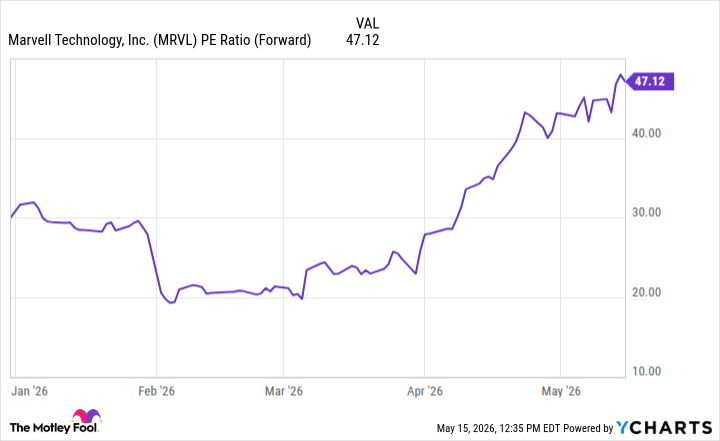
MRVL PE Ratio (Forward) data by YCharts
Nevertheless, Marvell's data center segment has tripled throughout the AI revolution. Meanwhile, Wall Street's forecast for fiscal 2027 revenue of nearly $11 billion and fiscal 2028 revenue approaching $15 billion reflects optimism that connectivity is not an afterthought in infrastructure buildouts but rather a product line supported by durable secular demand.
For investors focused on the multi-year AI infrastructure revolution, Marvell's setup remains attractive. The company is not selling GPUs in a winner-take-most market; rather, it is selling the picks and shovels for an entire chip gold rush.
While short-term volatility is likely, the underlying themes of larger AI models, accelerating hyperscaler capex, and the rise of connectivity as a new compute bottleneck make Marvell a potential compounder for the AI infrastructure era. For long-term investors willing to look past today's frothy valuation, Marvell offers a compelling way to participate in the physical backbone of AI networks.