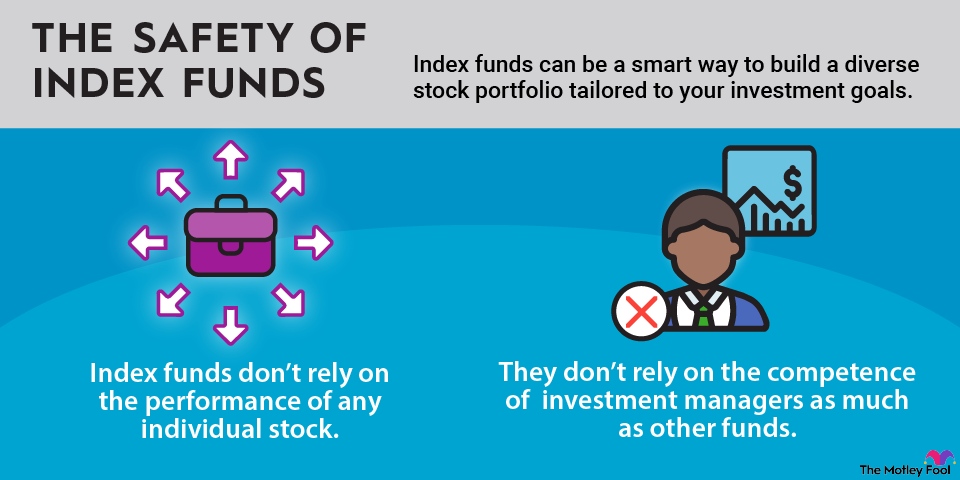
Tracking the S&P 500 has proven to be a great strategy for investors for decades. The index gives you exposure to the top stocks on the U.S. markets, allowing you to diversify while also benefiting from the growth in the overall economy.
The trouble today is that many index funds that track the S&P 500 may be vulnerable to how the most valuable stocks perform, including big names such as Nvidia, Apple, and Microsoft. And how those stocks do will inevitably be an indication of the health of the overall tech sector.
While investing in an index fund that tracks the S&P 500 can still be a good option if you're willing to hang on for decades, there may be a better alternative to consider these days, and that's the Vanguard Utilities ETF (VPU 0.44%).

Image source: Getty Images.
Why the Vanguard Utilities ETF can be a safer option than S&P 500 index funds
As its name suggests, the Vanguard Utilities ETF focuses on utility stocks. It doesn't have exposure to tech stocks, and that alone can instantly reduce arguably the biggest risk that comes with S&P 500 index funds these days. By focusing squarely on utilities, where companies typically generate stable and predictable financial results, the overall risk isn't that high for investors.
Consider 2022 as a prime example. That year, the stock market crashed due to rising inflation. The SPDR S&P 500 ETF, which tracks the S&P 500, was down more than 18%, and that's after factoring in dividends. Meanwhile, the Vanguard Utilities ETF generated total returns, which include its dividend payments, of just over 1%. While that isn't a terribly exciting return, it did nonetheless provide its investors with some safety at a time when the market was in a free fall.

NYSEMKT: VPU
Key Data Points
The Vanguard ETF can be a great investment to rely on for stability and dividends
At 2.5%, the Vanguard ETF's yield is higher than the S&P 500 average of 1.1%. This can give you some added incentive to add the fund to your portfolio today, because if nothing else, it can generate some terrific recurring income. The fund's expense ratio is also incredibly low at 0.09%, which is the equivalent of $9 in fees on a $10,000 investment.
Over the very long term, you may inevitably end up sacrificing gains in exchange for safety by going with the Vanguard Utilities ETF rather than a broader market index, but if your goal is to reduce your risk in the markets, it's an investment you'll want to consider right now.