The S&P 500 (^GSPC +1.18%) struggled in the early part of 2026 but has gone on to rally in recent months. It's up close to 11% thus far, and even if it maintained such a gain through to the end of the year, it would perform better than its historical average of 10%. If that happens, it will mark a fourth consecutive year where the S&P 500 has generated above-average returns.
But a lot hinges on how the economy is doing, or at least, how investors view things. And a lot of that is going to depend on economic data, such as inflation. On Thursday, the latest inflation numbers came out, and they weren't good, hitting their highest levels since late 2023. Here's why this could be a problem for the market.

Image source: Getty Images.
Inflation rose to 3.8% for April
A key number the Federal Reserve typically considers when making monetary policy decisions is the Personal Consumption Expenditures (PCE) inflation rate, which covers a broader range of expenditures than the Consumer Price Index (CPI). Data released on Thursday showed that in April, the PCE inflation rate was 3.8%, up from 3.5% in March. And Core PCE, which excludes food and energy, was 3.3% -- the highest it's been since November 2023.
Back then, inflation was on the way down, however, and investor sentiment was improving. Today, things are much different as consumers are more concerned about rising costs. Consumer sentiment hit a record low in May, falling even below levels it reached in 2022, when the stock market was crashing. It's yet another example of how there's been a disconnect between the economy and the stock market's overall performance. But whether that will continue to be the case is the big question moving forward.
Could the S&P 500 be due for a pullback later this year?
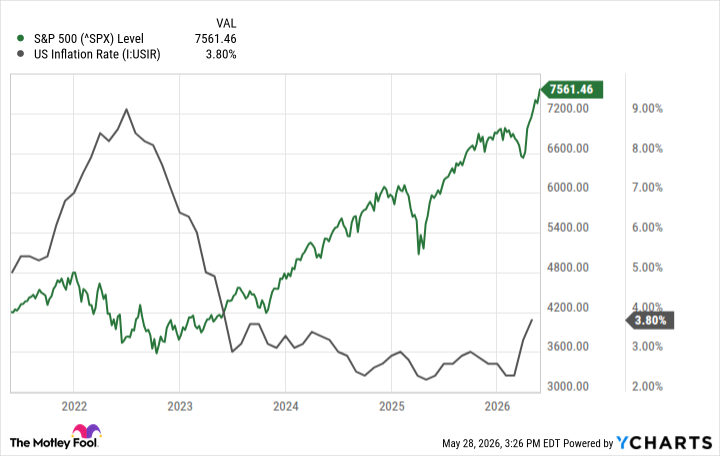
Generally, the stock market does well when inflation is low, and poorly when it's high, as is evident in the chart below. For now, it's still early, but it's a pattern worth watching. High inflation may lead to higher interest rates as the Fed seeks to slow the pace of price increases. That is a key reason why inflation data is so crucial, because if it's going in the wrong direction, the Fed may have no choice but to raise rates, which could weigh on stocks.
Given how hot the market has been in recent years, now may be a good time to consider reducing some of your risk. You can accomplish this by focusing more on dividend stocks and low-volatility investments, which may be less vulnerable to stock market swings.