Arguably no one in the investing world has bigger shoes to fill than Greg Abel, Warren Buffett's hand-picked successor to run Berkshire Hathaway, the large conglomerate that Buffett turned into a household name, delivering incredible market-crushing returns over many decades.
While no one expects Abel to be the next Buffett, as there truly is only one Warren Buffett, Abel is certainly operating under a microscope in his first year as CEO of the company.
In his first quarter on the job, Berkshire made some big changes to its massive portfolio, valued at roughly $332 billion.
Notably, Berkshire piled into a "Magnificent Seven" stock that multiple other prominent billionaire hedge fund managers chose to exit. Does Abel know something Wall Street doesn't?

Image source: Getty Images.
What does Abel see in this strong "Magnificent Seven" performer?
In the first quarter of the year, Berkshire more than tripled its position in Alphabet (GOOG -2.32%)(GOOGL -2.47%), mostly through class A voting shares.
That suddenly makes Alphabet, the parent of Google, the fifth-largest position in Berkshire's portfolio, now consuming roughly 6.7% of the portfolio. That's a big move for Abel and, seemingly, a departure from how Buffett invested, because it's an obvious bet on artificial intelligence.
Buffett was never afraid of new sectors and had held Apple as Berkshire's largest position by far for many years. While I expect Apple to benefit from AI, investors see it as having the weakest and least clear strategy among the Magnificent Seven.
Apple is not spending hundreds of billions on AI capital expenditures, which could prove wise if AI eventually stumbles.
Alphabet, on the other hand, is viewed as a hyperscaler and recently raised its capex guidance for this year to between $180 billion and $190 billion.
One would think that Buffett would hate this move because Buffett and his former right-hand man, Charlie Munger, Berkshire's former vice chairman, who died in 2023, always loved companies with strong free cash flow (FCF).
GOOGL Alphabet
NASDAQ · As of 4:00 PM ET 10/16/26

Capex eats into FCF, and Wall Street analysts now see Alphabet generating about $26 billion in FCF this year, down from more than $73 billion last year, according to data from Visible Alpha.
Of course, Buffett and Munger, viewed as some of the greatest investors of all time, also were not glued to one set of investing principles.
Alphabet likely offers a lot that they would have liked, too, and that Abel clearly likes as well. Alphabet currently dominates the traditional internet search market, with 85% to 90% market share, according to various sources.
While some were worried about how artificial intelligence chatbots would impact this sector, investors seem pleased with Alphabet's own large language models (LLMs), Gemini, which power Google's AI overviews and AI mode.
They believe this will help Alphabet protect its current moat. Furthermore, the U.S. Department of Justice (DOJ) sued Alphabet last year for monopolistic practices in its search and advertising businesses, and a federal judge agreed with the DOJ.
While Alphabet will face punishments that could make its grasp on the global search market more difficult to maintain, the fact that a federal judge called the company a monopoly likely played into Berkshire's investment thesis. Buffett always loved companies with strong moats and special brands.
Furthermore, Google operates other fast-growing businesses that have already built incredible moats, such as YouTube and Google Cloud. Other businesses like Waymo, its autonomous driving business, and its internal custom chip business, also have the potential to become powerhouse businesses.
Other funds sold Google, but perhaps more than one view can be right?
Interestingly, while Berkshire was accumulating shares of Alphabet, other famous billionaire hedge fund managers were selling their stakes.
Bill Ackman, who runs Pershing Square Capital Management, all but eliminated his stake in Alphabet, which the fund has held since 2023. Stanley Druckenmiller, who runs Duquesne Family Office, also dumped his stake.
Ackman, who is very outspoken on X, wrote: "To be clear, our sale of $GOOG was not a bet against the company. We are very bullish long term on Alphabet. But at current valuations and in light of our finite capital base, we used $GOOG as a source of funds for $MSFT."
Alphabet's stock has been on a heater, up close to 122% over the past year, during which time the valuation has expanded.
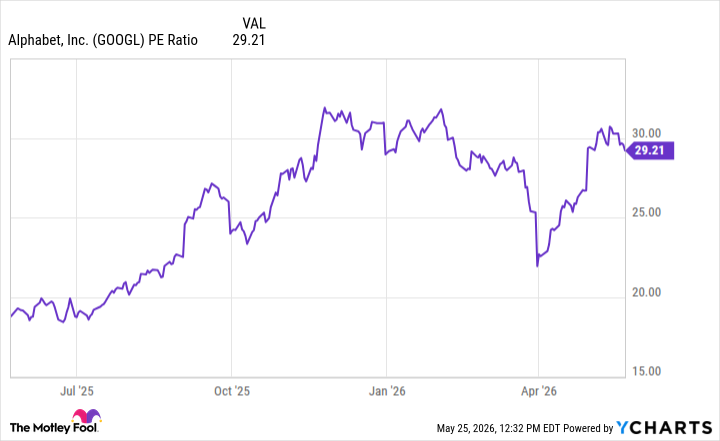
GOOGL PE Ratio data by YCharts
So, it seems Ackman and Pershing, which have a finite amount of capital, have done well with the stock and now see a better opportunity in Microsoft, which is driving the rotation. While we don't know, it's possible Druckenmiller and his team had a similar view.
Could Abel, Ackman, and Druckenmiller all be right?
It's certainly possible. While all three aren't your traditional hedge fund managers, it's common for a hedge fund to focus on shorter-term periods and do exactly what Ackman did: sell a strong performer in a peer group and buy the value play if it looks compelling.
After all, hedge funds are under pressure to beat the market because they charge high fees.
Buffett has always said he likes to buy stocks that he can hold forever.
While that doesn't always happen, it's possible that Abel and the Berkshire team view Alphabet as a forever stock, given its strong businesses, so all three of these prominent billionaires could have strong cases for the actions they took in the first quarter.