Times have become difficult for the stock of cybersecurity firm Zscaler (ZS +4.06%). The company, known for its zero-trust security, recently received downgrades from investment company Evercore ISI. This occurred following its earnings release for the third quarter of fiscal 2026 (ended April 30).
However, those moves also come as Zscaler stock trades at its lowest level since 2023. Amid such conditions, history shows this downgrade may ultimately be bullish, and here's why.

Image source: Getty Images.
The downgrade
Much of the negativity appears to stem from the fiscal Q3 earnings release. Investors did not react well to the projected annual recurring revenue (ARR) range of 16% to 17% for fiscal 2027, well below the 25% revenue growth in fiscal Q3.
Additionally, Zscaler revised its free cash flow margin projections for fiscal 2026 to 22.8% to 23.3%, down from the 26.5% to 27% range previously predicted. That came as the company raised its capital expenditures (capex), a metric that companies subtract from free cash flow calculations.
That news led to a 32% drop in the stock price in the following trading session. It was in that environment that Evercore analyst Peter Levine downgraded Zscaler from outperform to in-line.
In fairness, investors should probably reevaluate investments under such slowing conditions. Moreover, cybersecurity stocks like Zscaler face intense competition, making the company highly vulnerable to such slowdowns.

NASDAQ: ZS
Key Data Points
Nonetheless, the selling appears overdone. Zscaler stock has reached levels last seen in 2023.
Furthermore, while it continues to report net losses due to stock-based compensation expenses, its price-to-sales (P/S) ratio is below 7, well below those of its main competitors, CrowdStrike and Palo Alto Networks.
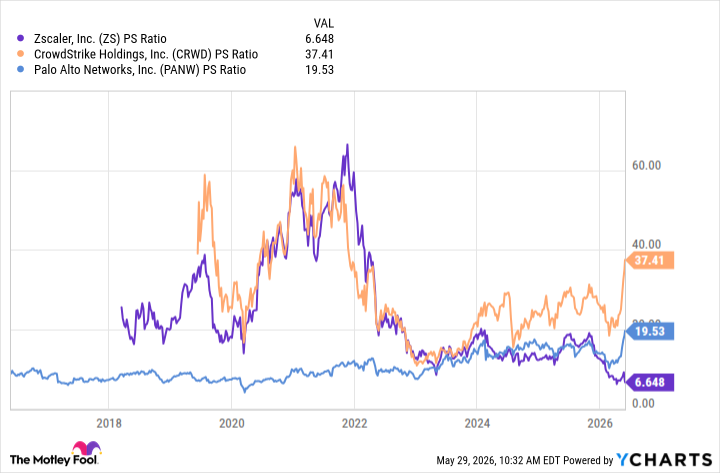
Data by YCharts.
Additionally, it so happens that these three cybersecurity stocks have risen after suffering downgrades. Morgan Stanley downgraded CrowdStrike in July 2025 from overweight to equal weight on valuation concerns. Though it fell in subsequent months, it is up by almost 50% since that downgrade.
Last November, HSBC downgraded Palo Alto Networks from hold to reduce on what it called a "sufficient, but not transformational" earnings report that month. That came after Palo Alto stock had struggled throughout 2025.
Still, investors eventually dismissed that negativity, and that stock has also risen by close to 50% since that announcement in November 2025.
Such history suggests that downgrades can have negative effects in the short term. However, investors tend to eventually take notice when investment analysts become overly pessimistic, which could eventually bode well for Zscaler stock.
Zscaler is a likely buy on a downgrade
Given Zscaler's current state and its stock, investors should probably consider adding shares following this downgrade. Indeed, amid a Zscaler sell-off, growth is slowing, and such slowdowns tend to be bad for stocks in the near term, particularly when downgrades follow.
Nonetheless, Zscaler remains on track for double-digit revenue growth. When coupled with a P/S ratio under 7, investors seem to have a bargain in Zscaler stock. Knowing that, you may want to buy before more investors take notice.