Shares of semiconductor equipment giant ASML Holdings (ASML +3.25%) rallied 24.3% in June, according to data from S&P Global Market Intelligence.
ASML didn't report any financial news during the month; however, there were numerous positive news items on ASML and semiconductor investment generally. Elon Musk visited the company's headquarters around the same time as Space Exploration Technologies' (SPCX +7.36%) initial public offering, as SpaceX has ambitions to become its own chipmaker.
Additionally, positive news and earnings reports from the memory sector increased expectations for memory production investment, with several Wall Street analysts increasing their expectations for wafer front-end (WFE) equipment investment amid the AI boom.

NASDAQ: ASML
Key Data Points
Musk gives ASML the thumb's-up
The month of June was dominated by the IPO of SpaceX, which proved to be a boon for many of SpaceX's vendors. It also proved a boon for many semiconductor equipment stocks, as the $86 billion or so raised from new shareholders could provide ample initial capital for Musk's Terafab project. Musk envisions Terfab as a massive semiconductor manufacturing entity co-owned by SpaceX and Tesla (TSLA +4.65%) to serve both companies' large future ambitions.
In mid-June, Musk spoke at ASML's technology conference, seemingly validating the Terafab vision as a real and viable project, not just a wish. Capacity for semiconductor equipment could become tight in the years to come, so Musk made sure to shower praise on ASML on X early in the month:
ASML should be treasured and supported. It is arguably the greatest company in Europe.
-- Elon Musk (@elonmusk) June 6, 2026
In addition to Terafab seemingly going from idea to a real project, demand from the memory industry appears to be going vertical. Memory chipmaker Micron Technology (MU -2.05%) held its fiscal third-quarter earnings release on June 24, absolutely trouncing expectations. Micron also raised its capital expenditures to $27 billion for the fiscal year, up from prior guidance of $25 billion.
Not to be outdone, on the last day of the month, Micron's rivals, Samsung and SK Hynix, announced a massive $520 billion in spending over several years to fund new greenfield memory plants.
Micron and all major memory producers are making extensive use of ASML's extreme ultraviolet lithography machines, so the increased capex guidance should be a big tailwind for ASML.
Towards the end of the month, semiconductor analysts at Wells Fargo raised their estimates for industry WFE spend to $190 billion in 2027 and $216 billion in 2028. For reference, this year is expected to be around $140 billion. Not to be outdone, analysts at Susquehanna increased their estimates of WFE even higher, believing that the industry could potentially reach $300 billion in 2028 as a result of increased pricing on the part of equipment vendors, as customers agree to price hikes to ensure supply.
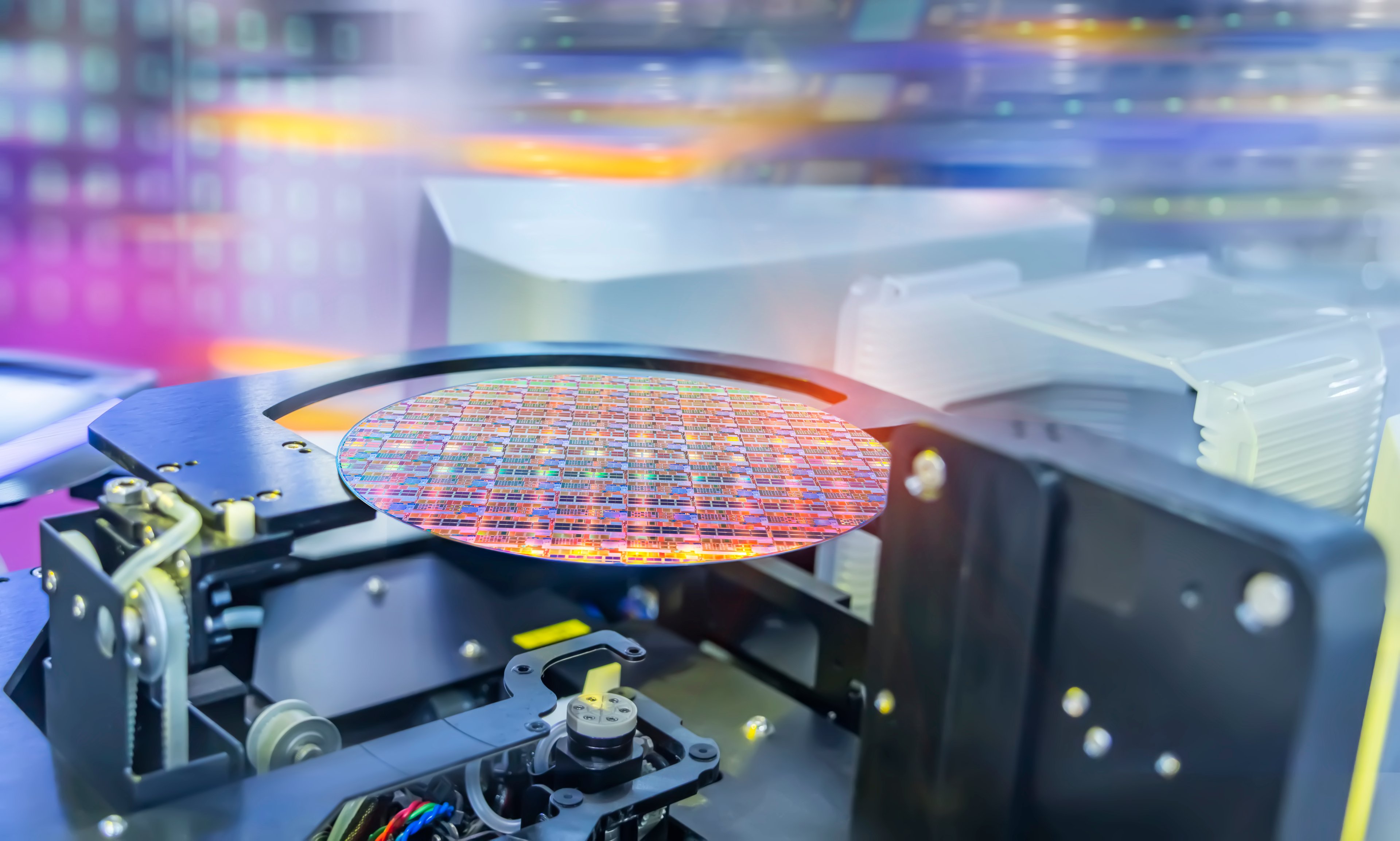
Image source: Getty Images.
ASML is a monopoly in a booming industry
At first glance, investors may view ASML's valuation, at 60 times earnings, and think the stock is very expensive. However, consider that ASML is essentially a monopoly, as the only company capable of building the extreme lithography machines needed to produce leading-edge logic and memory chips.
Not only is ASML a monopoly, but it's a monopoly in a booming industry with the advent of generative and agentic AI. If these analysts' estimates hold for the next few years, ASML's price might not be unreasonable at all.