The automotive industry has long been known for razor-thin margins, but that narrative is slowly changing as more subscription services and advanced software technology flood into vehicles. In fact, General Motors' (GM +2.56%) OnStar subscription services ended the second quarter with deferred revenue of $6.3 billion -- an almost 50% year-over-year increase. Those subscription sales come with far higher margins than its traditional automotive business, giving investors a new angle on an age-old industry and its potential.
Let's dig in and see how GM's digital strategy, as well as rival Ford Motor Company's (F +0.87%), could change the game for their investors.
What's going on?
Rather than pushing sales of its OnStar and Super Cruise services to consumers at the point of purchase, General Motors is going about it in a different way. The automaker is bundling long-term prepaid OnStar and Super Cruise trials into new vehicle purchase prices. All 2025 and newer models include eight years of OnStar Basics, and select equipped models include three years of hands-free Super Cruise and associated connected services.
The idea behind this strategy is simple: General Motors is essentially casting the widest possible net it can over consumers, hoping that in three or eight years' time, those consumers will have become so accustomed to having those services that they will opt to purchase them outright in their next vehicle or transition to paid monthly or yearly digital plans to keep those features in the existing vehicle.
So far, the results are encouraging, with General Motors reporting that retention rates were roughly 30% to 40% of drivers continuing to pay for Super Cruise after the three-year prepaid term.
If you're wondering what deferred revenue (that $6.3 billion) is, it's this: By bundling these multiyear trials into the upfront purchase of the vehicles, in accounting terms, this is revenue that General Motors has already collected during the vehicle purchase. But because a portion of the revenue is derived from OnStar services delivered each month throughout the trial, the automaker can't claim it as earned revenue until that time comes.
Make no mistake, deferred revenue isn't some imaginary pile of cash General Motors won't get a chance to utilize. Rather, think of it as a massive financial backlog that gives transparency to highly profitable upcoming revenue.

NYSE: GM
Key Data Points
Where GM goes from here
At the end of Q2, General Motors had $6.3 billion in deferred revenue and said it remains on pace to reach $7.5 billion in deferred revenue by the end of this year. Recognized revenue was $800 million during Q2, a 20% bump from the prior year, and it is on pace to recognize $3 billion through 2026. The rule of thumb is that these digital services like OnStar and Super Cruise check in with software-like gross profit margins, or roughly 70%. As an entire company, General Motors' gross profit margin fluctuated between 15% and 20% between 2020 and 2025.
General Motors is far from driving alone on this new path forward. Crosstown rival Ford Motor Company is doing something very similar with its BlueCruise -- also noted to deliver gross margins around 70%. Ford's BlueCruise subscription has an annual $495 price tag, or $49.99 monthly, and while it hasn't copied its rivals' upfront purchase strategy, it experienced an 88% rise in total hands-free miles driven globally last year and topped the half-billion, hands-free miles-driven threshold.
The major difference between the Detroit rivals is their strategies. As General Motors continues to cast its wide net, OnStar is expecting to add another 1 million subscribers in 2026 to reach nearly 13 million by year's end. Ford is experiencing rapid growth as demand increases, but without such a wide net as its rival, Ford brought its global total to 1.22 million vehicles with BlueCruise last year. At the end of 2025, it boasted an 80% increase in vehicles equipped from the prior year.
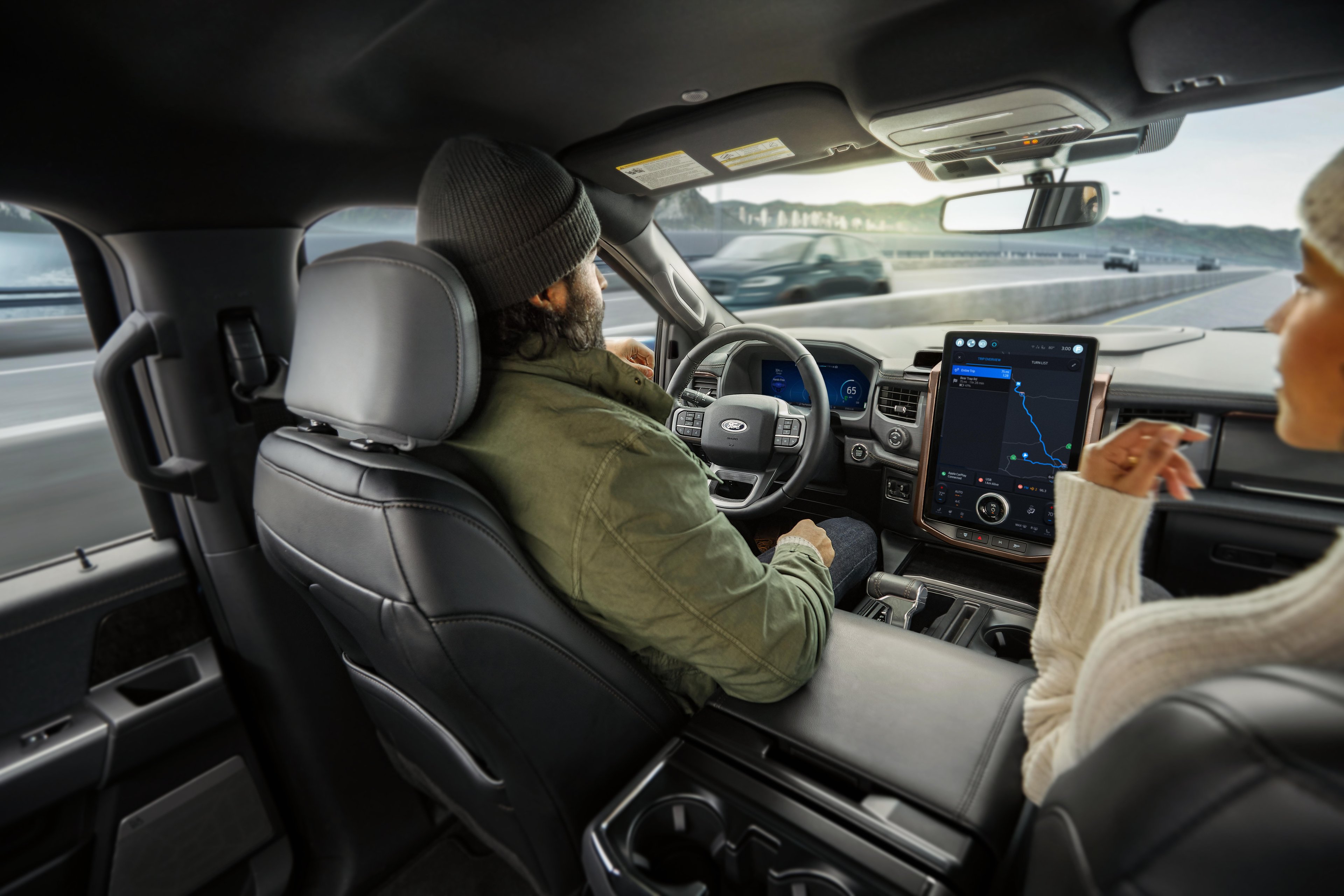
A BlueCruise-equipped vehicle. Image source: Ford Motor Company.
What it all means
General Motors and Ford Motor Company have already proven that demand exists for these services and have done enough business to show they can be lucrative, with high margins and solid retention rates. Investors would be wise to see this trend developing because these types of software and autonomous driving services are only going to get more common and desirable, especially as more software-advanced electric vehicles (EVs) hit the road, which long term can absolutely change the game and the razor-thin margin narrative the two Detroit icons have played for so long.