AMD (AMD -5.05%) stock has been on a roll in 2026, more than doubling in price so far this year. However, it has lost some value recently and is now about 15% down from the all-time high it set on June 30. The question is, is this pullback warranted, or does it present a smart opportunity to load up on AMD stock?
Let's take a look at how AMD is doing as a business relative to how it's priced, and then we can see if it's truly a stock worth buying at these levels.
Image source: The Motley Fool.
AMD's stock price has become uncoupled from its business
As a business, AMD appears to be gaining significant momentum. In the early days of the artificial intelligence boom, AMD didn't have a great graphics processing unit (GPU) offering, which cost it a chance to win more sales in the initial infrastructure build-out. While that's a piece of the market that will be nearly impossible to capture at this stage of the build-out, AMD has done a lot to capture new clients and establish itself as an alternative GPU manufacturer with solid products.

NASDAQ: AMD
Key Data Points
This has led to improved results, and AMD backed that up in Q2, with its data center division delivering impressive 107% year-over-year growth. AMD is a bit more diversified as a company than some rival chipmakers, as it also has a client and gaming division (primarily driven by consumer demand) and an embedded processor division. These two did OK, with revenue rising 6% and 19% in Q2, respectively. However, the data center growth is what investors are most focused on, and with it accelerating (in Q1, its growth was 57%), it's doing just fine.
Overall, AMD's revenue rose 50% year over year in Q2, with diluted earnings per share rising 156%. That's a solid figure, and any investors would be happy to own the stock with those results.
So, why has the stock slipped in the second half of 2026? I think it has more to do with the company's valuation than the actual business.
The problem with AMD's stock is that much of its expected growth is already priced in. AMD's trailing price-to-earnings (P/E) ratio is 124, and its forward P/E is 64. Those are some of the highest levels AMD has reached since 2025, and should give investors some concern about how much anticipated growth is already priced into the stock.
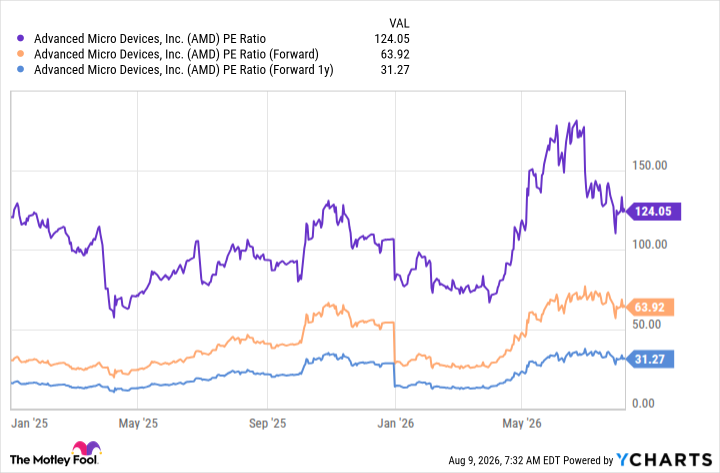
AMD PE Ratio data by YCharts.
Even if you factor in 2027's expected earnings, AMD isn't priced to move. If the chipmaker matches analysts' consensus estimates and the stock trades flat for the next 16 months, it would be priced at 31 times earnings at the end of 2027. That's a high price to pay for any stock, and could explain why AMD shares have been retreating.
As a result, I think AMD is one to avoid. There are plenty of other AI stocks that don't have a year and a half of expected growth already priced in, and that are far better bargains than AMD is now.