Salesforce's (CRM -2.13%) stock price has fallen 46% from its previous high amid what CEO Marc Benioff calls the "SaaSpocalypse" -- the fear that artificial intelligence (AI) agents will pressure corporate spending on software-as-a-service (SaaS) products.
Benioff doesn't see that playing out. His company spent a record $27 billion in stock buybacks in the first quarter ending in April, signaling confidence in its growth trajectory. That's a massive capital return, equal to nearly 19% of Salesforce's market cap as of April 30.
Combined with continued revenue growth, the repurchase sends a clear message: Management believes the market price may be discounting the company's long-term earnings power.
Image source: Salesforce.
What the stock buyback means for investors
Benioff signaled he's willing to accelerate repurchases when he sees a meaningful gap between the stock price and the company's long-term value.
The most immediate impact is a lower share count, which lifts earnings per share. Diluted shares outstanding fell 11% in the quarter, boosting non-GAAP (generally accepted accounting principles) EPS by $0.23 and helping drive a 50% year-over-year increase in adjusted earnings. Without the buyback, adjusted earnings would have risen 41%.
The buybacks boosted earnings, but they also reinforce a broader point: Salesforce's AI strategy appears to be strengthening the business -- a direct counter to the "SaaSpocalypse" narrative weighing on the stock.

NYSE: CRM
Key Data Points
The growth that underpins confidence in the future
On the fiscal Q1 earnings call, Benioff acknowledged AI is reshaping software: "You've heard the narrative on the SaaSpocalypse ... that these AI apps are transforming software, which is definitely true." But he also indicated that Salesforce is benefiting from that shift, rather than being disrupted by it: "All of our products are just so much better because of it."
In fiscal Q1, Agentforce's annual recurring revenue reached $1.2 billion, up 205% year over year. Customers are also embedding these tools into daily workflows, as shown by a 152% quarter-over-quarter increase in tokens processed to 28.6 trillion, with an 111% increase in agentic work units delivered.
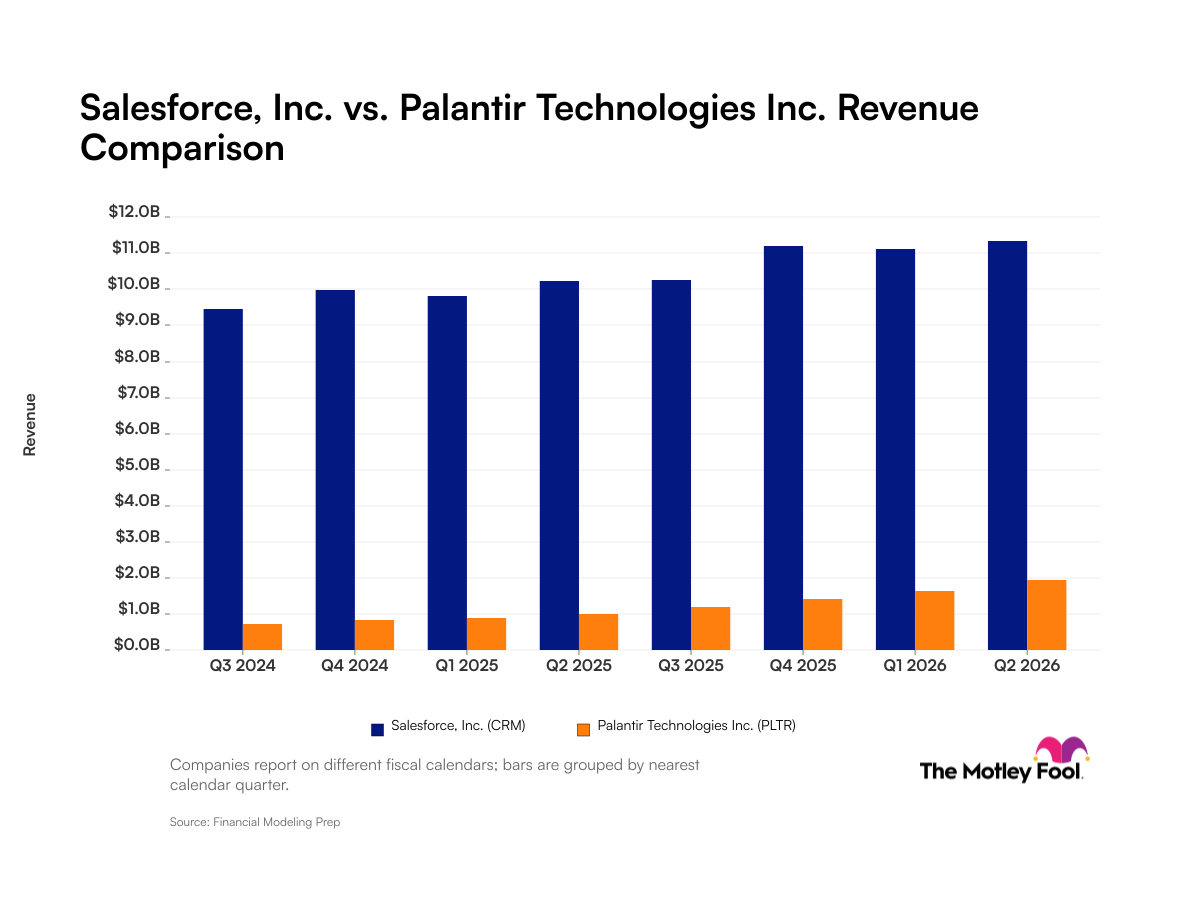
Some legacy areas showed weakness, including commercial cloud and Tableau. Still, total first-quarter revenue beat consensus, rising 13% year over year to $11 billion. Free cash flow was strong at $6.6 billion, providing the financial flexibility to fund buybacks at this scale.
What to watch
AI agents are creating new competitive dynamics, adding uncertainty to the long-term software landscape. For Salesforce, the key is continued momentum in measurable adoption: agentic work units delivered, token volume processed, and Agentforce annual recurring revenue. Sustained strength in those metrics would signal that the company's value proposition and competitive position remain intact.
Even after the rebound, the stock remains well below its prior highs and trades at a modest forward price-to-earnings multiple of 14. Investors may see the pullback as an attractive entry point.