The two leading retailers in the U.S., Amazon (AMZN -0.65%) and Walmart (NASDAQ: WMT), are on very different paths right now.
Amazon is hovering near a 52-week high, up about 14% year-to-date to $262 per share. Walmart stock is trading near its lowest point this year at around $115 per share, up about 3% year to date.
Along with their different trajectories, they also carry different valuations. Amazon, which is significantly outperforming Walmart, is much cheaper with a price-to-earnings (P/E) ratio of 21, which is as low as it's been in a decade, or more.

Image source: Getty Images.
Walmart, typically known as a defensive stock, is anything but right now. It's trading at roughly 40 times earnings, which is above its historical average.
Why are we seeing this unusual divergence?
Why Amazon is cheap
The market is starting to come around on Amazon, as evidenced by its approximately 13% jump since it released second-quarter earnings on July 30. That basically accounted for most of the year-to-date gains.
AMZN Amazon
NASDAQ · As of 10:45 AM ET 10/21/26

Net sales rose 20%, operating income soared 43%, and Amazon Web Services (AWS) climbed 37%, its fastest growth in more than four years. It seemed to justify Amazonʻs massive AI spending spree, as the company anticipates spending a whopping $200 billion in capital expenditures (capex) in 2026, up from $131.8 billion in 2025.
Amazon management said the capex is necessary to meet the high demand it is seeing in AWS, with some $244 billion in backlog at the start of 2026, up 40% year over year.
"Customers really want AWS for core and AI workloads. And we are monetizing capacity as fast as we can install it," CEO Andy Jassy said in February on the fourth-quarter 2025 earnings call.
The spending has really depleted Amazon's free cash flow. In Q2, it reported a cash outflow of $7.6 billion for the trailing 12 months. It was fueled by $66.1 billion in capital expenditures in AI. In comparison, Amazon had $18.2 billion in free cash flow in Q2 2025.
So the high spending and huge debt soured investors on Amazon for most of the year, bringing down the valuation. But the strong Q2 results, combined with its dirt cheap valuation, sparked the recent rally, even though the valuation is still low.
WMT Walmart
NASDAQ · As of 10:44 AM ET 10/21/26
Why Walmart is not
Walmart has outperformed Amazon over the past five years, with an average annualized total return of about 20% to just 10% for Amazon.
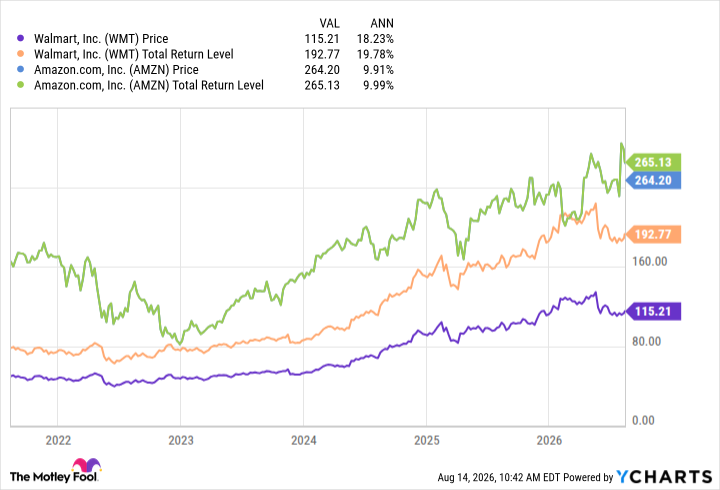
This also plays into the valuation divergence. Walmart's valuation has gradually increased during a strong five-year run. Now the market sees it as overvalued, with insufficient earnings power to justify the high multiple.
In the first quarter, it grew revenue by just 7% and operating income by just 5% year over year. It did not raise its guidance for the fiscal year, keeping sales growth at 4% to 5% and operating income growth at 7% to 10%.
It's just not enough growth to justify that multiple, particularly in a slow-growing economy with high inflation amid concerns that consumers won't be able to continue to carry the economy.
Walmart is not a great buy until the multiple comes down, but Amazon is a great buy right now.