Nvidia (NVDA +1.38%) and Broadcom (AVGO +1.78%) are two of the biggest names in the artificial intelligence (AI) chip world. Nvidia holds the crown as the largest company in the world, with a market cap of almost $5.5 trillion, while Broadcom is the seventh largest with a $1.9 trillion valuation. But which one of these two is actually the better bargain for stock investors right now?
Image source: Getty Images.
Broadcom has a major catalyst arriving in 2027
Nvidia became the world's largest company thanks to extreme demand for its graphics processing units (GPUs). Nvidia's GPUs are widely recognized as best in class, and their performance is further boosted by Nvidia's ecosystem, which includes software and networking solutions. Nvidia's products are utilized by every AI hyperscaler and have become the industry standard for AI training and inference.
NVDA Nvidia
NASDAQ · As of 4:00 PM ET 10/19/26

However, in specific applications, most of a GPU's wide-ranging capabilities are wasted. So, some AI hyperscalers are developing custom AI chips that are suitable only for narrow workloads. However, the AI hyperscalers don't have the expertise necessary to design and manufacture computing chips. To solve that issue, they've partnered with companies like Broadcom, which are using their networking-world design expertise to develop optimized AI chips for clients. These chips are known as ASICs -- application-specific integrated circuits. ASICs are nothing new, but they've only recently been deployed in AI settings to optimize performance.
In this context, ASICs are often referred to as custom AI chips, and there are a handful of examples of their success. Broadcom's largest client has been Alphabet (GOOG +0.96%) (GOOGL +1.05%), which partnered with Broadcom to design the Tensor Processing Unit (TPU). TPUs are widely recognized as a strong competitor to Nvidia's products, and Alphabet is also starting to sell TPUs directly to certain clients because they are more cost effective than GPUs in the right applications.
AVGO Broadcom
NASDAQ · As of 4:00 PM ET 10/19/26
Alphabet's success with TPUs has inspired other AI companies to partner with Broadcom to launch their own chips, and most of these products are now reaching production. Broadcom expects to realize over $100 billion in AI semiconductor sales next year, fueled by new orders. For reference, Broadcom's AI semiconductor revenue during the second quarter was $10.8 billion -- just over $40 billion annualized. That's a lot of growth coming up in the next year, but does that make it a better bargain than Nvidia?
Broadcom stock can look pricey or cheap, depending on how you frame it
At first glance, Broadcom looks far more expensive than Nvidia from a forward price-to-earnings (P/E) ratio standpoint.
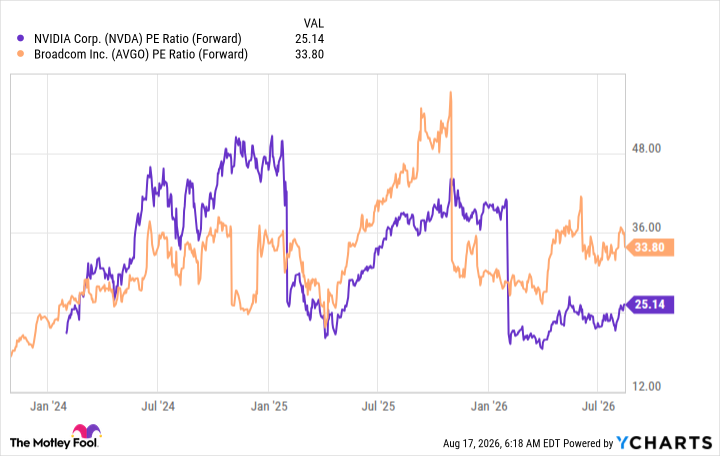
NVDA PE Ratio (Forward) data by YCharts.
However, that doesn't do Broadcom justice, as most of its growth is expected next year. Compare the stock price to next year's earnings estimates, and the gap closes.
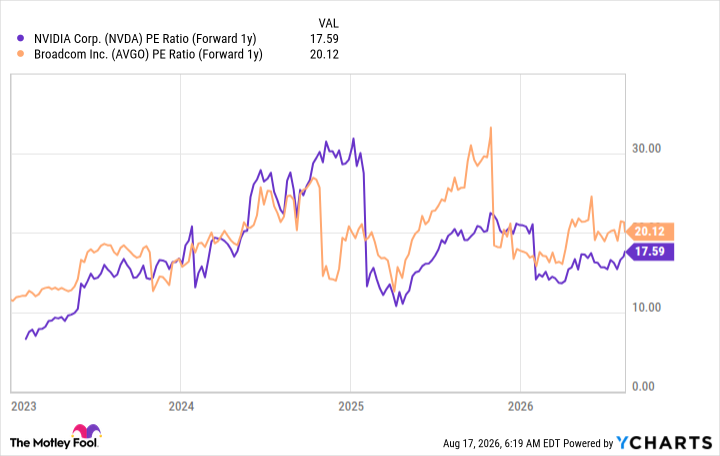
NVDA PE Ratio (Forward 1y) data by YCharts.
Still, Nvidia is slightly cheaper than Broadcom. So, which makes the most sense to invest in?
I'd say Nvidia. While I love Broadcom's growth story, the reality is that Nvidia's stock is priced much more cheaply. Furthermore, the analyst community isn't giving Nvidia the benefit of the doubt next year and is forecasting pretty slow growth compared to its peers. (They expect Nvidia to grow at a 43% pace.) Additionally, if one of Broadcom's clients falls through on its purchase commitments, it could shift Broadcom's 2027 outlook.
There is execution risk associated with Broadcom's stock that doesn't exist with Nvidia. If anything, Nvidia is being underprojected next year, while Broadcom is being overprojected. That leaves more room for error with Nvidia, and even though I like both stocks and own both, Nvidia makes for the better purchase today.