Rocket Lab (RKLB +0.70%) just keeps on stacking up wins -- and this time, literally so.
On Aug. 4, the space company announced the U.S. Space Force awarded it a $397 million contract -- one of the company's biggest wins ever -- to supply stackable "Flatellites" for the Space-Based Airborne Moving Target Indicator (SB-AMTI) program.
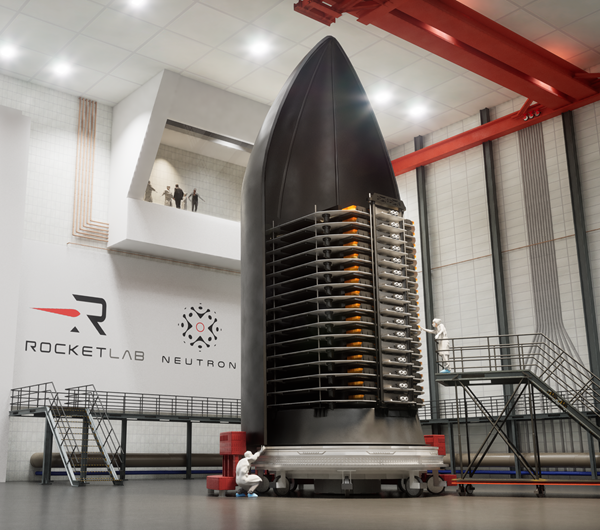
Image source: Rocket Lab.
What is a Flatellite, and what will it do?
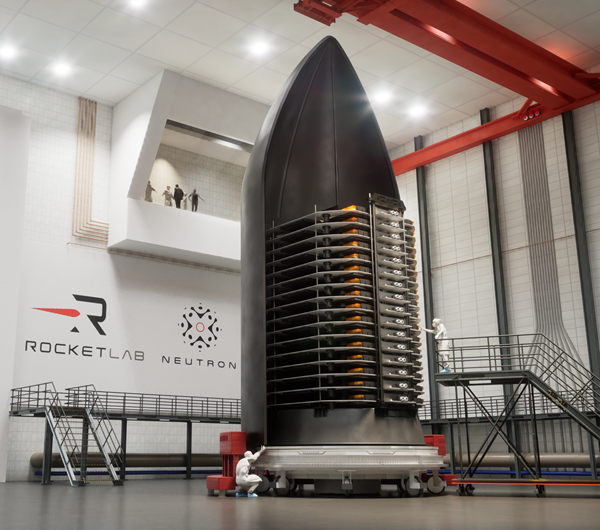
Space Force describes SB-AMTI as a "resilient space-based system to detect and track airborne threats in real time" -- so missile-tracking satellites. For its part, Rocket Lab describes the Flatellite as a new satellite design intended to be manufactured in mass quantities and deployed in large numbers, stacked efficiently and integrated seamlessly into its new Neutron reusable medium-lift rocket.
Industry analysts estimate Rocket Lab could fit perhaps 16 of its 800-kilogram Flatellites onto each Neutron (with a payload capacity of 13 tons) that it launches.

NASDAQ: RKLB
Key Data Points
What does this mean for Rocket Lab?
For years, Rocket Lab has been rolling up smaller companies in an effort to transform itself into a vertically integrated space company capable of building satellite parts, assembling them into satellites, launching them on its own rockets (which it also builds), and then operating them in orbit. It bought Sinclair Interplanetary for its star trackers in 2020, SolAero in 2022 for its solar arrays, Mynaric in 2026 for laser communications, and, most recently, promised to acquire Iridium Communications and its entire 80-satellite communications constellation for $8 billion.
The Space Force SB-AMTI contract illustrates how these integration efforts have paid off.
Government space contracts often involve multiple moving parts. One company (say, York Space or MDA Space) might be hired to build a satellite, a second company (Space Exploration Technologies or United Launch Alliance) to launch it, and sometimes a third company (Lockheed Martin or perhaps Boeing) to operate the satellites once they're in space.
That's not how this one will work. Rocket Lab will "develop, launch, and operate" all the Flatellites involved in SB-AMTI -- all on its own, vertically integrated, top to bottom. The entire $397 million of this effort will therefore go to Rocket Lab, shared with no one else, paid out to no subcontractors.
Granted, the contract announcement doesn't detail how the money will be allocated among Rocket Lab's several parts -- how much goes to the Launch Services business with its 41% gross profit margin, how much to Space Systems, which earns only 31%, or how much to any new divisions Rocket Lab might designate in the future, such as a "space services" division that provides Internet of Things (IoT) and navigation services from orbit, or a "Rocket Lab Defense" unit handling military contracts.
Viewed just in terms of revenue, however, the contract is already worth more than six months of the $769 million Rocket Lab already makes in a year. And that's not counting any options that might be added on to the company's missile defense work for Space Force. As Rocket Lab evolves even more to specialize in missile defense, we'll get a better idea of how profitable these kinds of contracts are for a fully vertically integrated Rocket Lab.